Hungary Exemption From Russian Oil Sanctions Highlights Geopolitics
Source:Indian Express ↗
Why It Matters
The differential treatment of India and Hungary under Western sanctions provides a critical case study for UPSC aspirants on how geography (landlocked pipelines vs. seaborne trade) and political alliances (NATO/EU membership) dictate international sanctions. It is highly relevant for GS Paper 2 (IR) and GS Paper 3 (Energy Security) to understand the diplomatic tightrope India walks to secure its energy needs without triggering secondary US sanctions.
Summary
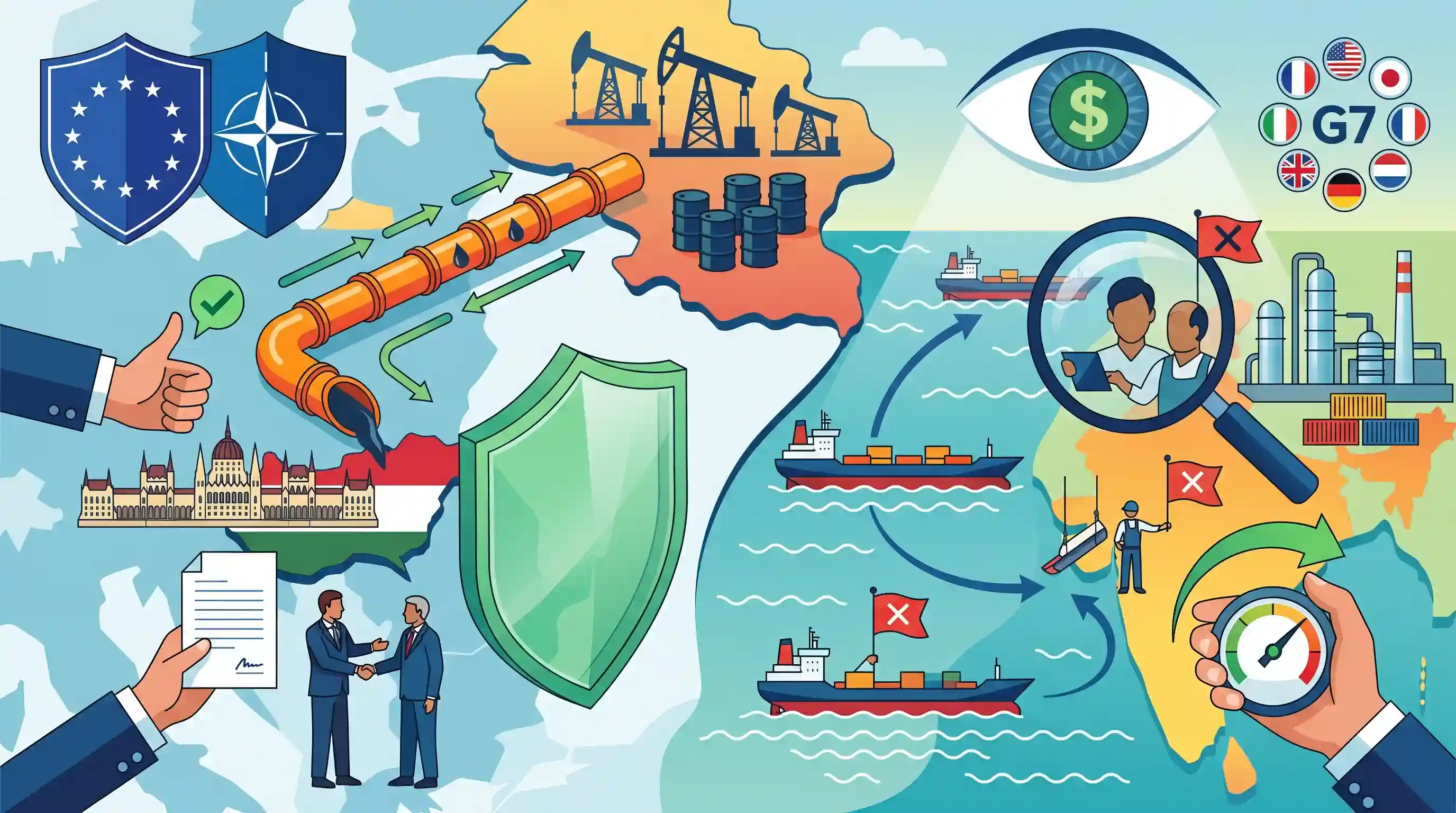
The article contrasts the application of Western sanctions on Russian oil imports between Hungary and India. Hungary, a landlocked nation dependent on the Druzhba pipeline, secured formal exemptions from EU bans due to its geography and structural leverage as an EU/NATO member. In contrast, India imports Russian oil via maritime routes subject to the G7 price cap. While India avoids direct sanctions by largely complying with price limits, its maritime operators and refiners face ongoing indirect scrutiny and targeted secondary sanctions from the US for any violations, highlighting the complex intersection of geography, alliances, and energy security in global geopolitics.
Key Points
- Hungary received an exemption from EU and US sanctions on Russian crude oil due to its heavy reliance on the landlocked Druzhba pipeline and lack of viable alternative supply routes.
- As an EU and NATO member, Hungary's consensus was required to pass broader EU sanctions packages against Russia, giving it leverage to negotiate the exemption.
- India imports Russian crude primarily through seaborne maritime routes, making those shipments subject to the G7 price cap mechanism of $60 per barrel.
- While India itself is not directly sanctioned for purchasing Russian oil, Indian entities (shipping firms, refineries) face scrutiny and potential secondary sanctions if they violate the price cap or deal with explicitly sanctioned Russian maritime entities.
Important Terms
G7 Price Cap Mechanism

A policy by G7 and allies capping Russian seaborne crude at $60/barrel. It denies Western insurance and shipping to oil traded above this price to limit Russia's war revenue.
UPSC context
GS Paper II/III: Energy security, international sanctions, and Western policy impact on India’s crude import strategy and inflation.
Druzhba Pipeline
One of the world's longest oil pipelines, transporting Russian crude to Central Europe. Its landlocked route through Ukraine provided Hungary a formal exemption from EU maritime oil embargoes.
UPSC context
GS Paper I/II: World geography and energy infrastructure; explains geopolitical leverage and structural energy dependency between landlocked and maritime nations.
Secondary Sanctions
Extraterritorial penalties imposed on third-party entities (like Indian refiners) for trading with a sanctioned target. They aim to force global compliance by threatening to block access to US financial markets.
UPSC context
GS Paper II: Effect of policies of developed countries on India; tests understanding of "strategic autonomy" versus international economic pressure.
Strategic Autonomy
A foreign policy doctrine where a nation makes independent decisions based on national interest. India uses it to justify importing discounted Russian oil for energy security despite Western pressure.
UPSC context
GS Paper II: India’s Foreign Policy; central theme in questions regarding India's balancing act between the West and Russia.
Sovcomflot
Russia’s state-owned commercial shipping major and largest tanker operator. Due to US sanctions, Indian refiners largely avoid its vessels to mitigate the risk of insurance denials or secondary sanctions.
UPSC context
GS Paper II: IR/Economy; illustrates the practical application of maritime sanctions and the private sector's adherence to global geopolitical shifts.
G7 (Group of Seven)
An intergovernmental forum of seven major advanced economies (Canada, France, Germany, Italy, Japan, UK, US). It coordinates global economic and security policies, including the Russian oil price cap.
UPSC context
GS Paper II: Important International institutions; tests knowledge of elite global groupings and their role in setting international economic norms.
Prelims Trap
"India has secured a formal exemption from Western sanctions on Russian crude oil."
India never received a formal exemption. It imports seaborne crude subject to the G7 price cap and avoids direct sanctions by purchasing below the limit, while Indian entities still face secondary sanction risks.
Static Concepts Connected
How do secondary sanctions and the G7 price cap function globally?
- Secondary Sanctions: Penalties imposed by one country (e.g., the US) on third-party foreign entities for trading with a sanctioned nation, leveraging global financial systems.
- Price Cap Mechanism: Prohibits Western firms from providing critical maritime services (insurance, shipping, finance) to Russian seaborne oil cargoes sold above a specific price ($60/bbl).
- Extraterritorial Reach: These unilateral measures rely heavily on the global dominance of the US dollar and Western maritime insurance markets (like the International Group of P&I Clubs).
How does the EU approve common economic sanctions?
- Unanimity Rule: Under the Common Foreign and Security Policy (CFSP), imposing typical economic sanctions requires unanimous approval from all 27 member states.
- Veto Power leverage: This consensus requirement gives individual nations (like Hungary) structural veto power, allowing them to negotiate specific national exemptions or carve-outs.
Cross-Topic Patterns
Seaborne reliance vs Pipeline integration
India's 85% dependence on seaborne crude makes it deeply vulnerable to Western maritime insurance bans and shipping regulations, contrasting sharply with landlocked nations protected by pipeline integration.
Secondary Sanctions & De-dollarisation
The aggressive use of unilateral US secondary sanctions accelerates the push for alternate payment mechanisms (Rupee-Rouble trade) and the creation of non-Western maritime insurance pools.

Expect a multi-statement question on extraterritorial secondary sanctions, comparing G7 price cap mechanics with UN-mandated sanctions.
Linked PYQs · 3
Linked PYQs · 3
- 2012MainsGS2
How have the US sanctions against Iran affected India's bilateral relations with Iran?
- 2024PrelimsGS1
Consider the following statements : Statement-I : Sumed pipeline is a strategic route for Persian Gulf oil and natural gas shipments to Europe. Statement-II : Sumed pipeline connects the Red Sea with the Mediterranean Sea. Which one of the following is correct in respect of the above statements?
- 2025MainsGS2
"Energy security constitutes the dominant kingpin of India's foreign policy, and is linked with India's overarching influence in Middle Eastern countries.” How would you integrate energy security with India's foreign policy trajectories in the coming years?
