Hungary Criticizes Ukraine President Over Drone Allegations
Source:Indian Express ↗
Why It Matters
The Hungary-Ukraine rift illustrates the lack of monolithic consensus within NATO and the EU regarding the Russia-Ukraine war. It also underscores how localized ethnic issues, such as the Transcarpathian Hungarian minority's language rights, can intersect with broader geopolitical conflicts, potentially destabilizing regional alliances and policy formulation.
Summary
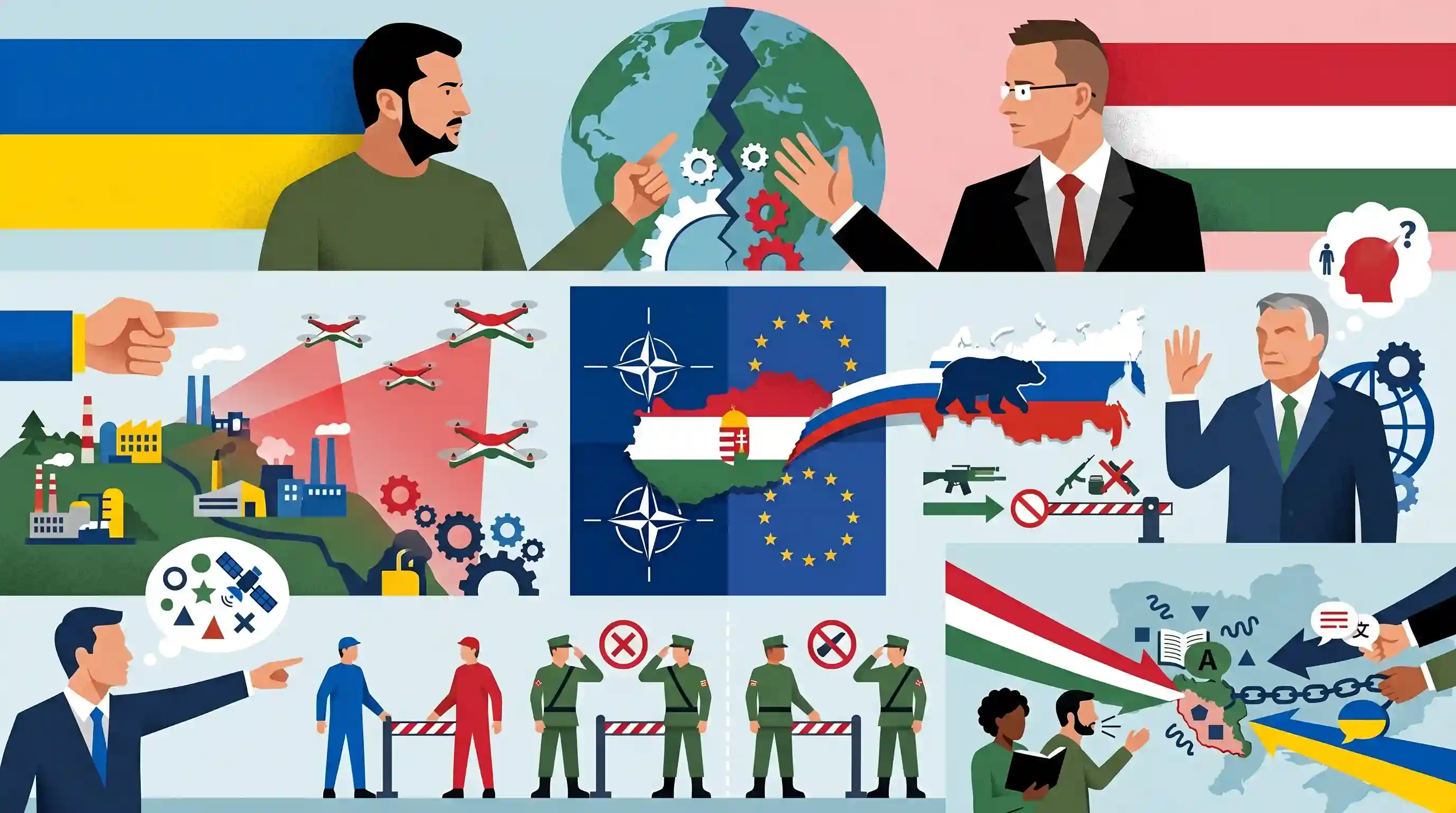
The diplomatic rift between Ukraine and Hungary has widened following accusations by Ukrainian President Volodymyr Zelenskyy that reconnaissance drones from Hungary violated Ukrainian airspace to survey relocated industrial sites. In response, Hungarian Foreign Minister Peter Szijjarto dismissed the claims as a sign Zelenskyy is "losing his mind." The spat highlights deeper geopolitical divisions: although a member of both NATO and the EU, Hungary under Prime Minister Viktor Orban maintains cordial relations with Russia and opposes Western military aid to Kyiv. Bilateral relations are further strained by retaliatory entry bans on military officials and ongoing disputes over the linguistic rights of the ethnic Hungarian minority in Ukraine's Transcarpathia region.
Key Points
- Hungary and Ukraine are engaged in a diplomatic spat over allegations that reconnaissance drones flew from Hungary to monitor western Ukraine's industrial areas.
- Hungarian Foreign Minister Peter Szijjarto dismissed the claims, mocking Ukrainian President Zelenskyy by stating he is 'losing his mind.'
- Despite its EU and NATO membership, Hungary maintains cordial relations with Russia and opposes Western military aid to Ukraine.
- Bilateral tensions are further strained by retaliatory entry bans on military officials and disputes over the linguistic and cultural rights of the 150,000 ethnic Hungarians living in Ukraine's Transcarpathia region.
Important Terms
NATO (North Atlantic Treaty Organization)

A 32-member intergovernmental military alliance established by the 1949 North Atlantic Treaty for collective defense. It operates on the principle that an attack against one is an attack against all.
UPSC context
GS Paper II (International Relations); tests understanding of global security architecture and collective security mechanisms during the Russia-Ukraine conflict.
European Union (EU)
A supranational political and economic union of 27 European member states. It maintains a common market and often requires unanimity for major foreign policy decisions.
UPSC context
GS Paper II (International Relations); tests knowledge of regional blocs, supranational governance, and internal challenges to collective diplomacy.
Transcarpathia
A strategically located region in western Ukraine bordering Hungary, Poland, Slovakia, and Romania. It is home to a significant ethnic Hungarian minority and is a focal point of diplomatic friction.
UPSC context
Prelims (Places in News); tests geographical awareness of strategically sensitive regions and ethnic enclaves in Eastern Europe.
Linguistic Rights
Human and civil rights that guarantee the individual and collective right to use one’s native language in education, administration, and public life without discrimination.
UPSC context
GS Paper II (Social Justice/Minority Rights); tests understanding of international human rights standards and constitutional protections for ethnic minorities.
Bilateral Relations
The conduct of political, economic, or cultural relations between two sovereign states. In this context, it refers to the increasingly strained diplomatic ties between Kyiv and Budapest.
UPSC context
GS Paper II (International Relations); tests the ability to analyze specific state-to-state dynamics and their impact on broader regional stability.
Prelims Trap
Hungary is an observer state, not a full member of NATO or the EU, due to its pro-Russia policies.
Hungary is a full member of both NATO and the EU. Its ability to disrupt Western aid relies precisely on its veto power as a full member.
Static Concepts Connected
Which countries share a land border with Ukraine?
- West: Poland, Slovakia, Hungary, Romania, and Moldova.
- North and East: Belarus to the north, and Russia to the east and northeast.
- South: Coastline along the Black Sea and the Sea of Azov.
How is unanimity used in European Union foreign policy decisions?
- Unanimity rule: Most Common Foreign and Security Policy (CFSP) decisions require unanimous agreement from all EU member states.
- Veto leverage: A single member, such as Hungary, can utilize this rule to block collective actions, sanctions, or financial aid.
Cross-Topic Patterns
Minority rights vs Assimilation policies
Ukraine's 2017 language law mirrors global syllabus themes (e.g., Sri Lanka) where majoritarian national integration policies clash with ethnic minority rights, often inviting interference from neighboring states.
UAVs and Gray-Zone Warfare
Cross-border drone espionage highlights gray-zone tactics—hostile actions staying below the threshold of conventional war. This directly links to UPSC syllabus on border management and modern security challenges.

Expect a 2026 Prelims map question matching Transcarpathia or the Carpathian Mountains to Ukraine and its western bordering nations.
Linked PYQs · 1
Linked PYQs · 1
- 2023MainsGS2
‘The expansion and strengthening of NATO and a stronger US-Europe strategic partnership works well for India.’ What is your opinion about this statement ? Give reasons and examples to support your answer.
