Environment ministry reviews human wildlife conflict mitigation
Source:The Hindu ↗
Why It Matters
Human-wildlife conflict and flagship conservation programs (Project Tiger/Cheetah/Elephant) are central to the GS3 Environment syllabus. The identification of Gandhisagar and Banni grasslands for Project Cheetah are highly testable facts for Prelims. Additionally, utilizing CAMPA funds and science-based corridor mapping offers vital points for Mains answers on mitigating man-animal conflict.
Summary
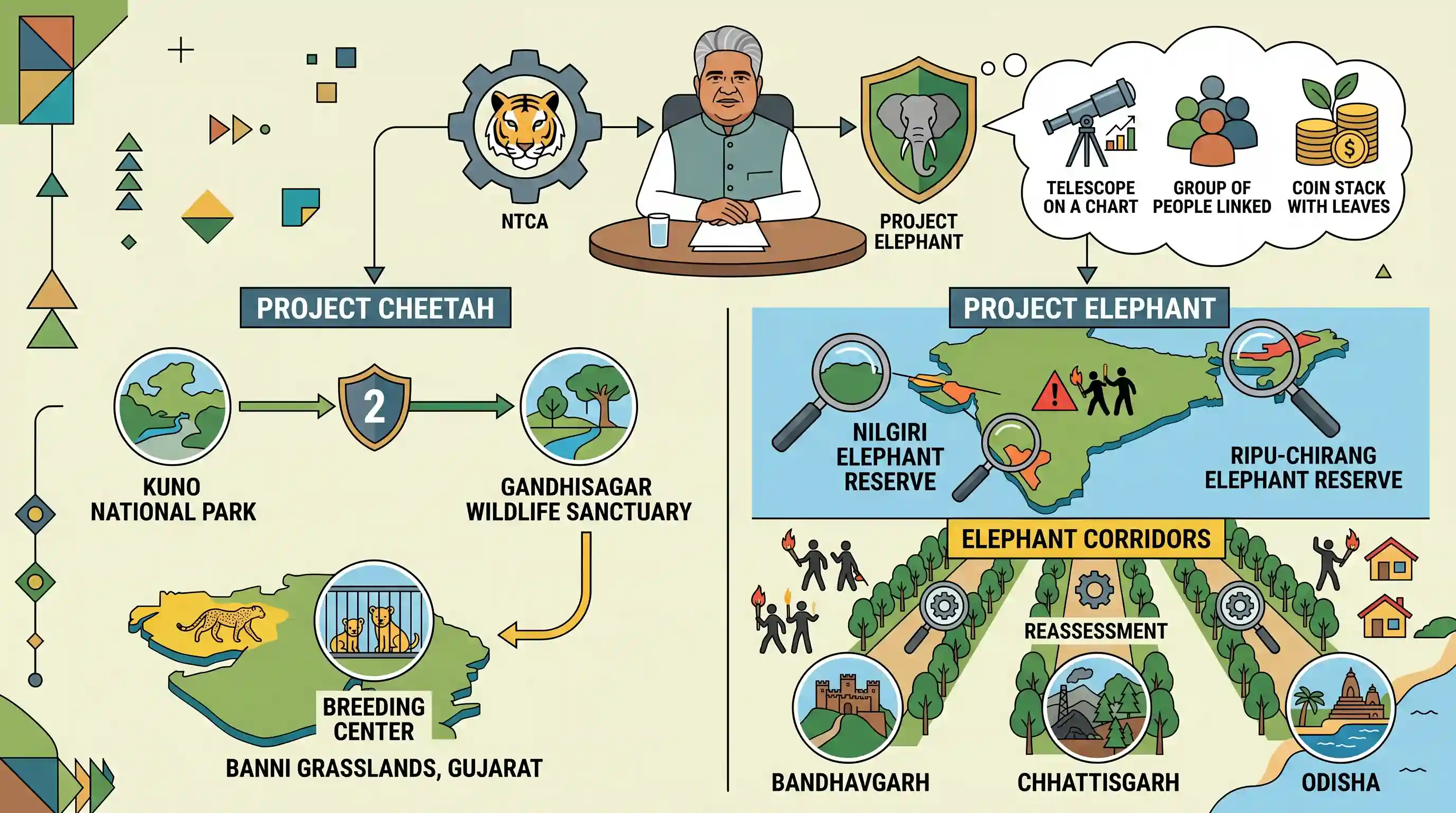
Union Environment Minister Bhupender Yadav recently reviewed measures to address human-wildlife conflict during meetings with the National Tiger Conservation Authority (NTCA) and the Project Elephant Steering Committee. Key discussions revolved around mitigating human-tiger and human-elephant conflicts through science-based management, community engagement, and the use of CAMPA funds. For Project Cheetah, the NTCA focused on preparing Madhya Pradesh's Gandhisagar Wildlife Sanctuary as the second home for cheetahs and setting up a breeding centre in Gujarat's Banni grasslands. Meanwhile, Project Elephant initiatives included plans for the Nilgiri and Ripu-Chirang Elephant Reserves and the reassessment of elephant corridors in conflict-prone zones like Bandhavgarh, Chhattisgarh, and Odisha.
Key Points
- Union Environment Minister Bhupender Yadav chaired high-level meetings with the NTCA and Project Elephant Steering Committee to review human-wildlife conflict mitigation strategies.
- Under Project Cheetah, NTCA discussed readying Gandhisagar Wildlife Sanctuary as a second home for cheetahs and establishing a breeding centre at Banni grassland in Gujarat.
- The Project Elephant meeting prioritized minimizing human-elephant conflict, updating science-based elephant corridors, and releasing conservation plans for reserves like Nilgiri and Ripu-Chirang.
- Emphasis was placed on leveraging community participation and effective utilization of CAMPA funds to manage conservation efforts and mitigate man-animal conflicts.
Important Terms
National Tiger Conservation Authority (NTCA)

A statutory body under the MoEFCC, established under the Wildlife (Protection) Act, 1972, to strengthen tiger conservation and provide oversight to tiger reserves.
UPSC context
GS Paper 3 (Conservation) & GS Paper 2 (Statutory Bodies). Tests the administrative and legal framework of wildlife protection.
Project Cheetah
India's flagship initiative to reintroduce cheetahs—extinct since 1952—starting with translocations from Namibia and South Africa to sites like Kuno and Gandhisagar.
UPSC context
GS Paper 3 (Biodiversity). Tests understanding of species reintroduction, habitat suitability, and transboundary conservation efforts.
Project Elephant
A Centrally Sponsored Scheme launched in 1992 to protect elephants and their habitats, ensure corridor connectivity, and mitigate human-elephant conflict.
UPSC context
GS Paper 3 (Conservation). Vital for policies regarding mega-fauna management and human-wildlife interface mitigation.
Compensatory Afforestation Fund Management and Planning Authority (CAMPA)
Statutory authority managing funds collected from agencies diverting forest land for non-forest use, dedicated to afforestation, forest protection, and conflict management.
UPSC context
GS Paper 3 (Environment/Forestry). Tests knowledge of environmental funding mechanisms and the 2016 CAMPA Act.
Gandhi Sagar Wildlife Sanctuary
A protected area in Madhya Pradesh being developed as the second reintroduction site for African cheetahs to support a sustainable metapopulation.
UPSC context
GS Paper 1 (Geography) & GS Paper 3 (Protected Areas). Frequent topic for Prelims map-based and habitat questions.
Human-Wildlife Conflict (HWC)
Negative interactions between humans and animals resulting in property damage, loss of life, or biodiversity decline, addressed through science-based management and community engagement.
UPSC context
GS Paper 3 (Biodiversity/Disaster Management). Tests socio-ecological awareness and mitigation strategies like corridor restoration and compensation.
Prelims Trap
"CAMPA funds are held in the Consolidated Fund of India, with the Centre retaining 90% of the corpus."
CAMPA funds are kept in the Public Account of India (not the Consolidated Fund), and 90% is disbursed to States, not the Centre.
Static Concepts Connected
What is the statutory backing and structure of the National Tiger Conservation Authority (NTCA)?
- Statutory Origin: Established as a statutory body in 2005 following an amendment to the Wildlife (Protection) Act, 1972.
- Leadership: Chaired by the Union Minister for Environment, Forest and Climate Change (not the Prime Minister).
- Expanded Mandate: Beyond its traditional tiger conservation role, the NTCA is the nodal agency overseeing the execution of Project Cheetah.
What are the key geographical features of Gandhisagar Wildlife Sanctuary and Banni Grasslands?
- Gandhisagar Sanctuary: Located in Madhya Pradesh and bisected by the Chambal River, it features the Khatiyar-Gir dry deciduous forest ecosystem.
- Banni Grasslands: Situated in Gujarat’s Rann of Kutch, it is Asia's largest tropical grassland and traditional home to the pastoral Maldhari community.
Cross-Topic Patterns
Invasive species in Banni
Banni’s selection for cheetah breeding highlights the ongoing ecological challenge of managing the invasive weed Prosopis juliflora, a frequent UPSC Prelims theme.
Trans-national wildlife corridors
Ripu-Chirang acts as a contiguous corridor to Bhutan's Royal Manas National Park, linking domestic wildlife management to international eco-diplomacy.
CAMPA and Public Account linkage
Tracing CAMPA funds tests fundamental economy knowledge, specifically the constitutional distinction between the Consolidated Fund and the Public Account of India.

A 2026 Prelims question will likely map emerging cheetah habitats (Gandhisagar, Banni) against their specific vegetation and river systems.
Linked PYQs · 3
Linked PYQs · 3
- 2020PrelimsGS1
Among the following Tiger Reserves, which one has the largest area under "Critical Tiger Habitat"?
- 2017PrelimsGS1
The term 'M-STRIPES' is sometimes seen in the news in the context of
- 2017PrelimsGS1
Recently there was a proposal to translocate some of the lions from their natural habitat in Gujarat to which one of the following sites?
