Kerala Human Rights Probe into Newborn Death
Source:The Hindu ↗
Why It Matters
The incident highlights crucial gaps in public healthcare delivery, medical accountability, and the role of State Human Rights Commissions in addressing grievances related to the right to health and medical negligence. It serves as a practical case study for ethics in public service and the mandate of quasi-judicial bodies in India.
Summary
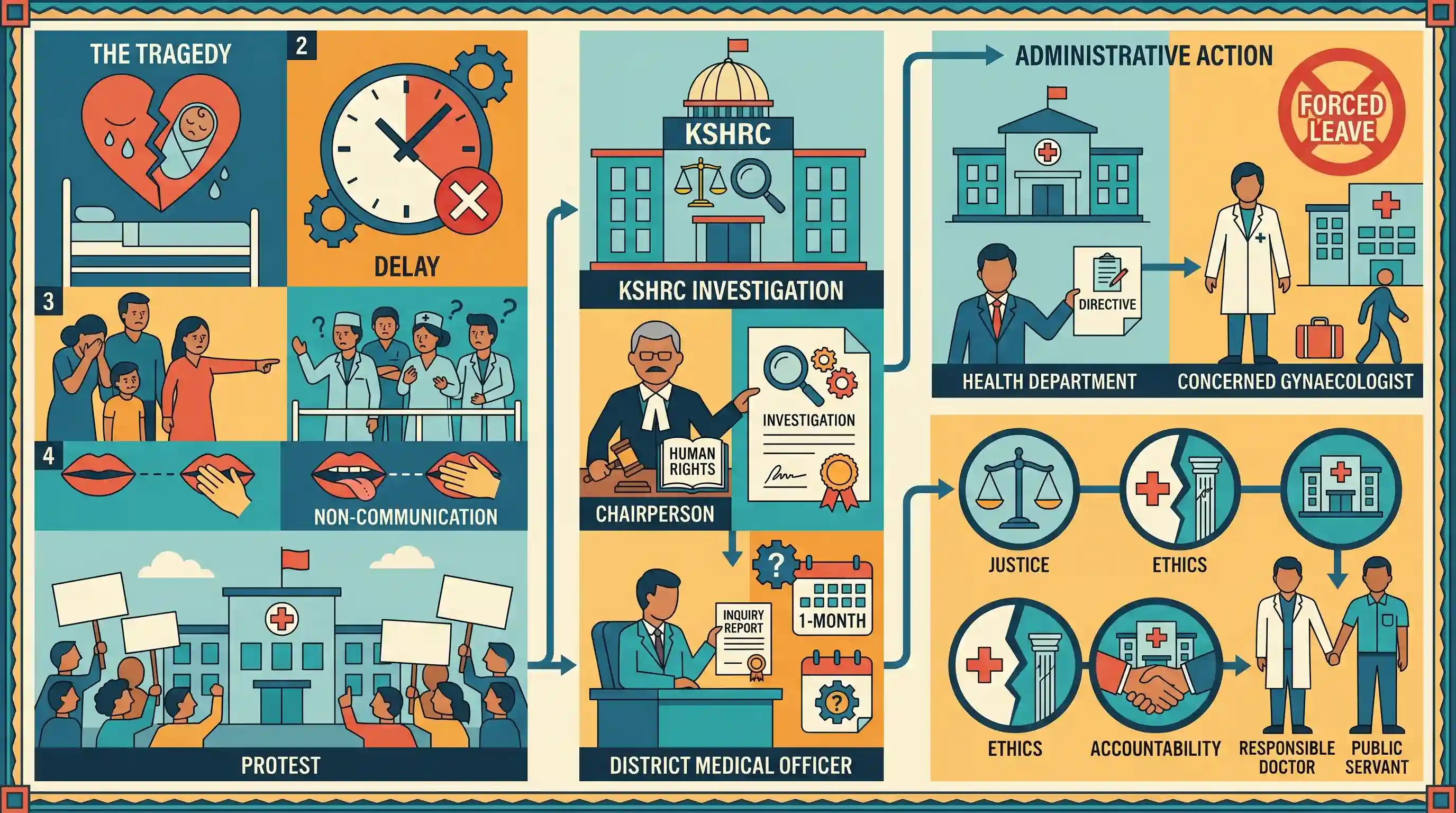
The Kerala State Human Rights Commission (KSHRC) has launched an investigation into the death of a newborn at a government hospital in Nedumangad, Thiruvananthapuram. The tragedy has sparked protests over alleged medical negligence, with the family claiming doctors failed to communicate potential complications and unnecessarily delayed a C-section. In response, the KSHRC ordered the District Medical Officer to submit a report within a month, while the health department directed the concerned gynaecologist to go on forced leave pending inquiry.
Key Points
- The Kerala State Human Rights Commission (KSHRC) ordered an investigation into the death of a newborn following a delayed C-section at the Nedumangad taluk hospital.
- Parents alleged medical negligence, citing that the medical staff failed to communicate potential complications and improperly delayed the surgical delivery.
- KSHRC Chairperson Alexander Thomas has instructed the District Medical Officer to submit a report on the incident within a month.
- Following public protests, the Directorate of Health Services directed the involved gynaecologist and RMO to go on forced leave.
Important Terms
Kerala State Human Rights Commission (KSHRC)

A statutory body established under the Protection of Human Rights Act, 1993, to investigate human rights violations and negligence by public servants within the state's jurisdiction.
UPSC context
GS Paper II; Statutory/Quasi-judicial bodies. Tests knowledge of state-level mechanisms for human rights protection and grievance redressal.
Quasi-judicial Body
A non-judicial entity, such as a commission or tribunal, granted legal powers to adjudicate disputes and conduct inquiries similar to a court of law.
UPSC context
GS Paper II; Governance. Evaluates understanding of administrative adjudication and the role of specialized bodies in the justice system.
Protection of Human Rights Act (PHRA), 1993
The central legislation providing the legal framework for the constitution of National and State Human Rights Commissions to protect human rights in India.
UPSC context
GS Paper II; Important laws. Tests knowledge of the statutory basis for human rights institutions and their jurisdictional limits.
Medical Negligence
A failure by a medical professional to exercise reasonable care or meet established standards of practice, resulting in harm, injury, or death to a patient.
UPSC context
GS Paper II (Health) and GS Paper IV (Ethics). Tests accountability, professional standards, and legal safeguards in healthcare.
Medical Ethics
The branch of ethics dealing with moral principles—such as autonomy, beneficence, and non-maleficence—governing the conduct of healthcare professionals toward patients and society.
UPSC context
GS Paper IV; Applied Ethics. Tests ability to navigate ethical dilemmas and professional integrity in public service.
Directorate of Health Services (DHS)
The administrative wing of the state health department responsible for managing government hospitals, implementing health programs, and overseeing the conduct of medical personnel.
UPSC context
GS Paper II; Management of Social Sector/Health. Tests understanding of the executive structure responsible for public healthcare administration.
Prelims Trap
State Human Rights Commissions are empowered to directly penalize medical staff for negligence and award compensation.
Under the Protection of Human Rights Act 1993, SHRCs have purely recommendatory powers. They cannot punish the guilty or directly grant monetary relief; they only recommend action to the state.
Static Concepts Connected
How is a State Human Rights Commission constituted and what are its powers?
- Appointment & Removal: Appointed by the Governor via a CM-led committee, but can only be removed by the President of India on grounds of proved misbehaviour or incapacity.
- Jurisdiction Limit: SHRCs can only inquire into human rights violations related to subjects enumerated in the State List (List II) and Concurrent List (List III).
- Civil Court Powers: It holds the powers of a civil court trying a suit under the Code of Civil Procedure, 1908, but its final reports are purely recommendatory.
How does the Supreme Court link healthcare access to Fundamental Rights?
- Article 21 Extension: In the Paschim Banga Khet Mazdoor Samity case, the SC ruled that denial of timely emergency care in state hospitals violates the Right to Life.
- Emergency Obligation: The Paramanand Katara judgment established that every doctor has a professional obligation to protect life, overriding any procedural criminal law hurdles.
Cross-Topic Patterns
Medical Ethics and Public Accountability
The tension between clinical autonomy and administrative accountability in government hospitals frequently appears in GS4 case studies involving medical negligence and public protests.
Taluk-level Healthcare Deficits
Delays in critical emergency procedures at secondary care centers highlight systemic infrastructure gaps, linking to challenges in implementing the National Health Mission.

SHRC appointment/removal mechanisms and recommendatory limits remain high-probability traps for Prelims 2026 multi-statement questions.
Linked PYQs · 3
Linked PYQs · 3
- 2021MainsGS2
Though the Human Rights Commissions have contributed immensely to the protection of human rights in India, yet they have failed to assert themselves against the mighty and powerful. Analyzing their structural and practical limitations, suggest remedial measures.
- 2024MainsGS2
In a crucial domain like the public healthcare system the Indian State should play a vital role to contain the adverse impact of marketisation of the system. Suggest some measures through which the State can enhance the reach of public healthcare at the grassroots level.
- 2024MainsGS4
“Ethics encompasses several key dimensions that are crucial in guiding individuals and organizations towards morally responsible behaviour.” Explain the key dimensions of ethics that influence human actions. Discuss how these dimensions shape ethical decision-making in the professional context.
