Odisha Reports Alarming Rise in Human Elephant Conflict
Source:The Hindu ↗
Why It Matters
Provides a crucial comparative case study for Mains GS3 on how poor land-use planning, linear infrastructure (canals/railways), and mining directly exacerbate human-wildlife conflict. It also provides updated 2025 DNA census data for Prelims, refuting common misconceptions about state-wise elephant populations (confirming Karnataka is highest, not Kerala or Odisha).
Summary
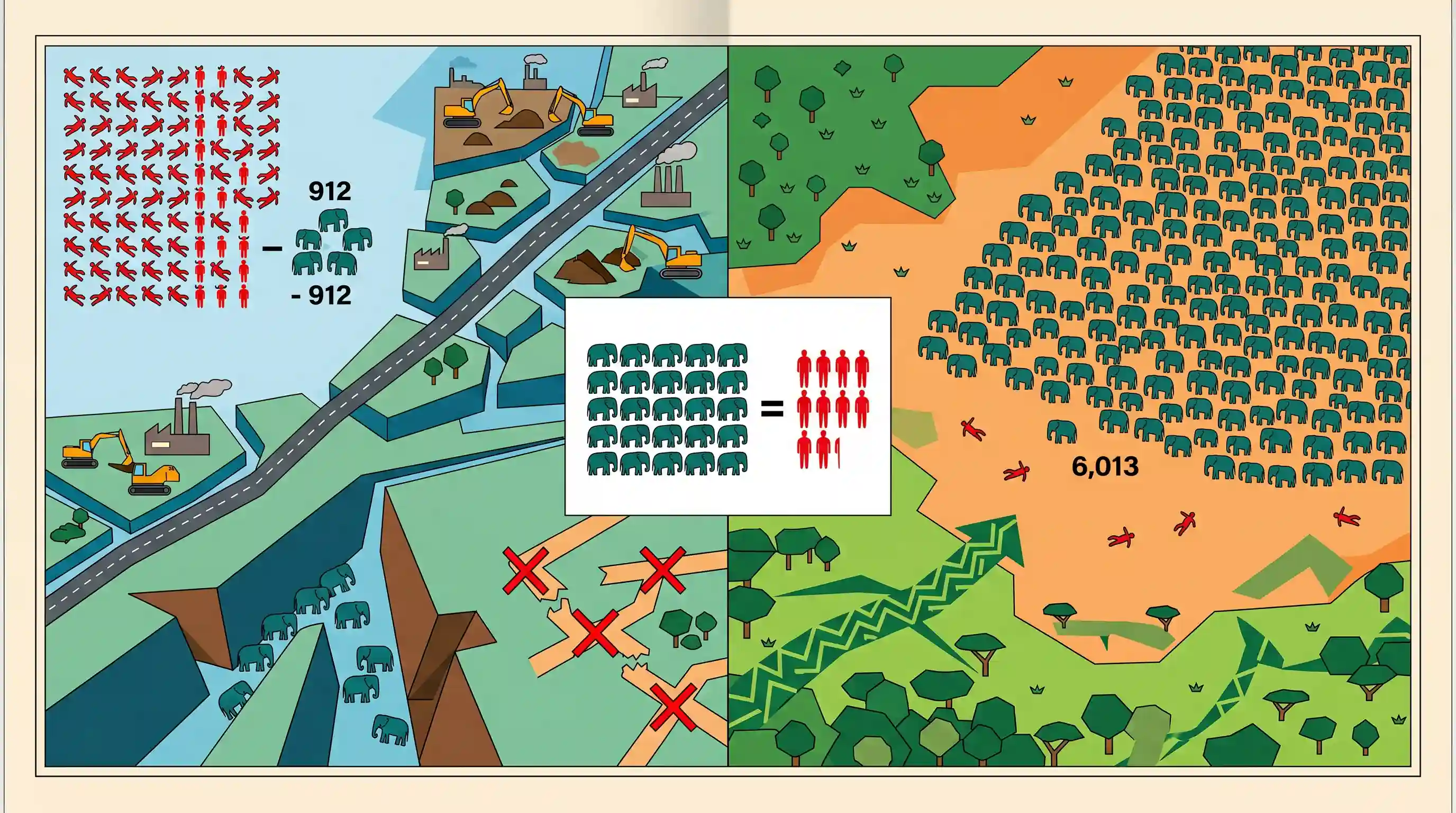
A study by the Wildlife Society of Orissa (WSO) reveals that Odisha has emerged as the deadliest state for human-elephant conflict, recording 171 human deaths in 2024-25. Despite hosting a fraction of India's elephant population (912 out of nearly 30,000) compared to Karnataka's leading 6,013, Odisha experiences an alarming ratio of 17 human casualties per 100 elephants. The escalating conflict is primarily driven by severe habitat fragmentation due to unchecked mining, industrial expansion, new highways, and steep-walled canal networks like Rengali, which trap elephants in small pockets. Furthermore, administrative apathy is evident as 14 critical elephant corridors identified in 2012 remain unnotified, preventing safe passage for the herds.
Key Points
- Odisha recorded the highest number of human deaths (171) due to encounters with elephants in 2024-25, followed by Jharkhand, West Bengal, and Assam.
- Despite having a relatively small population of 912 elephants, Odisha has the highest human kill ratio in India (17 human kills per 100 elephants).
- In contrast, Karnataka, which has the highest elephant population in India (6,013), records a significantly lower conflict ratio of 1 human kill per 100 elephants.
- The surge in human-elephant conflict in Odisha is attributed to habitat fragmentation caused by mining activities, new highways, railway networks, and the Rengali canal network.
- The State government failed to formally notify 14 identified elephant corridors, a decision that has been pending since 2012.
Important Terms
DNA-based Synchronous All-India Population Estimation of Elephants (2025)

The 2021-2025 national census using non-invasive genetic sampling (dung DNA) and mark-recapture models to provide a scientifically robust count, estimating approximately 22,446 elephants nationwide.
UPSC context
GS Paper III: Biodiversity and Environment. Tests knowledge of modern conservation technology and updated species population trends.
Elephant Corridors
Narrow strips of land that facilitate elephant movement between two or more viable habitat patches, crucial for maintaining genetic diversity and reducing human-animal encounters.
UPSC context
GS Paper III: Environment. Important for questions on mitigation of man-animal conflict and habitat connectivity.
Project Elephant
A centrally sponsored scheme launched in 1992 to protect elephants, their habitats, and corridors. It was merged with Project Tiger in 2023 to form Project Tiger & Elephant.
UPSC context
GS Paper III: Government Schemes. Focuses on flagship conservation initiatives and institutional restructuring.
Wildlife Institute of India (WII)
An autonomous institution under the MoEFCC that provides technical expertise, conducts the national elephant census, and houses the 'Elephant Cell' for scientific research.
UPSC context
GS Paper III: Environment. Relevant for institutional frameworks governing wildlife conservation in India.
Habitat Fragmentation
The process where large, continuous habitats are broken into smaller, isolated patches by infrastructure like mines and canals, leading to isolated populations and increased conflict.
UPSC context
GS Paper III: Environment. Key concept in environmental impact assessments (EIA) and biodiversity loss.
Wildlife Society of Orissa (WSO)
A non-governmental organization in Odisha that monitors wildlife trends and human-elephant conflict, providing critical data for regional conservation policy.
UPSC context
GS Paper III: Case Studies. Demonstrates the role of civil society and NGOs in environmental advocacy.
Prelims Trap
States with the highest elephant populations naturally record the highest number of human casualties in conflicts.
Conflict intensity depends on habitat fragmentation, not just population size. Odisha has far fewer elephants than Karnataka but records significantly higher human casualties.
Static Concepts Connected
What is the conservation status of the Asian Elephant and Project Elephant?
- Conservation Status: Listed as Endangered on the IUCN Red List, Schedule I of the Wildlife Protection Act, 1972, and Appendix I of CITES.
- Project Elephant: A Centrally Sponsored Scheme launched in 1992 to provide financial and technical support to states for the protection of elephants, their habitats, and corridors.
- Objective: Maintained by MoEFCC, this scheme also focuses on mitigating human-elephant conflict and ensuring the welfare of captive elephants.
How does habitat fragmentation alter carrying capacity and wildlife behavior?
- Barrier Effect: Linear infrastructure (canals, railways) cuts through contiguous forests, isolating wildlife in fragmented patches that cannot support their forage or breeding requirements.
- Resource Depletion: Trapped in smaller pockets with depleted resources, mega-herbivores like elephants are forced to forage in agricultural and residential zones, triggering severe conflicts.
- Mitigation Strategies: Engineering solutions like eco-bridges, animal underpasses, and slope-modifications for steep canals are required to restore habitat connectivity.
Cross-Topic Patterns
Linear Infrastructure and EIA gaps
The Rengali canal trapping elephants highlights the need for mandatory animal passage plans (eco-bridges, underpasses) during the Environmental Clearance and EIA phases of infrastructure projects.
Federalism in Wildlife Corridor Notification
Odisha's failure to notify 14 corridors since 2012 exposes a governance gap. While Project Elephant is Central, corridor notification, land acquisition, and state highway alignments remain strictly State subjects.

Expect a 2026 prelims statement contrasting elephant population hubs (Karnataka) with actual conflict intensity zones (Odisha highest).
Linked PYQs · 4
Linked PYQs · 4
- 2020PrelimsGS1
With reference to Indian elephants, consider the following statements: 1. The leader of an elephant group is a female. 2. The maximum gestation period can be 22 months. 3. An elephant can normally go on calving till the age of 40 years only. 4. Among the States in India, the highest elephant population is in Kerala. Which of the statements given above is/are correct?
- 2022PrelimsGS1
With reference to Indian laws about wildlife protection, consider the following statements : 1. Wild animals are the sole property of the government. 2. When a wild animal is declared protected, such animal is entitled for equal protection whether it is found in protected areas or outside. 3. Apprehension of a protected wild animal becoming a danger to human life is sufficient ground for its capture or killing. Which of the statements given above is/are correct?
- 2025MainsGS3
Mineral resources are fundamental to the country's economy and these are exploited by mining. Why is mining considered an environmental hazard? Explain the remedial measures required to reduce the environmental hazard due to mining.
- 2014MainsGS3
Environmental Impact Assessment studies are increasingly undertaken before a project is cleared by the Government. Discuss the environmental impacts of coal-fired thermal plants located at coal pitheads.
