Hubble Space Telescope Legacy and Evolution of Space Observatories
Source:The Hindu ↗
Why It Matters
UPSC frequently asks questions about space missions and astrophysics concepts (like black holes, dark energy, and cosmic expansion). The 2022 GS3 Mains paper directly asked candidates to compare the James Webb Space Telescope with its predecessors, making Hubble's 35th anniversary highly relevant for understanding the evolution of space observatories.
Summary
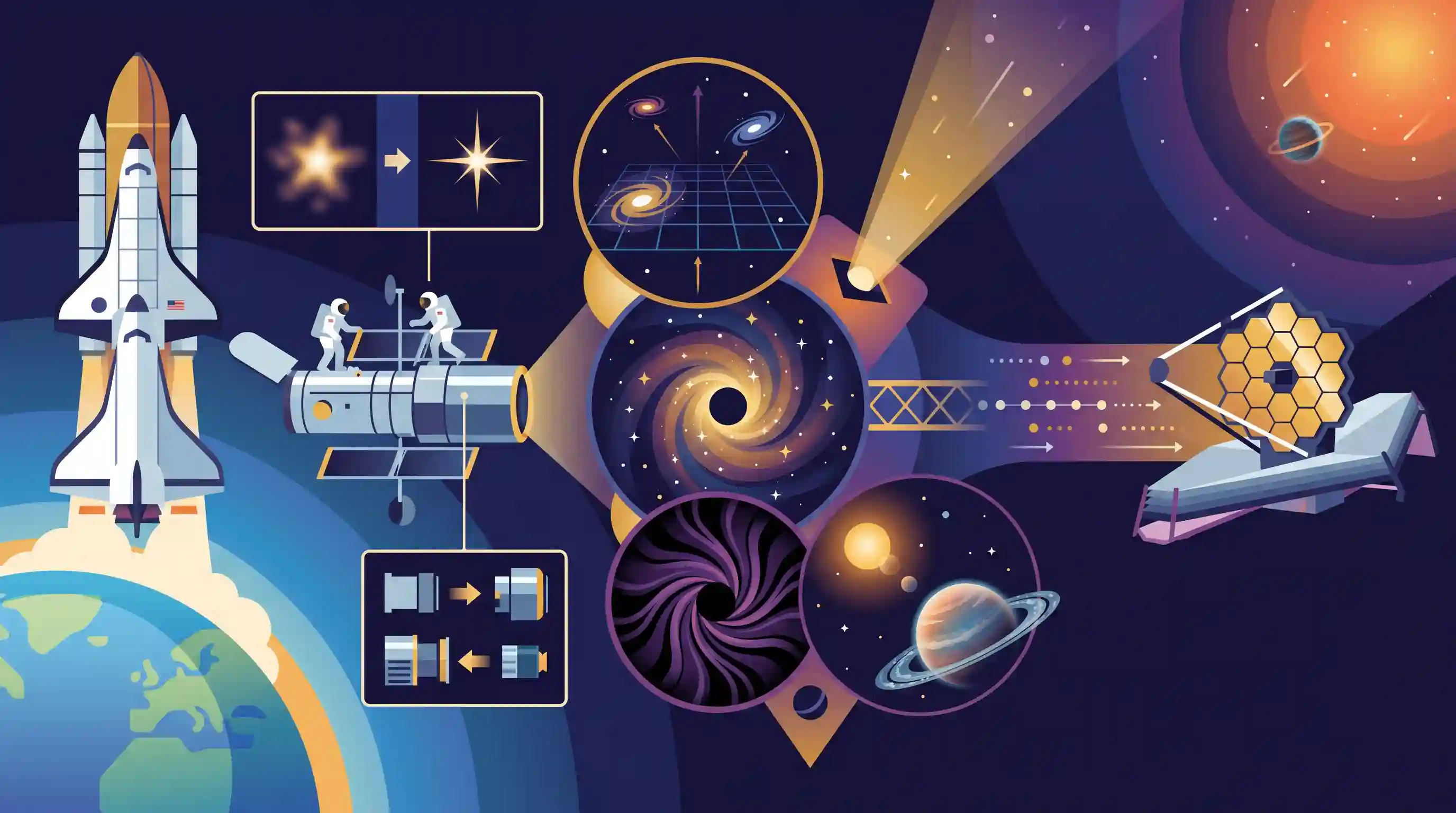
The Hubble Space Telescope has completed 35 years of operation, marking an unprecedented era in space exploration and astrophysics. Launched collaboratively by NASA and the European Space Agency, Hubble revolutionized our understanding of the cosmos by capturing high-resolution images unhindered by Earth's atmosphere. Its discoveries range from measuring the universe's expansion rate and proving the existence of supermassive black holes to uncovering dark energy and characterizing exoplanets. A key to Hubble's longevity was its modular design in Low Earth Orbit, which allowed astronauts aboard the Space Shuttle to conduct servicing missions—fixing its initially flawed mirror and installing newer instruments. This 35-year journey has not only reshaped astronomy but also provided a blueprint for subsequent flagship observatories like the James Webb Space Telescope.
Key Points
- The Hubble Space Telescope (HST), a joint project between NASA and ESA, marks 35 years of operation, significantly advancing modern astrophysics.
- Its key scientific contributions include determining the expansion rate and age of the universe, providing evidence for dark energy, discovering supermassive black holes at galaxy centers, and studying exoplanetary atmospheres.
- Hubble's unique Low Earth Orbit (LEO) placement enabled five Space Shuttle servicing missions, which corrected an early spherical aberration in its primary mirror and upgraded its scientific instruments over decades.
- Hubble's upgradeable architecture, scientific yield, and collaborative operational model established the blueprint for next-generation space observatories like the James Webb Space Telescope (JWST).
Important Terms
Hubble Space Telescope (HST)

A large space-based observatory launched in 1990 by NASA and ESA. It captures high-resolution images in ultraviolet, visible, and near-infrared light, unhindered by atmospheric distortion.
UPSC context
GS Paper III: Science & Technology. Essential for understanding space observatories and their role in fundamental astrophysics.
Space Shuttle Program
A retired NASA human spaceflight program (1981–2011) that used partially reusable spacecraft. It was critical to Hubble for its launch and five subsequent manned servicing missions.
UPSC context
GS Paper III: Space Technology. Illustrates the evolution of reusable launch vehicles and human-assisted satellite servicing.
European Space Agency (ESA)
An intergovernmental organization of 22 member states. It provided key components like solar arrays and instruments for Hubble, ensuring European scientists guaranteed observation time.
UPSC context
GS Paper III: International Cooperation. Tests knowledge of global space partnerships and major international scientific institutions.
James Webb Space Telescope (JWST)
Hubble’s successor, designed primarily for infrared astronomy. It orbits at the Sun-Earth L2 point (1.5 million km away) and uses a 6.5-meter mirror to study the early universe.
UPSC context
GS Paper III: Developments in Science. Frequently compared with Hubble regarding wavelength sensitivity and orbital location.
Dark Energy
A mysterious force hypothesized to permeate space, causing the universe's expansion to accelerate. Hubble’s observations were instrumental in proving its existence.
UPSC context
GS Paper III: Awareness in Space. A core concept in modern cosmology often appearing in scientific theory questions.
Low Earth Orbit (LEO)
An orbit relatively close to Earth (160–2,000 km). Hubble’s LEO position (~547 km) was strategically chosen to allow Space Shuttle servicing missions for repairs and upgrades.
UPSC context
GS Paper III: Space Technology. Key for distinguishing between satellite orbits (LEO vs. MEO vs. GEO).
Hubble Constant
A unit of measurement used to describe the expansion rate of the universe. Hubble's observations narrowed its value, helping determine the universe's age (approx. 13.8 billion years).
UPSC context
UPSC Prelims: General Science. Tests fundamental astronomical units and the history of universe expansion theories.
Prelims Trap
"Like the James Webb Space Telescope, Hubble is positioned at a Lagrange point to avoid atmospheric interference."
Hubble is in Low Earth Orbit (LEO) at ~540km, allowing astronaut servicing. JWST is at L2, 1.5 million km away, unserviceable by humans.
Static Concepts Connected
Why are space telescopes placed in different orbits (LEO vs. L2)?
- LEO (Low Earth Orbit): Orbit like Hubble's (~540 km) allows for human servicing missions and rapid data transmission, but experiences Earth's shadow and thermal variations.
- L2 (Lagrange Point 2): Used by JWST (1.5 million km away). Offers a thermally stable, deep-space environment essential for sensitive infrared observations without Earth's optical interference.
Why do observatories use different electromagnetic spectra (Visible vs. Infrared)?
- Visible/UV (Hubble): Ideal for observing hot, energetic phenomena like young stars, galaxies, and the atmospheric compositions of exoplanets.
- Infrared (JWST): Longer wavelengths penetrate thick cosmic dust clouds, allowing scientists to witness the formation of early galaxies and detect relatively cooler celestial objects.
Cross-Topic Patterns
Orbit selection for Indian space missions
The LEO vs L2 orbit distinction directly mirrors ISRO's placement strategy: Gaganyaan in LEO for human spaceflight, and Aditya-L1 at a Lagrange point for unobstructed, continuous solar observation.
Dark Energy vs. Dark Matter in Prelims
Hubble's role in proving the universe's accelerating expansion (Dark Energy) frequently appears in UPSC alongside Dark Matter concepts in fundamental physics multi-statement questions.

Expect a multi-statement comparative MCQ in 2026 contrasting Hubble, JWST, and Aditya-L1 based on orbit types and spectral bands.
Linked PYQs · 3
Linked PYQs · 3
- 2022MainsGS3
Launched on 25th December, 2021, James Webb Space Telescope has been much in the news since then. What are its unique features which make it superior to its predecessor Space Telescopes ? What are the key goals of this mission ? What potential benefits does it hold for the human race?
- 2019PrelimsGS1
Recently, scientists observed the merger of giant 'blackholes' billions of light-years away from the Earth. What is the significance of this observation?
- 2023PrelimsGS1
Consider the following pairs: Objects in space Description 1. Cepheids: Giant clouds of dust and gas in space 2. Nebulae: Stars which brighten and dim periodically 3. Pulsars: Neutron stars that are formed when massive stars run out of fuel and collapse How many of the above pairs are correctly matched?
