GDP Growth Revisions and Monetary Policy Tightening Projections
Source:The Hindu ↗
Why It Matters
This article provides critical real-world context on how exogenous shocks (geopolitics/oil prices and climate change/El Niño) directly translate into domestic macroeconomic challenges like high inflation and lower GDP growth, forcing the RBI to tighten monetary policy. These interlinkages are heavily tested in GS3 Economy and GS1 Geography.
Summary
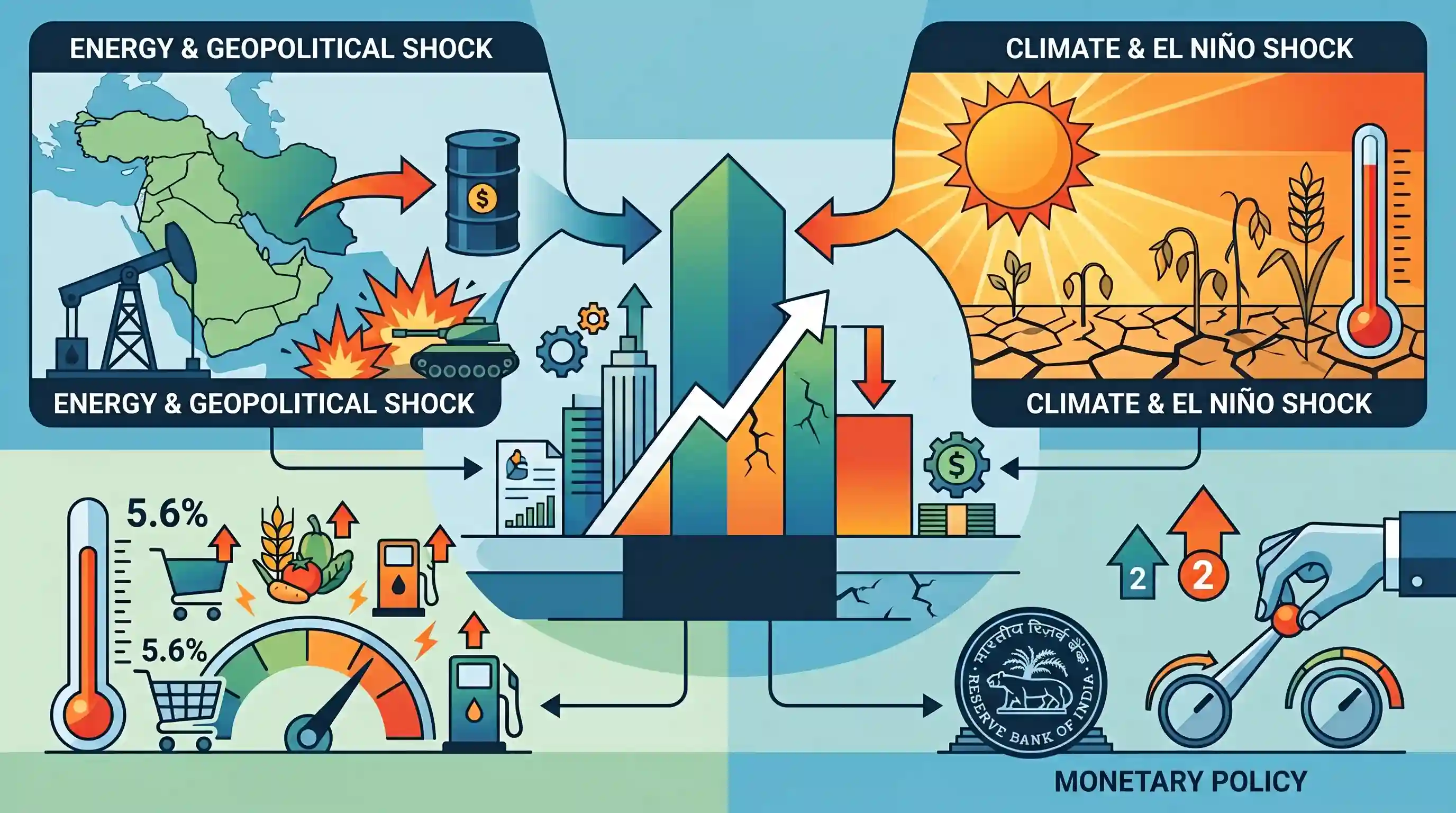
A recent HSBC report has sharply slashed India's GDP growth estimate for FY27 to 6%, down from a previous projection of 7.4%. This downward revision is attributed to twin macroeconomic shocks: an energy crisis fueled by the West Asia conflict pushing oil prices past $100 per barrel, and El Niño-induced high temperatures and deficient rainfall denting agricultural output. These factors are expected to push headline inflation to 5.6%, driven largely by food and fuel costs. Consequently, HSBC predicts that the Reserve Bank of India (RBI) will abandon its neutral stance and implement two interest rate hikes to curb inflation, highlighting the growing vulnerability of India's macroeconomic stability to geopolitical and climatic exogenous shocks.
Key Points
- HSBC has revised India's FY27 GDP growth forecast downward from 7.4% to 6%, citing the dual economic shocks of an energy crisis and deficient rainfall.
- The conflict in West Asia is expected to keep crude oil prices elevated (above $100 per barrel), driving up domestic energy costs and necessitating fuel price hikes.
- Headline inflation is projected to climb to 5.6% in FY27, primarily driven by food inflation as extreme heat and El Niño conditions severely impact agricultural yields.
- In response to persistent inflation above the 6% threshold, the Reserve Bank of India (RBI) is anticipated to tighten monetary policy with two rate hikes (totaling 50 basis points) later in the fiscal year.
- Climate modeling indicates that soaring surface temperatures are increasingly becoming a more significant driver of food inflation than simple rainfall deficits.
Important Terms
Repo Rate

The primary interest rate at which the RBI lends money to commercial banks. It is the principal tool used to control inflation and influence economic growth.
UPSC context
GS Paper III (Economy); core tool for 'Monetary Policy' and 'Inflation Management' topics.
Monetary Policy Committee (MPC)
A statutory six-member body headed by the RBI Governor that determines the benchmark policy rate (Repo Rate) required to achieve the inflation target.
UPSC context
GS Paper III (Economy); critical for understanding 'Mobilization of Resources' and 'Growth'.
El Niño
The periodic warming of surface waters in the central and eastern Pacific Ocean, typically leading to deficient monsoon rainfall and higher temperatures in India.
UPSC context
GS Paper I (Geography) and III (Agriculture/Economy); impacts 'Food Security' and 'Agricultural Growth'.
Headline Inflation
A measure of total inflation within an economy, including volatile commodities like food and fuel, usually calculated in India via the Consumer Price Index (Combined).
UPSC context
GS Paper III (Economy); key metric for 'Inflation' and 'Price Stability' syllabus sections.
Flexible Inflation Targeting (FIT)
The policy framework (mandated at 4% with a +/- 2% tolerance band) within which the RBI adjusts interest rates to maintain price stability while supporting growth.
UPSC context
GS Paper III (Economy); essential for 'Monetary Policy' and 'RBI Mandate' questions.
Monetary Policy Stance
A qualitative description of a central bank’s future policy direction, such as 'neutral' (flexible), 'accommodative' (rate-cut prone), or 'hawkish' (rate-hike prone).
UPSC context
GS Paper III (Economy); tests understanding of 'Macroeconomic Stability' and policy signaling.
Prelims Trap
"The RBI targets core inflation to avoid punishing the economy for exogenous supply-side shocks like global oil price spikes."
Under the flexible inflation targeting framework, the RBI is statutorily mandated to target Headline CPI, which explicitly includes volatile food and energy components, not just core inflation.
Static Concepts Connected
What is the difference between Headline and Core Inflation?
- Headline Inflation: Measures total inflation within an economy, including highly volatile commodities like food and energy.
- Core Inflation: Excludes the transient price volatility of food and energy to reveal the underlying, long-term inflation trend.
- RBI Mandate: The flexible inflation targeting framework legally binds the RBI to target Headline CPI at 4% (+/- 2%), not core inflation.
How does Imported Inflation affect the Indian Economy?
- Mechanism: Rising global prices of crucial imports (like crude oil) directly push up domestic production and transport costs.
- Currency Impact: A higher import bill increases demand for foreign currency, leading to Rupee depreciation, which further inflates import costs.
- Policy Dilemma: Forces the central bank to hike interest rates to curb inflation, risking an economic slowdown.
Cross-Topic Patterns
Climateflation altering RBI's monetary calculus
Rising surface temperatures and El Niño directly impact agricultural yields, creating structural food inflation that forces tight monetary policy even during low growth periods.
Geopolitics, CAD and Imported Inflation
High crude prices from West Asia instability inflate India's import bill, simultaneously widening the Current Account Deficit and driving imported inflation.

Expect a multi-statement prelims question interlinking El Niño's impact on headline CPI with the RBI's growth-inflation monetary trade-offs.
Linked PYQs · 4
Linked PYQs · 4
- 2024MainsGS3
What are the causes of persistent high food inflation in India? Comment on the effectiveness of the monetary policy of the RBI to control this type of inflation.
- 2022PrelimsGS1
With reference to the Indian economy, consider the following statements: 1. If the inflation is too high, Reserve Bank of India (RBI) is likely to buy government securities. 2. If the rupee is rapidly depreciating, RBI is likely to sell dollars in the market. 3. If interest rates in the USA or European Union were to fall, that is likely to induce RBI to buy dollars. Which of the statements given above are correct?
- 2021PrelimsGS1
With reference to Indian economy, demand-pull inflation can be caused/ increased by which of the following? 1. Expansionary policies 2. Fiscal stimulus 3. Inflation-indexing wages 4. Higher purchasing power 5. Rising interest rates Select the correct answer using the code given below.
- 2017PrelimsGS1
With reference to 'Indian Ocean Dipole (IOD)' sometimes mentioned in the news while forecasting Indian monsoon, which of the following statements is/are correct? 1. IOD phenomenon is characterised by a difference in sea surface temperature between tropical Western Indian Ocean and tropical Eastern Pacific Ocean. 2. An IOD phenomenon can influence an El Nino's impact on the monsoon. Select the correct answer using the code given below:
