HRTC invests to build electric vehicle charging hubs across Himachal
Source:energetica-india ↗
Why It Matters
HPAS Prelims frequently tests candidates on specific state-level budgetary allocations, infrastructural upgrades, and environmental initiatives (as seen in past PYQs on state budget outlays). Awareness of HRTC's push towards electric mobility is crucial for state-specific current affairs and aligns with the broader theme of sustainable development and energy transition in the state.
Summary
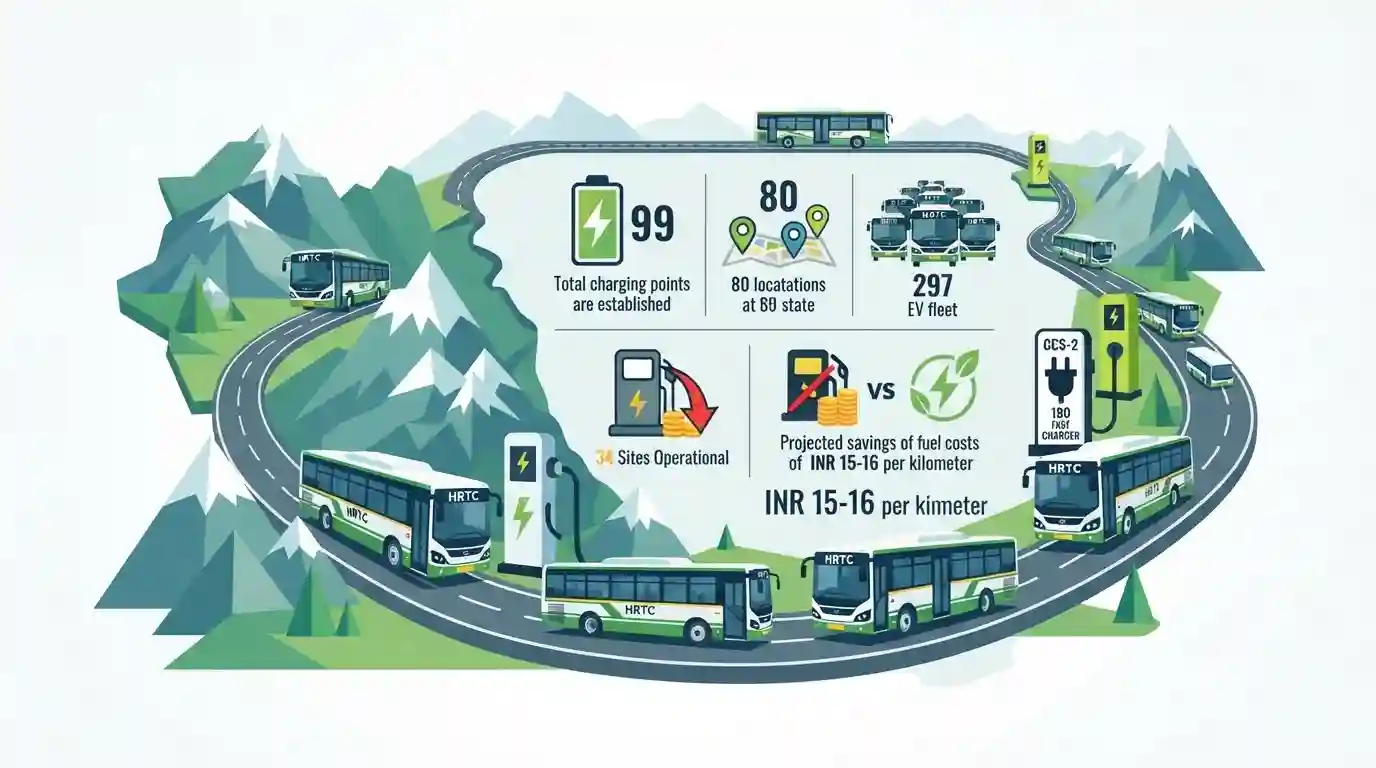
The Himachal Road Transport Corporation (HRTC) is making a major push towards green mobility by investing INR 122 crore to establish 99 EV charging points across 80 locations in Himachal Pradesh. Aimed at supporting a growing fleet of 297 electric buses, the move is projected to cut diesel costs by INR 15-16 per kilometre. The infrastructure utilizes 180 kW fast CCS-2 chargers, with 34 sites already operational. This initiative highlights the state government's commitment to sustainable public transport and aligns with efforts to reduce carbon emissions and modernize the state's transport infrastructure.
Key Points
- Himachal Road Transport Corporation (HRTC) is setting up 99 electric vehicle (EV) charging points at 80 locations across Himachal Pradesh.
- The total investment for the project is INR 122 crore, which aims to support the corporation's fleet of 297 electric buses.
- The deployment of electric buses is expected to yield significant savings, reducing diesel fuel costs by INR 15-16 per kilometre.
- The charging infrastructure features 180 kW fast CCS-2 chargers, and the installations are already operational at 34 sites.
Important Terms
Himachal Road Transport Corporation (HRTC)

The state-owned transport agency of Himachal Pradesh. Currently transitioning to a sustainable public transport model, HRTC manages a growing fleet of electric buses to reduce operational costs and carbon emissions across hilly terrains.
UPSC context
Crucial for HPAS GS Paper 3 (Infrastructure) and HP GK. Tests knowledge of state public utilities and green transitions.
CCS-2 Chargers
Combined Charging System Type 2 (CCS-2) is a standardized fast-charging technology integrating AC and DC power. HRTC is installing 180 kW CCS-2 chargers to rapidly recharge its electric bus fleet across 80 state locations.
UPSC context
Relevant for HPAS GS Paper 3 (Science & Tech, Infrastructure). Tests awareness of modern electric vehicle technologies and clean energy.
Green Mobility in Himachal Pradesh
The state's strategic shift toward zero-emission transportation, driven by the HP EV Policy. It focuses on replacing diesel vehicles with electric fleets and building extensive charging networks to protect the fragile Himalayan ecology.
UPSC context
High priority for HPAS GS Paper 3 (Environment & State Policies). Focuses on sustainable development and eco-friendly infrastructure in hill states.
Prelims Trap
"Himachal Pradesh EV policy mandates a 100% transition to electric vehicles for all new vehicle registrations by 2025."
Aspirants often assume total electrification targets. The HP EV Policy actually targets Battery Electric Vehicles (BEVs) to account for 15% of all new vehicle registrations by 2025, not 100%.
Static Concepts Connected
What are the pillars of HP's vision to become India's first 'Green Energy State'?
- Solar Power Generation: Aggressive rollout of solar projects to harness untapped renewable potential and reduce grid dependence.
- Green Hydrogen Policy: Drafting dedicated policies to attract investment in green hydrogen production and localized industrial use.
- E-Mobility Transition: Phasing out diesel HRTC buses, converting government fleets to EVs, and building state-wide charging networks.
What are the core mechanisms of the FAME India scheme driving EV adoption?
- Demand Incentives: Direct upfront subsidies to reduce the purchase price of electric two, three, and four-wheelers.
- Public Transport Subsidy: Financial support to State Transport Undertakings (STUs) for the procurement of electric buses.
- Charging Infrastructure: Funding the creation of high-voltage fast-charging stations across major cities and national highways.
Cross-Topic Patterns
E-mobility boosting Eco-Tourism
Transitioning HRTC to electric buses directly supports Himachal's eco-tourism policy by drastically cutting vehicular emissions and noise pollution in ecologically sensitive tourist corridors like Shimla, Kullu, and Rohtang.
Green Tech for Fiscal Consolidation
With HRTC saving INR 15-16 per km on diesel, EV adoption serves a dual purpose: environmental conservation and crucial fiscal consolidation by reducing operational losses of the state transport undertaking.

Expect a multi-statement question on HP's Green State vision, combining HRTC's EV rollout, the 15% EV target by 2025, and solar policies.
Linked PYQs · 2
Linked PYQs · 2
- 2024HPAS_PRELIMSGS1
Consider the following statements : (1) Himachal Pradesh Government approved an outlay of 1200 crore rupees for economic services during 2022-23. (2) Himachal Pradesh Government approved an outlay of 267 crore rupees for rural development during 2022-23. (3) Himachal Pradesh Government approved an outlay of 140 crore rupees for Mahatma Gandhi National Employment Guarantee Scheme during 2022-23. (4) Himachal Pradesh Government approved an outlay of 22 crore rupees for Forestry and Wildlife during 2022-23. Choose the correct answer from the options given below :
- 2024HPAS_PRELIMSGS1
For the year 2022-23, match the Industry sub-sector in Himachal Pradesh with the percentage of workers employed in them : | List I (Industry Sub-sector) | List II (Percentage of workers employed) | |---|---| | (a) Mining and Quarrying | (i) 2 | | (b) Manufacturing | (ii) 41 | | (c) Electricity and Other Utilities | (iii) 50 | | (d) Construction | (iv) 7 | Choose the correct option : Code: (a) (b) (c) (d)
