National HPV Vaccination Drive and Cervical Cancer Prevention
Source:Indian Express ↗
Why It Matters
This topic is highly relevant for UPSC as it bridges public health policy (GS2) with advancements in indigenous biotechnology (GS3). Understanding the burden of cervical cancer and the strategic deployment of the indigenously developed Cervavac vaccine is crucial for questions on preventive healthcare, women's empowerment through health, and India's self-reliance in pharmaceuticals.
Summary
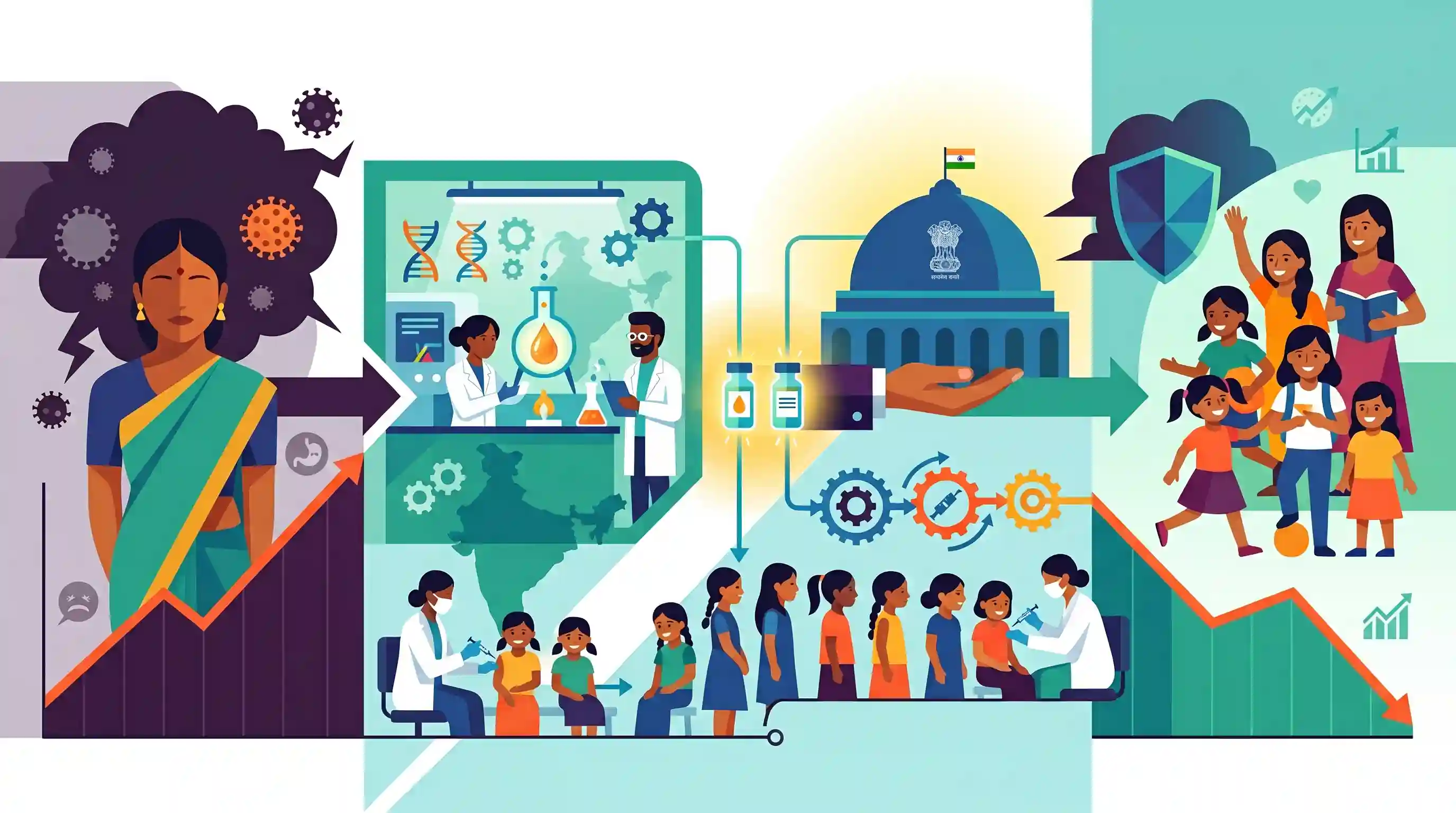
The Government of India is preparing to launch a nationwide Human Papillomavirus (HPV) vaccination campaign aimed at drastically reducing the incidence of cervical cancer, a leading cause of mortality among Indian women. The initiative will likely feature the rollout of 'Cervavac', India's first indigenously developed quadrivalent HPV vaccine by the Serum Institute of India. By potentially incorporating the HPV vaccine into the Universal Immunization Programme (UIP) for pre-adolescent girls, the government aims to strengthen preventive healthcare, alleviate the heavy public health burden of cervical cancer, and bolster women's health outcomes across the country.
Key Points
- The Indian government plans to launch a nationwide Human Papillomavirus (HPV) vaccination drive to combat cervical cancer among young women.
- Cervical cancer is one of the most prevalent and fatal cancers affecting women in India, primarily caused by high-risk strains of HPV.
- The drive is expected to rely on 'Cervavac', an indigenous quadrivalent HPV vaccine developed by the Serum Institute of India (SII), making the vaccine more affordable and accessible.
- Integrating the HPV vaccine into the Universal Immunization Programme (UIP) marks a significant shift towards preventive oncology and reducing the national disease burden.
Important Terms
Universal Immunization Programme (UIP)

India's nationwide vaccination initiative (launched 1985) providing free, routine immunisation against 12+ preventable diseases for children and pregnant women.
UPSC context
GS Paper II: Social Justice/Health. Tests knowledge of public health delivery, Mission Indradhanush, and maternal/child health policies.
Cervavac
India’s first indigenously developed quadrivalent human papillomavirus (qHPV) vaccine, produced by the Serum Institute of India (SII) in collaboration with the Department of Biotechnology.
UPSC context
GS Paper III: Science & Technology. Focuses on indigenous biotechnology, achievements of Indian scientists, and self-reliance (Atmanirbhar Bharat).
Human Papillomavirus (HPV)
A common sexually transmitted virus; high-risk strains (primarily types 16 and 18) are responsible for approximately 70-80% of cervical cancer cases globally.
UPSC context
GS Paper III: Science. Fundamental biological knowledge regarding viral diseases and preventive medicine for competitive exams.
National Technical Advisory Group on Immunization (NTAGI)
The apex advisory body in India that provides scientific and technical recommendations to the Ministry of Health on immunization policies and vaccine introduction.
UPSC context
GS Paper II: Governance/Health. Tests understanding of the institutional framework for health decision-making and expert bodies.
Quadrivalent Vaccine
A vaccine designed to provide protection against four different strains or types of a specific pathogen simultaneously (e.g., HPV types 6, 11, 16, and 18).
UPSC context
GS Paper III: Science & Tech. Specific technical terms in biotechnology and vaccine pharmacology often appear in Prelims.
Cervical Cancer
Cancer occurring in the cervix (lower part of the uterus), which is the second most common cancer among Indian women and is highly preventable through vaccination.
UPSC context
GS Paper II: Social Justice/Women’s Health. Addresses India's high disease burden and the socio-economic impact of non-communicable diseases.
Prelims Trap
The government will provide the HPV vaccine to all adult women under the Universal Immunization Programme to eliminate cervical cancer.
The drive targets pre-adolescent girls (9-14 years) because the HPV vaccine is most effective when administered before potential exposure to the virus.
Static Concepts Connected
What is the scope of India's Universal Immunization Programme (UIP)?
- Target demographic: Targets pregnant women, infants, and children to protect against vaccine-preventable diseases.
- Disease coverage: Currently provides free vaccines against 12 diseases nationally and sub-nationally (e.g., Diphtheria, Polio, Measles, Rotavirus, Pneumococcal).
- Funding: It is a fully funded initiative by the Central Government under the National Health Mission.
How do Virus-Like Particle (VLP) vaccines like Cervavac function?
- Viral mimicry: They are multiprotein structures engineered to closely mimic the organization of naturally occurring viruses.
- No genetic material: They completely lack the viral genome (DNA/RNA), meaning they are non-infectious and cannot replicate.
- Immune response: Their authentic structure allows them to readily trigger strong B-cell and T-cell immune responses safely.
Cross-Topic Patterns
Biotech PPPs in Public Health
Cervavac mimics the Rotavac and Covaxin models, highlighting the success of Department of Biotechnology-industry partnerships in producing affordable indigenous vaccines.
UIP shift towards preventive oncology
Adding HPV to the UIP marks a significant policy shift from preventing classic communicable childhood diseases to addressing virally-induced non-communicable diseases (cancers) for women.

UIP expansion + VLP vaccine tech (Cervavac) is a high-probability combo for a 2026 Prelims Science/Schemes multi-statement question.
Linked PYQs · 4
Linked PYQs · 4
- 2016PrelimsGS1
'Mission Indradhanush' launched by the Government of India pertains to
- 2019PrelimsGS1
Which one of the following statements is not correct?
- 2022MainsGS3
What is the basic principle behind vaccine development ? How do vaccines work? What approaches were adopted by the Indian vaccine manufacturers to produce COVID-19 vaccines ?
- 2021MainsGS3
What are the research and developmental achievements in applied biotechnology? How will these achievements help to uplift the poorer sections of the society?
