HPERC simplifies rooftop solar approvals for PM Surya Ghar scheme
Source:solarquarter ↗
Why It Matters
Questions on the implementation nuances of major central schemes like PM Surya Ghar: Muft Bijli Yojana and related state-level initiatives (like HP's solar schemes) are important for HPAS Prelims. It demonstrates how State Regulatory Commissions facilitate national green energy targets by easing grid interaction norms.
Summary
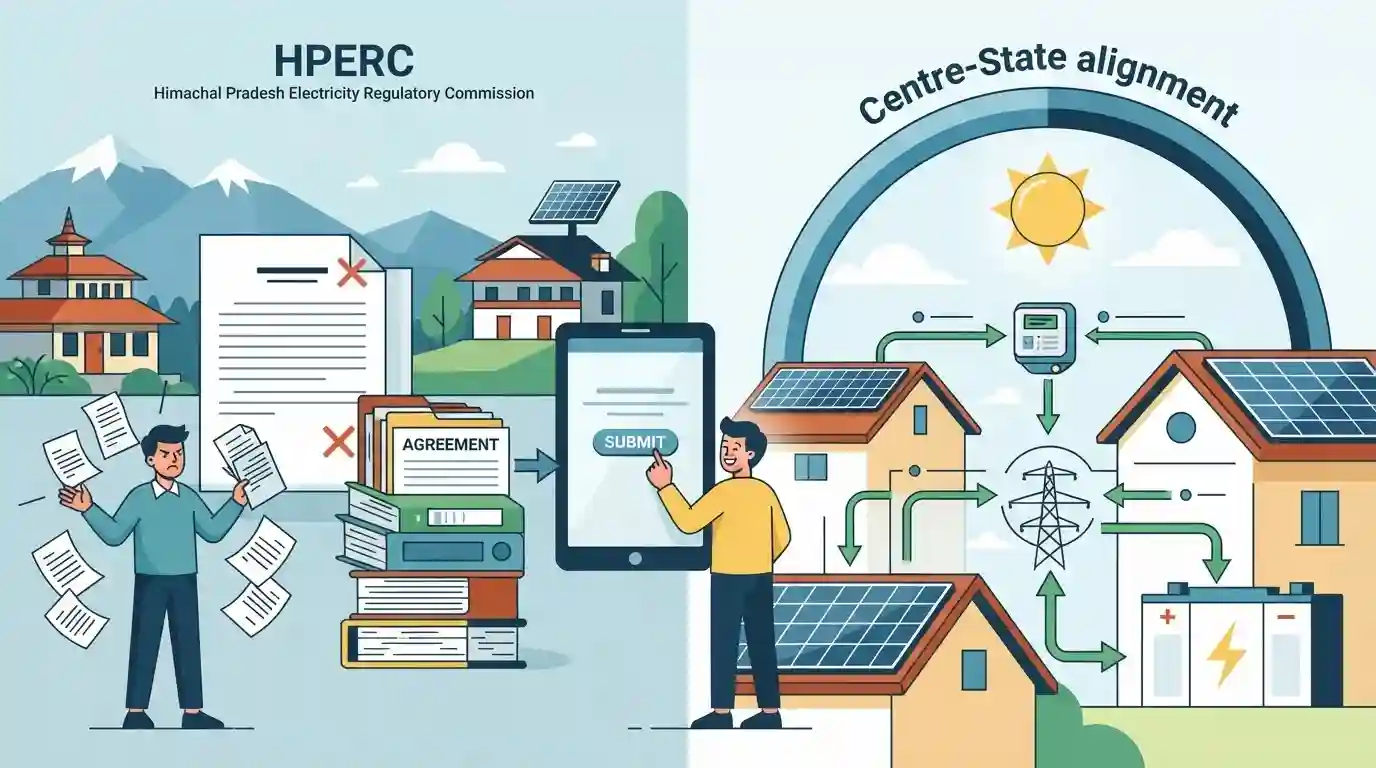
The Himachal Pradesh Electricity Regulatory Commission (HPERC) has notified the Fourth Amendment to the Rooftop Solar PV Grid Interactive System Regulations, 2015. This regulatory shift is designed to simplify and accelerate rooftop solar installations under the PM Surya Ghar: Muft Bijli Yojana. By eliminating the cumbersome requirement of a separate Net Metering Agreement with the distribution licensee, the state has integrated a Digital Solar Metering Connection Agreement into the online application. This move reduces bureaucratic hurdles, aligns state policies with the Centre's renewable energy objectives, and encourages broader adoption of rooftop solar among residential consumers in Himachal Pradesh.
Key Points
- HPERC approved the Fourth Amendment to the Rooftop Solar PV Grid Interactive System Regulations, 2015, to streamline solar rooftop installations in Himachal Pradesh.
- The amendment simplifies the approval process for residential consumers under the central government's PM Surya Ghar: Muft Bijli Yojana.
- It eliminates the need for consumers to sign a separate physical Net Metering Agreement with the power distribution licensee.
- A Digital Solar Metering Connection Agreement has now been integrated directly into the online application form on the national portal to fast-track deployment.
Important Terms
PM Surya Ghar: Muft Bijli Yojana

A flagship central government scheme offering subsidies to residential households for rooftop solar installations, aiming to provide clean, free electricity and reduce dependency on conventional power grids.
UPSC context
Important for GS Paper 2 and 3. Tests knowledge of national welfare schemes and their implementation in state energy infrastructure.
Himachal Pradesh Electricity Regulatory Commission (HPERC)
The statutory authority governing Himachal Pradesh's power sector. It regulates electricity tariffs, enforces compliance, and guides the state's transition to renewable energy through policy framing and grid modernization.
UPSC context
Tests GS Paper 2 (Statutory Bodies) and GS Paper 3. Crucial for understanding state regulatory frameworks and energy sector governance.
Rooftop Solar PV Grid Interactive System Regulations, 2015 (Fourth Amendment)
A 2026 HPERC regulatory update designed to accelerate rooftop solar adoption by eliminating the mandatory separate Net Metering Agreement, thereby streamlining approvals for consumers.
UPSC context
Relevant for GS Paper 3 (Energy Infrastructure). Demonstrates ease of doing business and state-level policy reforms in the renewable sector.
Digital Solar Metering Connection Agreement
An online agreement format introduced by HPERC that replaces the traditional net metering paperwork, allowing citizens to seamlessly apply for grid-connected rooftop solar via central and state portals.
UPSC context
Fits GS Paper 2 (E-Governance). Highlights the reduction of bureaucratic hurdles and the digital transformation of public utility services.
Prelims Trap
PM Surya Ghar covers 100% of installation costs and requires a mandatory physical Net Metering Agreement with the state distribution licensee.
The scheme provides scaled subsidies (60% up to 2kW, 40% for 2-3kW), and HPERC explicitly eliminated the physical agreement requirement to speed up deployment.
Static Concepts Connected
What is 'Net Metering' in the context of rooftop solar power systems?
- Import-Export Balance: Consumers generate solar power for self-use and export excess to the grid, paying the distribution company only for the "net" electricity consumed.
- Billing Mechanism: The distribution licensee credits the consumer's bill for the exported solar units, effectively reducing overall electricity costs and incentivizing adoption.
What are the primary objectives of the Swaran Jayanti Energy Policy of Himachal Pradesh?
- Capacity Target: Aims to add 10,000 MW of green energy capacity in the state by 2030, reinforcing HP's commitment to clean energy transition.
- Green Energy Mix: Promotes a diversified portfolio of solar, hydro, wind, and biomass energy to position Himachal Pradesh as India's premier Green Energy State.
Cross-Topic Patterns
Kangra's Solar Model Village
Raja Khas becoming HP's first Solar Model Village links the central PM Surya Ghar scheme directly to decentralized rural governance and block-level development in Kangra.
E-Governance in State Utilities
Moving from physical net metering agreements to integrated Digital Solar Metering reflects broader administrative reforms in Himachal aimed at 'Ease of Living' and reducing state-level bureaucratic friction.

Expect a multi-statement question testing PM Surya Ghar's subsidy limits (2kW vs 3kW) alongside HP's Swaran Jayanti 2030 energy targets.
Linked PYQs · 3
Linked PYQs · 3
- 2025HPAS_PRELIMSGS1
Match List I with List II : | List-I (Scheme) | List-II (Launch Year) | |---|---| | (a) Mukhya Mantri Roshni Yojana | (i) 2015 | | (b) Himachal Pradesh Horticulture Development Project | (ii) 2019 | | (c) Mukhya Mantri Gram Path Yojana | (iii) 2009 | | (d) Swavalamban Yojana | (iv) 2020 | Choose the correct answer from the options given below : Code: (a) (b) (c) (d)
- 2025HPAS_PRELIMSGS1
Arrange the following schemes of Government of India from newest to oldest : (1) Pradhan Mantri Sahaj Bijli Har Ghar Yojana (2) Mangrove Initiative for Shoreline Habitats and Tangible Incomes (3) Atal Bhujal Yojana (4) Stand-up India Yojana Choose the correct answer from the options given below :
- 2025HPAS_PRELIMSGS1
Match List I with List II : | List-I (Scheme) | List-II (Ministry) | |---|---| | (a) Atal Pension Yojana | (i) Ministry of Communications | | (b) Startup India Scheme | (ii) Ministry of Finance | | (c) Eco-NIWAS | (iii) Ministry of Commerce and Industry | | (d) BharatNet | (iv) Ministry of Power | Code: (a) (b) (c) (d)
