HRRL Refinery Inaugurated in Balotra for Regional Growth
Source:indianinfrastructure ↗
Why It Matters
The HRRL is Rajasthan's first major refinery and a massive infrastructure milestone. It converts locally produced crude from the Barmer-Sanchi basin into high-value BS-VI fuels and petrochemicals, reducing India's imports and transforming the economic landscape of Western Rajasthan.
Summary
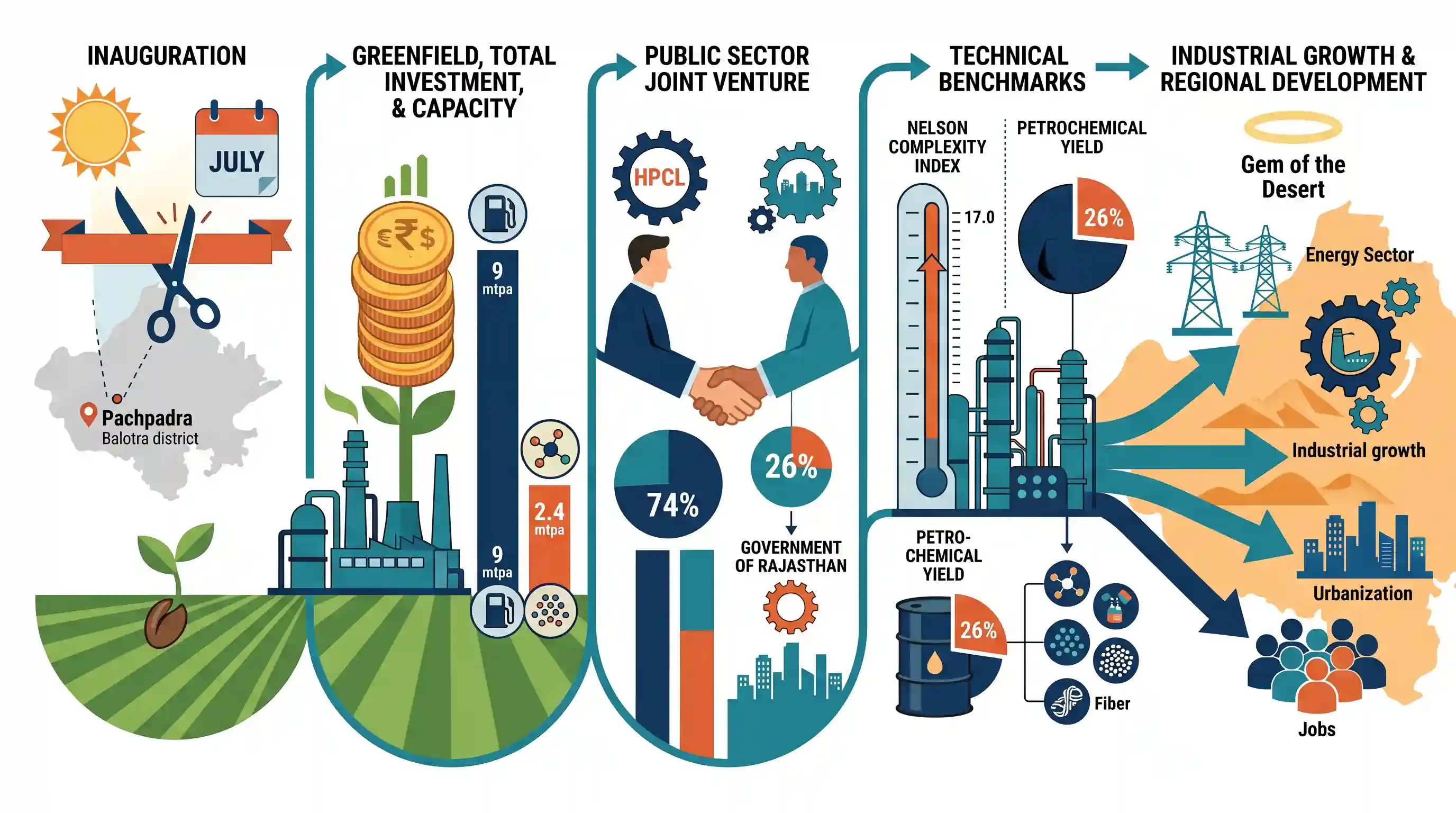
The HPCL Rajasthan Refinery (HRRL) located at Pachpadra in Balotra district, Rajasthan was inaugurated on July 4, 2026. Developed at a cost of Rs 794.59 billion, this greenfield integrated refinery-cum-petrochemical complex has a capacity of 9 mtpa and a petrochemical capacity of 2.4 mtpa. The project is a joint venture between HPCL (74%) and the Government of Rajasthan (26%). It features a high Nelson Complexity Index of 17.0 and over 26% petrochemical yield, marking a major milestone for Rajasthan's industrial and energy sectors.
Key Points
- The HPCL Rajasthan Refinery (HRRL) at Pachpadra in Balotra district (carved out of Barmer), Rajasthan, was inaugurated on July 4, 2026.
- Developed as a greenfield integrated refinery-cum-petrochemical complex, the project cost is Rs 794.59 billion (~Rs 79,459 crore).
- The refinery has a capacity of 9 million tonnes per annum (mtpa) combined with a petrochemical capacity of 2.4 mtpa.
- The project is a joint venture between HPCL and the Government of Rajasthan with a 74:26 equity sharing ratio.
- It has an exceptionally high Nelson Complexity Index of 17.0, meaning it can process heavier crudes efficiently, and has a petrochemical yield of over 26%.
- It is Rajasthan's first major oil refinery and will boost local employment, economic growth, and regional industrialization.
Important Terms
HPCL Rajasthan Refinery Limited

A joint venture between HPCL (74%) and the Rajasthan government (26%), establishing a massive greenfield integrated refinery-cum-petrochemical complex in Pachpadra, Balotra.
UPSC context
GS Paper 3: Infrastructure; tests knowledge of major energy joint ventures and public sector investments in regional development.
Hindustan Petroleum Corporation Limited
A Maharatna Central Public Sector Enterprise under the Ministry of Petroleum and Natural Gas, engaged in refining, marketing, and distribution of petroleum products nationwide.
UPSC context
GS Paper 3: Economic Development; tests understanding of state-owned enterprises driving India's domestic energy security.
Nelson Complexity Index
A metric measuring a refinery's secondary conversion capacity relative to its primary crude distillation capacity, indicating its ability to process heavy crudes and yield high-value products.
UPSC context
GS Paper 3: Industrial Sector; tests technical concepts in refining efficiency, value addition, and energy infrastructure.
Greenfield Project
An industrial or infrastructural project built completely from scratch on a previously undeveloped site, without utilizing pre-existing structures or facilities.
UPSC context
GS Paper 3: Infrastructure; tests understanding of investment classifications, environmental clearances, and industrial expansion strategies.
Pachpadra
A town in the Balotra district of western Rajasthan, historically famous for its salt lake and now home to India's first greenfield integrated refinery-cum-petrochemical complex.
UPSC context
GS Paper 1: Geography of India; tests knowledge of key industrial locations, resource distribution, and regional economic geography.
Prelims Trap
The HPCL Rajasthan Refinery (HRRL) is owned entirely by the central public sector undertaking HPCL.
HRRL is actually a joint venture with a 74:26 equity structure between HPCL and the State Government of Rajasthan, making the state an active equity partner.
Static Concepts Connected
What is the Nelson Complexity Index (NCI) in petroleum refining?
- Core definition: A metric quantifying the sophistication and secondary conversion capacity of an oil refinery compared to basic crude distillation.
- Feedstock flexibility: Higher NCI values indicate the capability to process cheaper, heavier, and sourer crude oils into high-value clean fuels.
- Economic margin: Refineries with higher complexity command higher Gross Refining Margins (GRMs) due to superior product yield and fuel-to-chemical conversion rates.
What is the significance of the Barmer Basin in India's energy sector?
- Geographic location: Located in western Rajasthan, it contains the prolific MBA (Mangala, Bhagyam, Aishwarya) onshore oil fields.
- Crude characteristics: Produces heavy, highly viscous, and waxy crude oil that historically required heated pipelines for long-distance transport.
- Production share: It is one of India's largest domestic onshore crude producers, contributing roughly 20% of the nation's total onshore output.
Cross-Topic Patterns
Petrochemical integration & import substitution
High-yield petrochemical integration reduces India’s dependency on imported polymer feedstock, aligning refinery expansion directly with domestic manufacturing under chemical PLI schemes.
Cooperative federalism in mega-infrastructure
The 74:26 joint venture model serves as a template for resolving complex land acquisition and resource royalty disputes between central PSUs and state governments.

Expect questions pairing India's onshore waxy crude fields (MBA cluster) with the technical concept of the Nelson Complexity Index.
Linked PYQs · 2
Linked PYQs · 2
- 2018RPSC_PRELIMSGS1
The proposed oil refinery in Pachpadra, Barmer, is a joint venture of which?
- 2018RPSC_PRELIMSGS1
Which of the following is NOT an oil field in Rajasthan?
