Forest Department adopts digital tools to commercialize bio-resources
Source:newsarenaindia ↗
Why It Matters
This collaboration blends emerging technologies (AI, satellite mapping) with natural resource management to sustainably exploit the state's forest wealth. For HPAS Prelims, it is highly relevant for state-specific economy, e-governance platforms (Him Pariwar, PEHEL), and environmental conservation policies (HP Grazing Policy 2026).
Summary
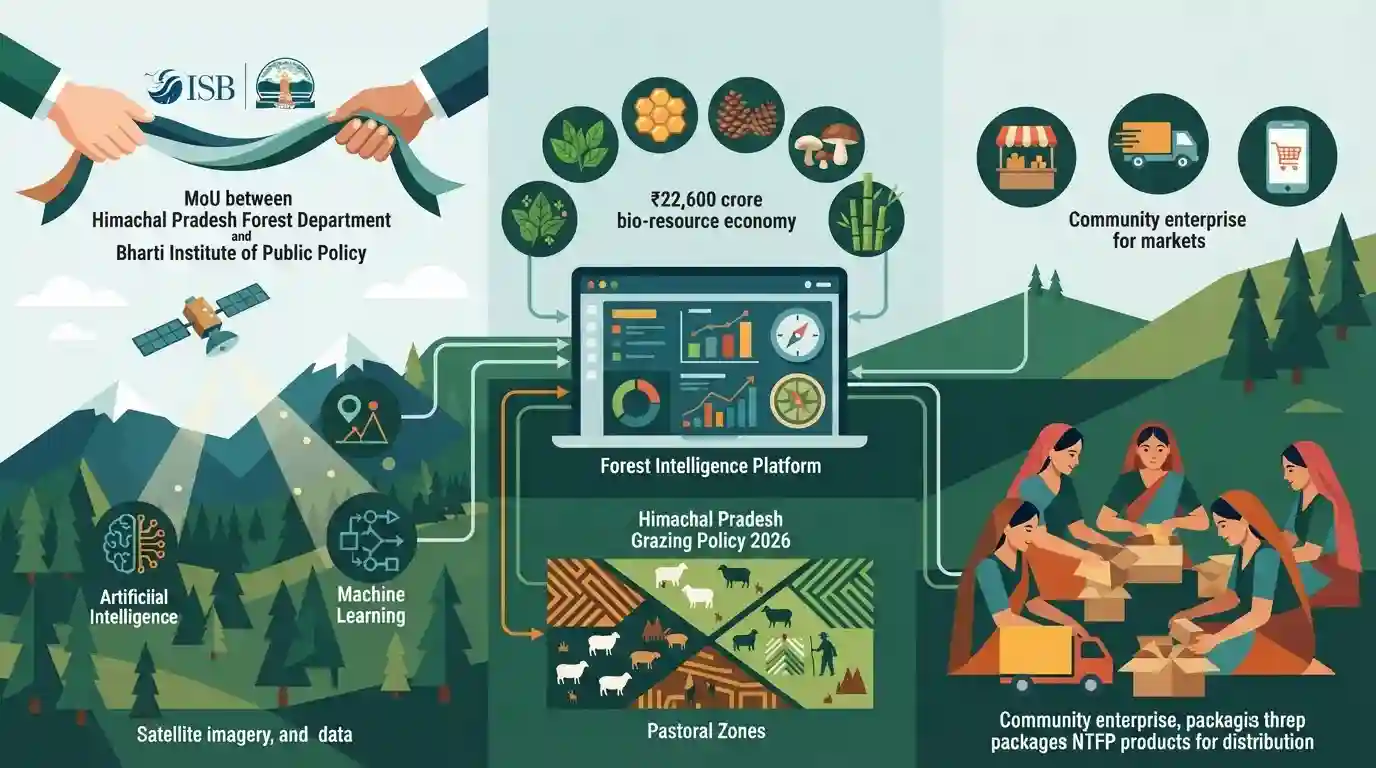
The Himachal Pradesh Forest Department has signed a five-year MoU with the Bharti Institute of Public Policy (BIPP) at the Indian School of Business (ISB) to unlock the state's untapped forest and pastoral economy. By employing satellite imagery, artificial intelligence, and machine learning, the state aims to sustainably commercialize its ₹22,600 crore non-timber forest product (NTFP) and bio-resource economy. The initiative includes launching a Forest Intelligence Platform, rolling out the Himachal Pradesh Grazing Policy 2026, and promoting women-led community enterprises for market access.
Key Points
- The Himachal Pradesh Forest Department and ISB-BIPP signed a 5-year MoU to commercialize the state's untapped forest and pastoral economy, estimated at ₹22,600 crore.
- Technology such as AI/ML and satellite imagery was used by forest guards to collect over 2,00,000 tree-level records, leading to the publication of the 'Counting Green Wealth' report.
- The collaboration prioritizes five major bio-resources: amla, pine needles, wild mangoes, sal seeds, and rhododendron flowers.
- The MoU covers four focus areas: forest economy and community enterprises (promoting women-led producer companies), the Forest Intelligence Platform (piloted in Palampur), training of forest staff, and modernizing pastoral data management.
- A grazing portal and a comprehensive pastoral database will be launched under the upcoming Himachal Pradesh Grazing Policy, 2026, linked with Aadhaar, Him Pariwar, Bharat Pashudhan, and the PEHEL scheme.
Important Terms
Himachal Pradesh Grazing Policy, 2026

A science-based pastoral governance framework introducing structured rotational grazing and localized advisory committees to balance ecological resilience, biodiversity conservation, and the economic empowerment of traditional graziers.
UPSC context
Vital for HP General Studies (Environment and Rural Economy) examining sustainable forest management and pastoralist welfare.
Him Pariwar Portal
A centralized digital portal launched by the state government offering families seamless access to over 300 online public services, essential documents, and welfare schemes to ensure transparent governance.
UPSC context
Highly relevant for GS Paper II (e-Governance) testing digital administration and welfare delivery mechanisms in Himachal.
Pir Panjal Jungle Producer Company
A women-owned, community-led enterprise in Pangi engaged in the thangi (hazelnut) business. It serves as a working model for securing better market access for non-timber forest products.
UPSC context
Crucial for GS Paper III (Forest Economy/NTFPs) and GS Paper I (Women Empowerment) in HP.
Bharti Institute of Public Policy (BIPP)
A public policy institute at the Indian School of Business that signed a five-year MoU with HP to sustainably commercialize bio-resources using satellite imagery, AI, and machine learning.
UPSC context
Tests awareness of institutional partnerships and technology adoption (GS III) for forest resource management.
Bharat Pashudhan
A central digital database for livestock management, currently being integrated with Himachal's new grazing portals and Aadhaar to seamlessly verify user data and streamline pastoral governance.
UPSC context
Important for GS Paper II and III regarding central-state integration in e-governance and animal husbandry.
Prelims Trap
The ISB-BIPP MoU focuses on mapping and commercially extracting ₹22,600-cr worth of prime timber reserves in HP.
The MoU and the ₹22,600 crore valuation strictly target Non-Timber Forest Products (NTFPs) and the pastoral economy—not commercial timber logging.
Static Concepts Connected
Who are the key pastoral communities of Himachal Pradesh?
- Gaddis: Traditionally sheep and goat herders residing mostly in Chamba and Kangra, practicing seasonal transhumance between alpine pastures and lower valleys.
- Gujjars: Primarily nomadic or semi-nomadic buffalo herders who follow seasonal migration routes across the Shivalik and Himalayan ranges.
- Kinnauras: Agro-pastoralists from Kinnaur district, integrating sheep breeding and rearing with high-altitude farming and trading.
What defines Minor Forest Produce (MFP) or NTFPs under Indian law?
- Legal Definition: The Forest Rights Act (2006) defines MFP as all non-timber forest produce of plant origin, including bamboo, brushwood, canes, tussar, cocoons, honey, wax, and medicinal plants.
- Ownership Rights: FRA vests the right of ownership, access to collect, use, and dispose of MFPs with forest-dwelling Scheduled Tribes and other traditional forest dwellers.
- Institutional Support: TRIFED administers the 'Mechanism for Marketing of MFP through MSP' scheme and Van Dhan Vikas Kendras to ensure fair remuneration and value addition for gatherers.
Cross-Topic Patterns
Tech-Integration in Pastoral Schemes
Linking the new Grazing Portal with 'Him Pariwar' and 'Bharat Pashudhan' merges state family registries with central livestock tracking, creating a robust e-governance template for nomadic groups.
Forest Fires and Pine Needles
Commercializing pine needles as a priority bio-resource provides an economic incentive to clear them from forest floors, directly mitigating Himachal's severe seasonal forest fire problem.

Multi-statement Q likely testing the PEHEL scheme's targets, linking Him Pariwar to grazing data, and the 5 priority NTFPs (amla, pine).
Linked PYQs · 3
Linked PYQs · 3
- 2023HPAS_PRELIMSGS1
International Day of Forests, 2023 pertains to the theme of :
- 2020HPAS_PRELIMSGS1
Consider the given four statements and choose the correct answer from the given options. Which of the following statement(s) is / are not correct about the Social Welfare programs of Government of Himachal Pradesh? 1. e-Udyan portal: Where farmers can avail Horticulture farming service benefits while sitting in their home. 2. Vishesh Mahila Uthan Yojna: Scheme formulated for rehabilitation of physically and sexually abused women through technical and vocational training. 3. Medha Protsahan Yojna: Rupees one lakh is provided to the meritorious students to provide guidance at coaching centers. 4. Mukhya Mantri Ek Bigha Scheme: State Government will empower rural women by helping them become self-sufficient and get employment under MGNREGS.
- 2018HPAS_PRELIMSGS1
Which are the projects selected by World Economic Forum to be launched as Centre for Fourth Industrial Revolution in India ?
