HPU Researcher Develops Bacterial Method for Microplastic Cleanup
Source:himbumail ↗
Why It Matters
The application of biotechnology (bioremediation using bacteria) to address environmental pollution (microplastics) is a core theme in GS3 Science & Technology and Environment. It also has a Himachal Pradesh-specific current affairs relevance due to the researcher's affiliation with HPU, which is pertinent to HPAS Prelims.
Summary
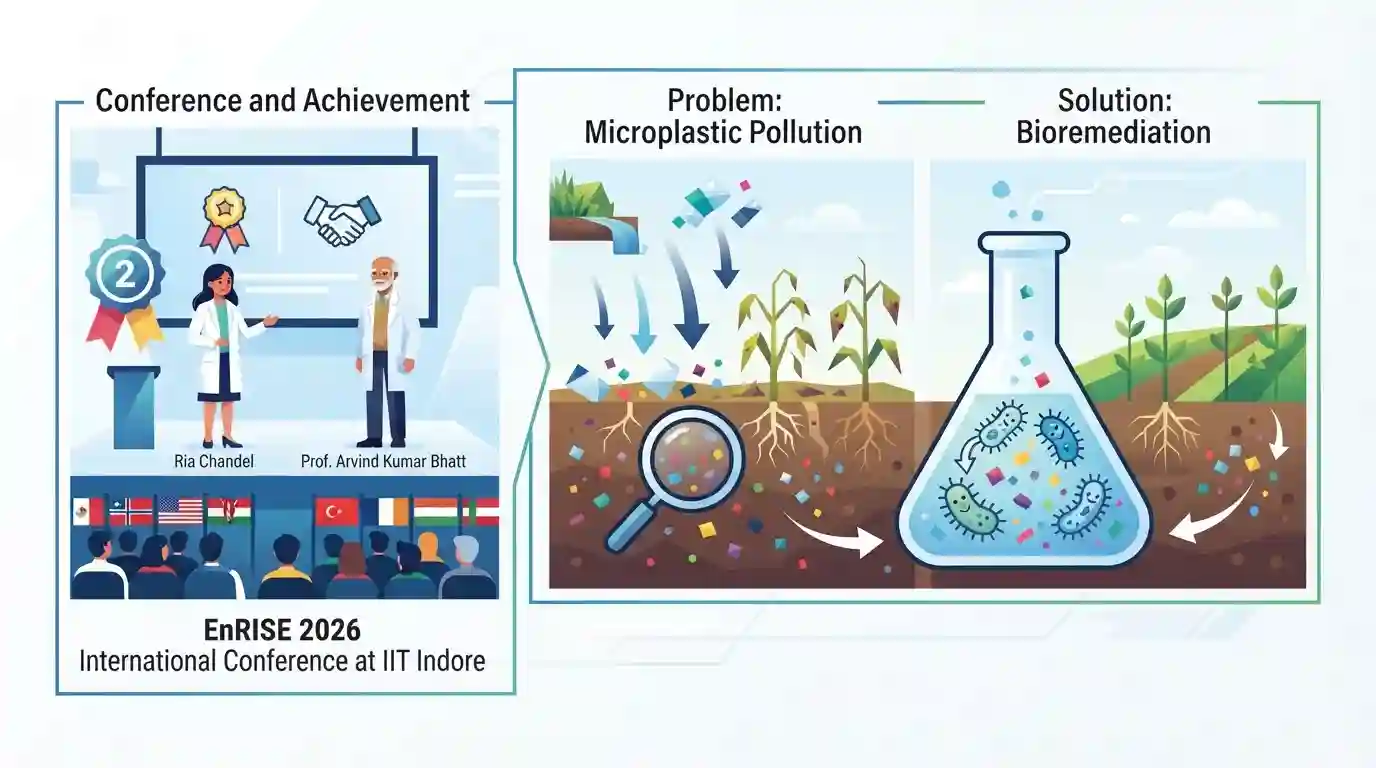
A researcher from Himachal Pradesh University (HPU), Ria Chandel, has won the second prize for her innovative research on combating microplastic pollution at the EnRISE 2026 International Conference at IIT Indore. Her research, guided by Prof. Arvind Kumar Bhatt, explores the use of eco-friendly bacteria for the bioremediation of microplastics in agricultural soils. Microplastics negatively impact soil health and crop productivity and can enter the food chain, causing health hazards. Chandel's bacterial approach degrades these plastics without generating toxic byproducts, offering a sustainable solution to a growing environmental threat. The conference brought together over 400 researchers from multiple countries to discuss sustainable engineering and environmental solutions.
Key Points
- Ria Chandel, a researcher from Himachal Pradesh University (HPU), secured the second prize at the International Conference EnRISE 2026 at IIT Indore.
- Her research focuses on utilizing eco-friendly bacteria to combat microplastic pollution in agricultural soils.
- Microplastics severely impact soil health, crop yields, and enter the food chain, posing health risks.
- The bacteria degrade these hazardous plastics safely without releasing toxic byproducts.
- The conference, EnRISE 2026, was organized by the Department of Civil Engineering at IIT Indore and featured over 400 global researchers.
Important Terms
Himachal Pradesh University

A public university in Shimla leading environmental research. Its researchers recently won international recognition for developing eco-friendly bacterial solutions to tackle microplastic pollution in Himalayan agricultural soils.
UPSC context
Important for HPAS GS Paper 3 (Environment). Highlights the role of state institutions in developing sustainable technologies for the fragile Himalayan ecosystem.
IIT Indore
An autonomous public technical institute in Madhya Pradesh. It hosted the EnRISE 2026 International Conference, serving as a global platform for researchers to discuss sustainable engineering and environmental solutions.
UPSC context
Relevant for GS Paper 3 (Science & Tech). Shows collaboration networks where local Himalayan research can gain national validation and exposure.
EnRISE 2026 International Conference
A major academic conference held at IIT Indore that brought together over 400 global scientists to deliberate on sustainable engineering, environmental innovations, and ecological conservation strategies.
UPSC context
Connects to GS Paper 3 (Environment). Events like this are significant for tracking emerging technologies in pollution control and international collaboration.
Bioremediation
The use of naturally occurring or deliberately introduced microorganisms (like eco-friendly bacteria) to consume and break down environmental pollutants, such as microplastics, into non-toxic substances.
UPSC context
Core concept for GS Paper 3 (Biotechnology and Environment). Tests candidates' knowledge on sustainable and non-toxic methods for combating modern pollution.
Microplastics
Tiny plastic particles that accumulate in the environment. In agricultural settings, they severely degrade soil health, threaten crop productivity, and can bioaccumulate within the human food chain.
UPSC context
Highly relevant for GS Paper 3 (Pollution). Frequently tested for its pervasive environmental impact and the urgent need for innovative waste management.
Prelims Trap
"Microplastics are defined as plastic particles smaller than 1 millimeter in diameter."
HPAS often tweaks scientific definitions. Microplastics are actually defined as plastic fragments smaller than 5 millimeters in diameter, not 1 millimeter.
Static Concepts Connected
What are the primary modes of bioremediation?
- In-situ bioremediation: Treating contaminated soil or water at the original site without excavation (e.g., bioventing, biosparging).
- Ex-situ bioremediation: Excavating and removing the contaminated material to be treated elsewhere (e.g., landfarming, bioreactors).
- Mycoremediation: A specialized form of bioremediation that specifically utilizes fungi (mycelium) to decontaminate an environment.
How do microplastics negatively impact agricultural soil ecosystems?
- Soil Structure Disruption: They alter bulk density and water-holding capacity, which can hinder root penetration and stunt plant growth.
- Microbial Health Decline: The presence of plastics disrupts beneficial soil microbiota, severely impacting organic nutrient cycling.
- Trophic Transfer: Microplastics are absorbed by plant roots and travel up the food chain, ultimately posing risks to human health.
Cross-Topic Patterns
Biotech merging with agricultural soil health
The application of biotechnology for pollution control (bioremediation) directly intersects with agriculture, highlighting the modern push toward sustainable farming and soil health preservation.
HP academic contributions at national platforms
HPU researchers gaining recognition at premier national institutes underscores the growing importance of tracking state-level R&D achievements for the HPAS 'State Specific Current Affairs' section.

Expect a multi-statement question combining microplastic size criteria (<5mm), bioaccumulation in trophic levels, and bioremediation.
Linked PYQs · 3
Linked PYQs · 3
- 2018HPAS_PRELIMSGS1
In which of the following conditions bio-gas is produced ?
- 2023HPAS_PRELIMSGS1
Consider the following statements : (1) Protozoans cause serious diseases like dysentery. (2) All microorganisms grow on our food and cause food poisoning. (3) Microorganisms can live in desert environment. (4) All microorganisms are useful for commercial production of medicines and alcohol. Choose the correct answer from the options given below :
- 2016HPAS_PRELIMSGS1
The global agreement that deals with the control of transboundary movements of hazardous wastes and their disposal is called :
