Himachal Vigilance Bureau Probes Disproportionate Assets Case
Source:theprint ↗
Why It Matters
This case illustrates the practical application of the new Bharatiya Nagarik Suraksha Sanhita (BNSS) in anti-corruption investigations and highlights the role of state vigilance agencies in scrutinizing disproportionate and benami assets held by public representatives.
Summary
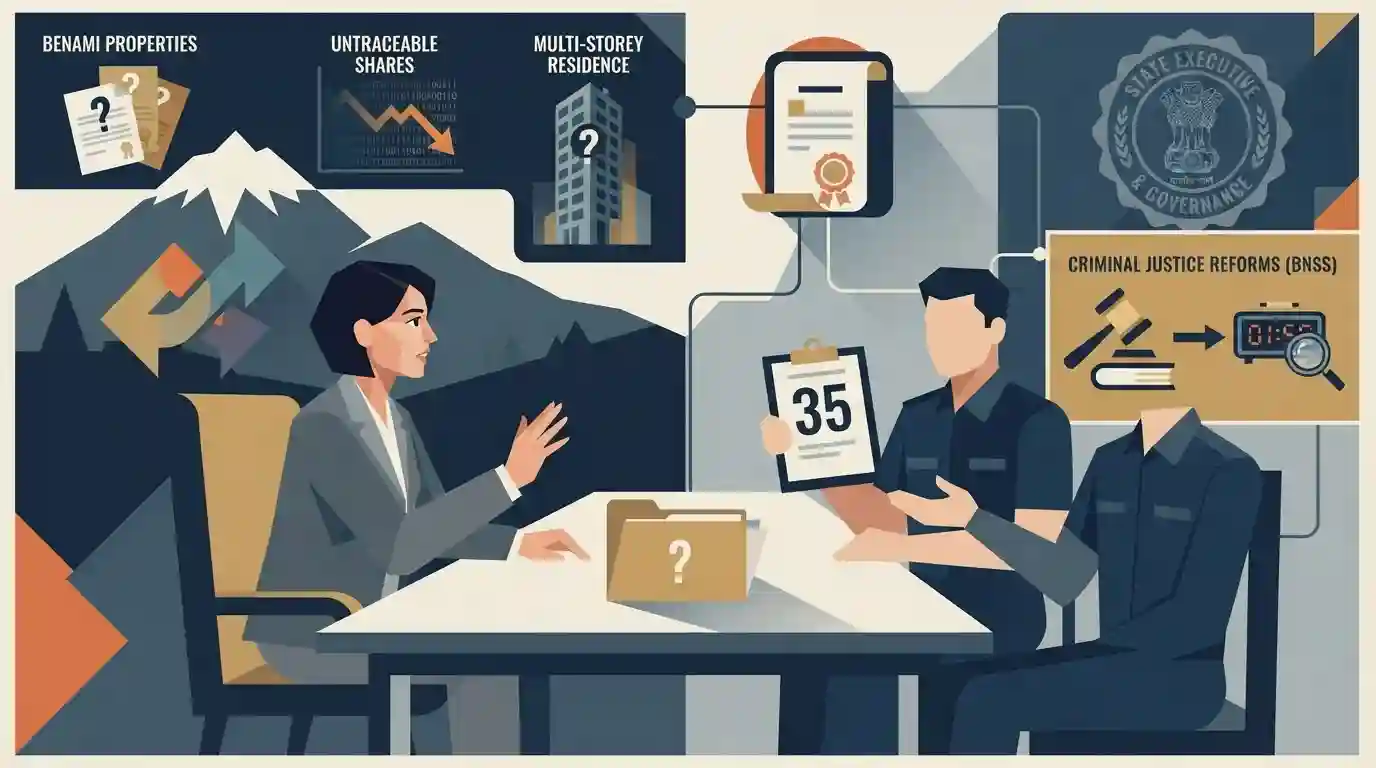
BJP MLA from Dharamshala, Sudhir Sharma, appeared before the Himachal Pradesh State Vigilance and Anti-Corruption Bureau regarding an ongoing disproportionate assets case but failed to submit the required documentary evidence. The summons was issued under Section 35 of the Bharatiya Nagarik Suraksha Sanhita (BNSS). The probe is investigating allegations of benami properties, untraceable shares, and a multi-storey residence in Rakkar. Sharma has dismissed the allegations as politically motivated, citing his recent political switch.
Key Points
- Dharamshala BJP MLA Sudhir Sharma is under investigation by the Himachal Pradesh State Vigilance and Anti-Corruption Bureau for a disproportionate assets (DA) case.
- Sharma appeared before the bureau after receiving a notice under Section 35 of the Bharatiya Nagarik Suraksha Sanhita (BNSS).
- He was questioned regarding investments in benami properties, shares, and a multi-storey house located in Rakkar.
- He failed to provide documentary evidence explaining the assets during his appearance.
- Sharma claims the investigation is a politically motivated effort to target him after he joined the BJP.
Important Terms
Bharatiya Nagarik Suraksha Sanhita (BNSS)

The 2023 criminal procedure code that replaced the CrPC of 1973. It governs the procedural aspects of criminal justice in India, including the investigation, arrest, and trial mechanisms.
UPSC context
GS Paper 2 (Governance). Tests knowledge of recent criminal justice reforms and statutory frameworks.
Section 35 of BNSS
A provision replacing Sections 41/41A of the CrPC, outlining conditions for police to arrest without a warrant and mandating a notice of appearance for offenses punishable by up to seven years.
UPSC context
GS Paper 2 (Polity/Governance). Crucial for understanding safeguards against arbitrary arrest and personal liberty protections.
State Vigilance and Anti-Corruption Bureau (SV&ACB)
The primary anti-corruption enforcement agency of the Himachal Pradesh government, tasked with investigating graft, disproportionate assets, and misconduct by public servants under the Prevention of Corruption Act.
UPSC context
GS Paper 2 (State Governance). Evaluates knowledge of HP's institutional mechanisms for accountability and transparency.
Disproportionate Assets (DA)
A condition under the Prevention of Corruption Act where a public servant's wealth intentionally and significantly exceeds their known, lawful sources of income without a satisfactory explanation.
UPSC context
GS Paper 2 & 4 (Governance/Ethics). Tests understanding of anti-corruption laws and public servant accountability.
Benami Property
Assets purchased or held in one person's name (the benamidar) while the payment is provided by another, who remains the actual beneficiary, often to hide illicit wealth or evade taxes.
UPSC context
GS Paper 3 (Economy). Important for topics on black money, tax evasion, and economic enforcement acts.
Prelims Trap
Section 35 of BNSS deals with the confiscation of benami properties in corruption cases.
Section 35 of BNSS replaces CrPC 41/41A, governing police powers to arrest without a warrant and issue appearance notices, not property confiscation.
Static Concepts Connected
How are Disproportionate Assets (DA) penalized under Indian law?
- Statutory Basis: Tackled under Section 13 of the Prevention of Corruption Act (PCA), 1988, which criminalizes 'intentional enrichment' by public servants.
- Core Criteria: Possessing pecuniary resources or property disproportionate to a public servant's known lawful sources of income which they cannot satisfactorily account for.
- Burden of Proof: Once the investigating agency establishes the existence of disproportionate assets, the burden of proof shifts to the accused to explain their legal source.
What is the institutional framework under the Benami Transactions Act?
- Benami Definition: A transaction where a property is held by one person (benamidar), but the consideration is paid by another who holds the ultimate beneficial interest.
- Four-Tier Mechanism: The 2016 Amendment established a four-tier mechanism: the Initiating Officer, Approving Authority, Administrator, and Adjudicating Authority.
- Strict Confiscation: The Act empowers the designated authorities to attach and eventually confiscate benami properties without paying any compensation.
Cross-Topic Patterns
BNSS transition in state agencies
The SV&ACB's use of BNSS Section 35 highlights the active operational shift of state-level investigative agencies from the CrPC to the new Bharatiya criminal codes in high-profile political cases.
PCA and Benami Act convergence
DA investigations frequently combine the Prevention of Corruption Act with the Benami Act to untangle and attach multi-layered property holding patterns utilized by public officials.

Expect multi-statement questions testing BNSS notice/arrest provisions (Sec 35) vs old CrPC, alongside PCA and Benami Act definitions.
Linked PYQs · 2
Linked PYQs · 2
- 2025HPAS_PRELIMSGS1
In which case Supreme Court decided that not singing of National Anthem cannot be considered its disrespect or offence ?
- 2023HPAS_PRELIMSGS1
Consider the following Acts and Policy : (1) Water (Prevention and Control of Pollution) Act (2) Water Cess Act (3) The National Water Policy (4) Air (Prevention and Control of Pollution) Act With reference to the Acts and Policy mentioned above, in terms of their starting year, which one of the following is the correct ascending order? Choose the correct answer from the options given below :
