High Court protects rights of female applicants in public recruitment
Source:livelaw ↗
Why It Matters
This ruling sets a crucial precedent regarding gender equality and non-discrimination (Articles 14, 15, and 16) in public employment. It highlights administrative insensitivity and reiterates that a citizen's fundamental right to marriage cannot be restricted by bureaucratic recruitment delays.
Summary
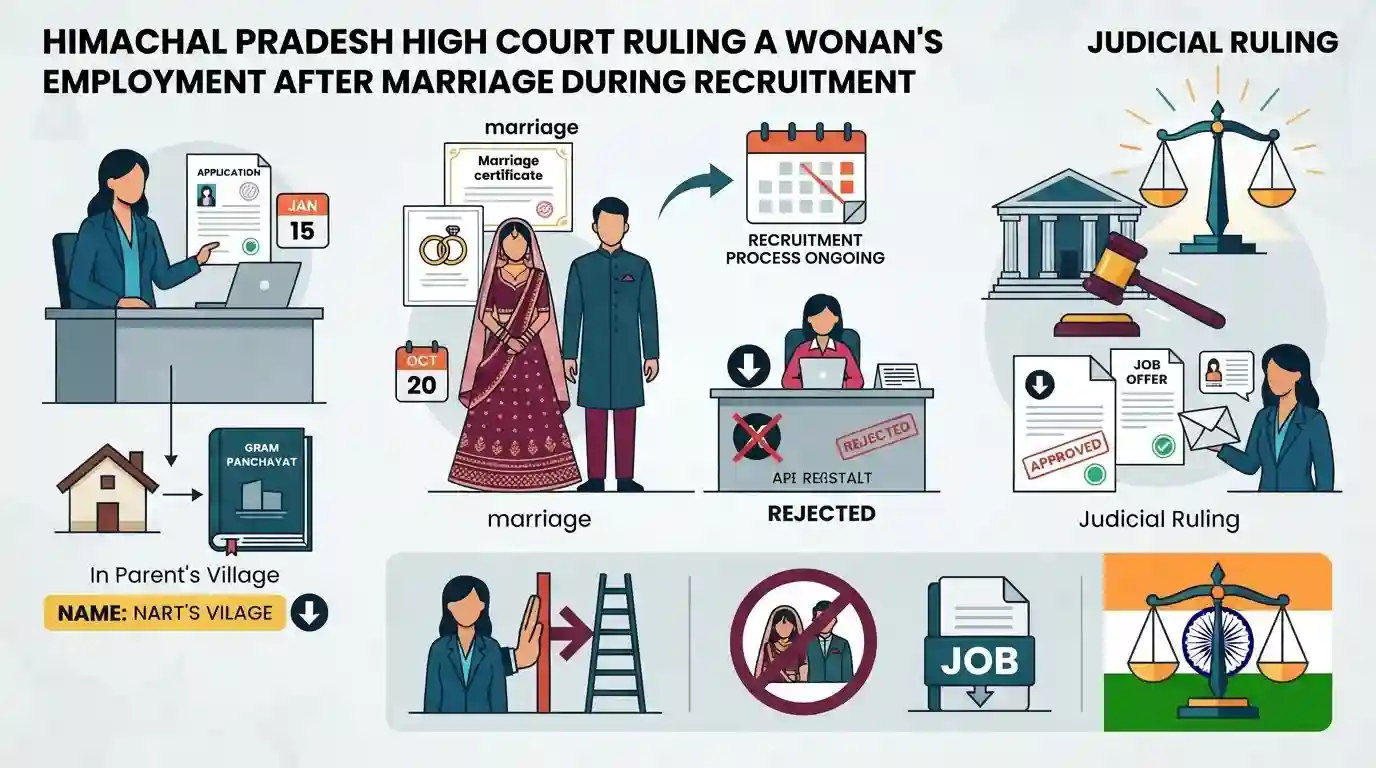
The Himachal Pradesh High Court has ruled that a woman candidate cannot be denied employment or related benefits simply because she got married while the recruitment process was ongoing. The case involved a female applicant for the 'Van Mitra' post who was denied BPL category marks after her marriage led to her removal from her parents' Gram Panchayat register. The Court stated that eligibility must be assessed as of the application date, emphasizing that administrative delays in recruitment cannot compel a woman to postpone marriage, as this would violate her fundamental right to equality and non-discrimination in public employment.
Key Points
- The petitioner, Nitu Kumari, applied for a Van Mitra post under the BPL (Below Poverty Line) category while unmarried.
- She got married during the recruitment process, which led to her removal from her parental Gram Panchayat BPL list, and the Forest Department consequently denied her BPL marks.
- The Himachal Pradesh High Court ruled that an applicant's eligibility must be determined based on their status at the time of application, not at the time of appointment.
- Justice Ajay Mohan Goel held that expecting a woman to remain unmarried until a recruitment process concludes is unreasonable and violates fundamental constitutional rights.
Important Terms
Van Mitra Scheme

An HP government initiative engaging local youth in forest beats to assist the Forest Department with the protection, conservation, and development of forest areas through community participation.
UPSC context
Important for HP General Knowledge and GS Paper 3 (Environment), highlighting community-based forest management and local employment generation.
Himachal Pradesh High Court
The apex judicial body in the state, which recently ruled that marital status changes during delayed recruitment processes cannot disqualify women from public employment, upholding constitutional equality.
UPSC context
Crucial for GS Paper 2 (Polity), testing awareness of landmark state judgments protecting women's fundamental rights in public employment.
Gram Panchayat
A village-level local self-government institution. In this case, removing a woman's name from her parents' Gram Panchayat register post-marriage led to an unjust denial of BPL benefits.
UPSC context
Vital for GS Paper 2 (Panchayati Raj), illustrating how local administrative records intersect with welfare benefits and public employment eligibility.
Forest Department
The state agency responsible for managing forest resources. It acts as the implementing authority for the Van Mitra scheme and was directed to appoint the wrongfully rejected candidate.
UPSC context
Relevant for GS Paper 3 (Environment) and state administration, testing knowledge of departments executing key environmental policies and facing judicial scrutiny.
Prelims Trap
"BPL status must be valid on the date of final appointment to claim weightage marks."
Eligibility is legally assessed as of the application cut-off date. Administrative delays cannot prejudice candidates whose socio-economic or marital status changes subsequently.
Static Concepts Connected
What are the key features of Himachal's Van Mitra scheme?
- Core Objective: Engages local youth across the state's 2,061 forest beats to strengthen grassroots community involvement in forest protection.
- Primary Duties: Mitigating forest fires, preventing illegal felling, and driving tree plantation initiatives on both forest and non-forest lands.
- Financial Incentives: Provides financial incentives to locals, directly linking rural livelihood generation with the state's ecological management goals.
How does the Constitution protect equality in public employment?
- Article 16(2): Explicitly prohibits discrimination in any state employment or office on grounds of religion, race, caste, sex, descent, place of birth, or residence.
- Article 15(3): Empowers the State to make special affirmative provisions for women, enabling progressive recruitment policies and reservations.
- Article 14: Ensures equality before the law, which courts use to strike down arbitrary administrative actions that inherently disadvantage female applicants.
Cross-Topic Patterns
Art 16 + Gendered Admin Delays
Judicial rulings are consistently using Articles 14 and 16 to strike down state rules that penalize women for life events, like marriage or pregnancy, occurring during protracted recruitment cycles.
Van Mitra + Community Forest Management
The scheme connects rural livelihood generation with HP's climate goals, reflecting a policy shift from purely bureaucratic forest policing to community-driven ecological stewardship.

Expect a multi-statement question combining 'Van Mitra' scheme's ecological aims with HP's BPL recruitment weightage criteria.
Linked PYQs · 2
Linked PYQs · 2
- 2025HPAS_PRELIMSGS1
Consider the following statements : (1) Article 13(2) provides reservations to backward classes. (2) Article 15(4) and 16(4) provide reservations for OBCs. (3) Article 15(6) and 16(6) provide reservations to EWS of society. (4) Article 14 provides reservation for SC | STs. Choose the correct answer from the options given below :
- 2022HPAS_PRELIMSGS1
Which Articles have been inserted to provide reservations for Economically Weaker Sections (EWS) in 2019 ?
