Schilthorn Top road project stayed by Himachal Pradesh High Court
Source:himbumail ↗
Why It Matters
The issue demonstrates the critical role of the judiciary and PILs in checking potential misuse of administrative power. It highlights the ongoing conflict between infrastructure development and environmental conservation in the fragile Himalayan ecology.
Summary
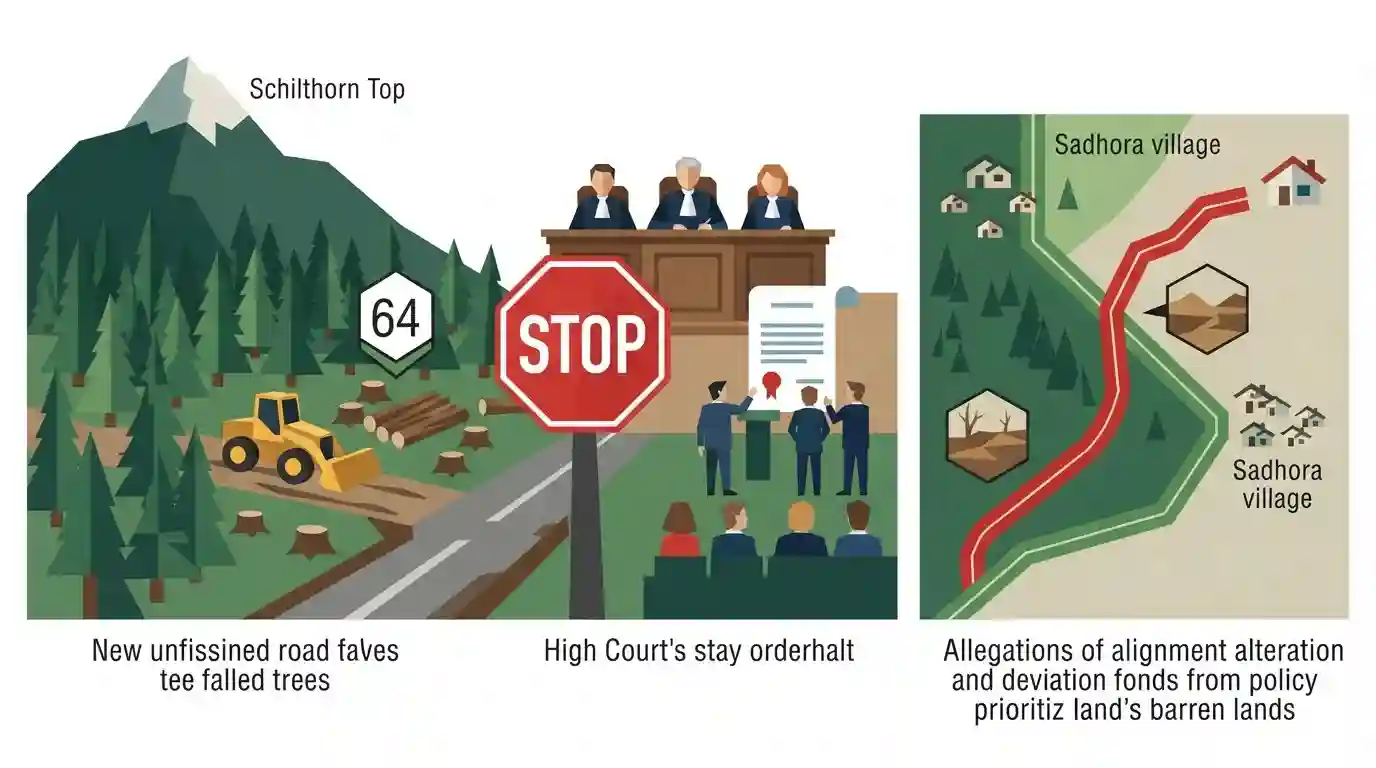
The Himachal Pradesh High Court has halted the construction of a road near Schilthorn Top in the Mashobra range, which was intended to connect to the Shimla-Mandi road. The stay order followed a Public Interest Litigation (PIL) alleging that the road's alignment was altered to benefit a private individual rather than serving the public interest of the nearby Sadhora village. The court raised concerns over the proposed felling of 64 trees in a forested area for merely a 144-metre stretch, questioning the state's deviation from its 2017 policy that prioritizes barren lands for road construction to minimize environmental damage.
Key Points
- The Himachal Pradesh High Court stayed the construction of a 144-metre road near Schilthorn Top in the Mashobra range following a Public Interest Litigation (PIL).
- The proposed road alignment allegedly bypassed the village of Sadhora, failing to serve its 245 residents, and instead appeared to benefit a single private individual.
- The construction would require the felling of 64 trees in a pristine forest area, raising significant environmental concerns.
- The court questioned the state government on the justification for the alignment and tree felling, citing a 2017 cabinet decision that prioritizes road construction on barren or sparsely forested lands.
Important Terms
Public Interest Litigation (PIL)

A legal mechanism allowing individuals to seek judicial intervention on behalf of the broader public. In Himachal Pradesh, it is frequently used to challenge administrative deviations, safeguard forest land, and ensure executive accountability.
UPSC context
GS Paper 2 (Polity); tests the application of judicial review, judicial activism, and citizen-led executive accountability.
Himachal Pradesh High Court
The apex judicial authority in Himachal Pradesh, located in Shimla. It exercises crucial jurisdiction over state matters, regularly intervening to halt environmentally damaging infrastructure projects and checking potential executive overreach.
UPSC context
GS Paper 2 (State Governance); evaluates knowledge of state judicial mechanisms, environmental jurisprudence, and administrative checks.
Mashobra Range
A prominent forested geographical area near Shimla. Known for its dense green cover and ecological importance, it is a sensitive zone where infrastructure projects and tree-felling face intense judicial and public scrutiny.
UPSC context
GS Paper 1 (HP Geography) & GS 3 (Environment); tests awareness of local topography and ecological hotspots.
Himachal Pradesh Road Construction Policy
State guidelines regulating infrastructure development in hilly terrain. A key 2017 directive mandates prioritizing barren or uncultivable lands for road alignments to minimize deforestation and protect the state's fragile ecosystem.
UPSC context
GS Paper 3 (Infrastructure & Environment); tests understanding of sustainable development policies balancing connectivity with conservation.
Prelims Trap
"An aggrieved landowner can file a PIL to stop a state road project from cutting through their private property."
Under HP High Court PIL Rules 2010, petitioners must explicitly declare they have NO private interest. PILs cannot be used to resolve personal property or alignment disputes.
Static Concepts Connected
What are the core principles governing Public Interest Litigation (PIL) in India?
- Locus Standi: Traditional locus standi is relaxed; any public-spirited citizen or entity can move the court on behalf of the affected.
- Fundamental Rights: Often invoked to enforce Part III Fundamental Rights, specifically Article 21 (which includes the right to a clean environment).
- Non-adversarial Nature: Designed to be collaborative rather than traditional litigation, aiming to resolve public harm and hold the executive accountable.
What are the key policy checks on road construction in Himachal's forested areas?
- Forest Conservation Act 1980: Any diversion of forest land for non-forest purposes (like roads) requires prior approval from the Central Government.
- 2017 State Policy: A specific 2017 state cabinet decision mandates prioritizing barren or sparsely forested lands for road alignments to minimize ecological damage.
Cross-Topic Patterns
Judicial review over infrastructure alignment
The court's intervention in road alignments (an executive domain) highlights the growing reliance on PILs to enforce environmental compliance and check localized political favoritism in Himachal.
Himalayan ecology and temple access
Connects localized tree-felling controversies (Mashobra) to broader state-wide judicial actions, including recent suo motu halts on clearances near Chandertal, Shikari Devi, and Churdhar temples.

Expect a multi-statement question combining HP High Court PIL rules (locus standi) with state environmental guidelines for road projects.
Linked PYQs · 3
Linked PYQs · 3
- 2020HPAS_PRELIMSGS1
Consider the given four statements and choose the correct answer from the given options. 1. Justice Deepak Misra has been instrumental in the creation of Public Interest Litigation (PIL). 2. Justice Ranjan Gogoi joined Rajya Sabha after retirement from Supreme Court. 3. Justice P.N. Bhagwati introduced PIL. 4. Justice V.K. Krishna Iyer resigned before time.
- 2023HPAS_PRELIMSGS1
Match List I with List II : | List-I (District) | List-II (Reserved Forest Area in Sq. Km. in 2019-20) | |---|---| | (a) Chamba | (i) 227 | | (b) Kullu | (ii) 853 | | (c) Sirmaur | (iii) 340 | | (d) Kangra | (iv) 1 | Choose the correct answer from the options given below : Code: (a) (b) (c) (d)
- 2025HPAS_PRELIMSGS1
Match List I with List II : | List-I (Wildlife Sanctuary) | List-II (District) | |---|---| | (a) Kias | (i) Kullu | | (b) Tarla | (ii) Shimla | | (c) Tundah | (iii) Chamba | | (d) Bandli | (iv) Mandi | Choose the correct answer from the options given below : Code: (a) (b) (c) (d)
