High Court penalizes state government for frivolous service appeal
Source:aninews ↗
Why It Matters
Highlights issues in public administration related to frivolous government litigation, the enforcement of state litigation policies, and the role of the judiciary in protecting marginalized, low-wage workers from bureaucratic harassment.
Summary
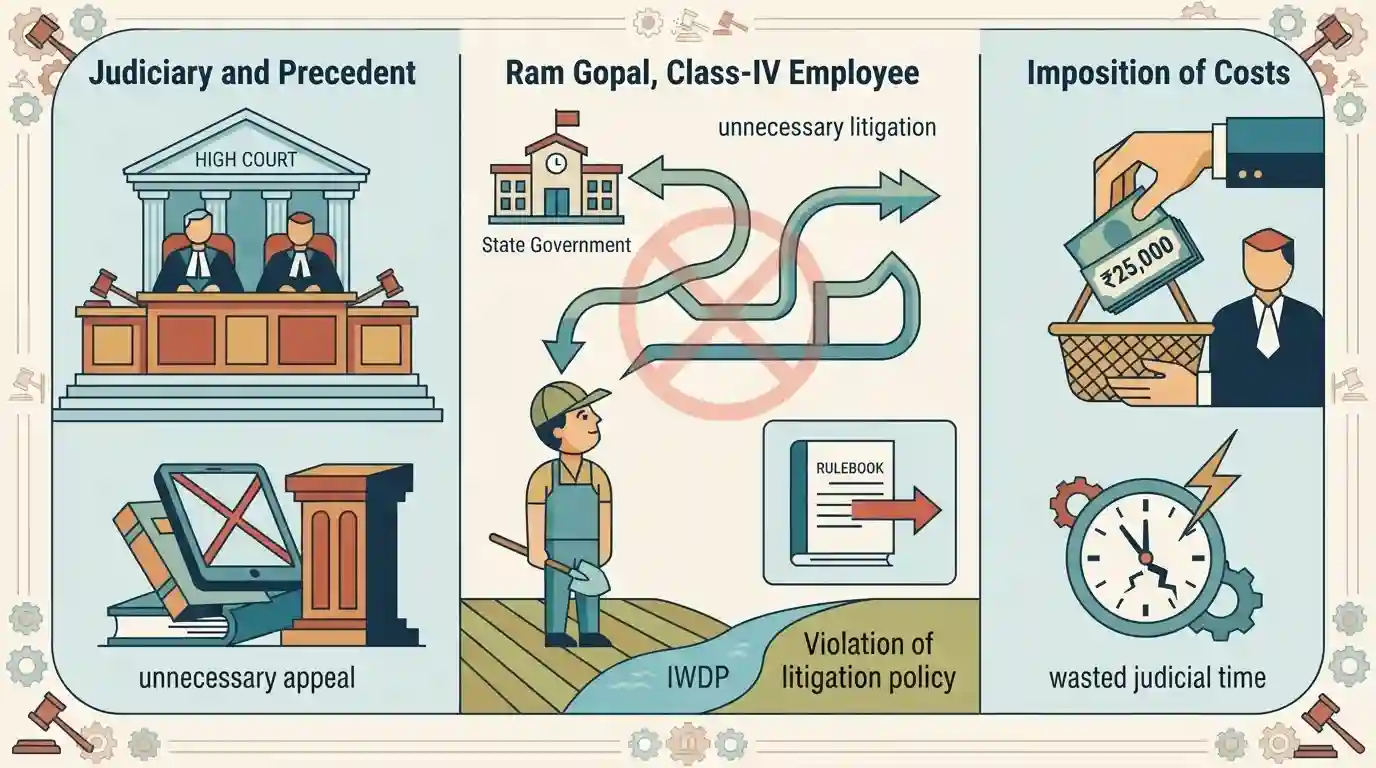
The Himachal Pradesh High Court has imposed a cost of ₹25,000 on the State government for filing an unnecessary appeal in a service matter involving a Class-IV employee. A Division Bench comprising Chief Justice G.S. Sandhawalia and Justice Bipin Chander Negi severely criticized the state for ignoring established judicial precedents and violating its own litigation policy. The case involved Ram Gopal, a daily wage worker under the Integrated Watershed Development Project (IWDP) seeking regularization. The court observed that the state was unnecessarily harassing low-paid employees and wasting judicial time by pursuing litigation in matters already settled by earlier rulings.
Key Points
- The Himachal Pradesh High Court imposed a fine of ₹25,000 on the State government for filing a frivolous appeal against a Class-IV employee.
- The court reprimanded the State for ignoring its own litigation policy, which seeks to avoid unnecessary appeals against low-paid employees like daily wagers.
- The petitioner, Ram Gopal, had worked under the Integrated Watershed Development Project (IWDP) since 1999 and sought regularization based on an earlier judicial precedent (Sant Ram vs State of HP).
- The High Court bench condemned the state's actions for wasting judicial time, noting the appeal was wholly uncalled for and highlighted systemic harassment of low-level workers.
Important Terms
Himachal Pradesh State Litigation Policy

A policy framework adopted by the state government to reduce government-induced litigation, curb frivolous appeals in already settled matters, and minimize the burden on the judicial system.
UPSC context
Crucial for HPAS GS Paper 2 (Governance) regarding administrative accountability, judicial efficiency, and state litigation management.
Integrated Watershed Development Project (IWDP)
A World Bank-supported initiative implemented in Himachal Pradesh to conserve soil and water, rehabilitate degraded lands, and enhance the livelihoods of rural and forest-dependent communities.
UPSC context
Highly relevant for HPAS GS Paper 3 (Economy and Environment) focusing on sustainable agriculture, rural development, and natural resource management.
Letters Patent Appeal (LPA)
An intra-court appeal process that allows a party to challenge a judgment delivered by a single judge before a larger Division Bench of the same High Court.
UPSC context
Important for HPAS GS Paper 2 (Polity) to understand the state's judicial appellate structure and the mechanisms of legal recourse.
Himachal Pradesh High Court
The apex judicial body in the state, located in Shimla, responsible for ensuring executive accountability, protecting citizens' rights, and dispensing justice.
UPSC context
Relevant for HPAS GS Paper 2 (Polity) concerning the jurisdiction, powers, and role of the state judiciary in upholding constitutionalism.
Prelims Trap
"The Integrated Watershed Development Project (IWDP) in Himachal Pradesh was funded by the Asian Development Bank."
The IWDP (Hills-II/Shiwalik Project) was funded by the World Bank, not ADB. Aspirants often confuse this with ADB-funded infrastructure or JICA-funded forestry projects in HP.
Static Concepts Connected
What are the key objectives of the Himachal Pradesh State Litigation Policy (2011)?
- Responsible Litigant: To transform the government into an efficient and responsible litigant by preventing frivolous cases and appeals.
- Reduce Pendency: To decrease the burden on courts by curbing unnecessary litigation, especially appeals that harass low-paid employees and daily wagers.
- Alternative Resolution: Encourages the use of Alternative Dispute Resolution (ADR) mechanisms like Lok Adalats and mediation at the pre-litigation stage.
What is the criteria for regularizing daily wage workers in Himachal Pradesh?
- 8-Year Rule: Daily wage workers are generally entitled to regularization or work-charged status upon completing 8 years of continuous service.
- Judicial Precedent: This service right stems from established landmark judicial precedents in the state, specifically Mool Raj Upadhyaya vs. State of H.P.
Cross-Topic Patterns
Externally Aided Projects in HP
The IWDP was World Bank-funded. HPAS prelims frequently tests matching externally aided projects (e.g., JICA for forestry, KfW for environment, ADB for tourism) with their international funding agencies.
Judiciary enforcing administrative accountability
The High Court imposing costs highlights administrative apathy. This serves as a strong Mains GS-II example for judicial review checking executive overreach and protecting marginalized state workers.

Expect matching questions on externally aided HP projects (World Bank/JICA/ADB) or Mains questions on the HP State Litigation Policy.
Linked PYQs · 3
Linked PYQs · 3
- 2024HPAS_PRELIMSGS1
Match List I with List II : | List I | List II | |---|---| | (a) Habeas Corpus Writ | (i) Re-examining Lower Court records by Superior Court | | (b) Mandamus Writ | (ii) Exercising Power under which authority | | (c) Certiorari Writ | (iii) Restricting officials to act | | (d) Quo Warranto Writ | (iv) To produce in person | Choose the correct answer from the options given below : Code: (a) (b) (c) (d)
- 2024HPAS_PRELIMSGS1
Consider the following statements : Which of the following are included in the original jurisdiction of Supreme Court ? (1) A dispute between Govt. of India and one or more states. (2) A dispute regarding elections to either House of Parliament. (3) A dispute between Govt. of India and a Union Territory. (4) A dispute between two or more states. Choose the correct answer from the options given below :
- 2023HPAS_PRELIMSGS1
Consider the following Acts and Policy : (1) Water (Prevention and Control of Pollution) Act (2) Water Cess Act (3) The National Water Policy (4) Air (Prevention and Control of Pollution) Act With reference to the Acts and Policy mentioned above, in terms of their starting year, which one of the following is the correct ascending order? Choose the correct answer from the options given below :
