National statistical survey planned to evaluate hill state economy
Source:plutusias ↗
Why It Matters
This is an important current affairs development linking core macroeconomic indicators (CPI, PLFS) and the administrative machinery (NSO, MoSPI) with regional development and Center-State fiscal federalism. It provides highly relevant context for questions on institutional bodies, economic surveys, and Finance Commission functions.
Summary
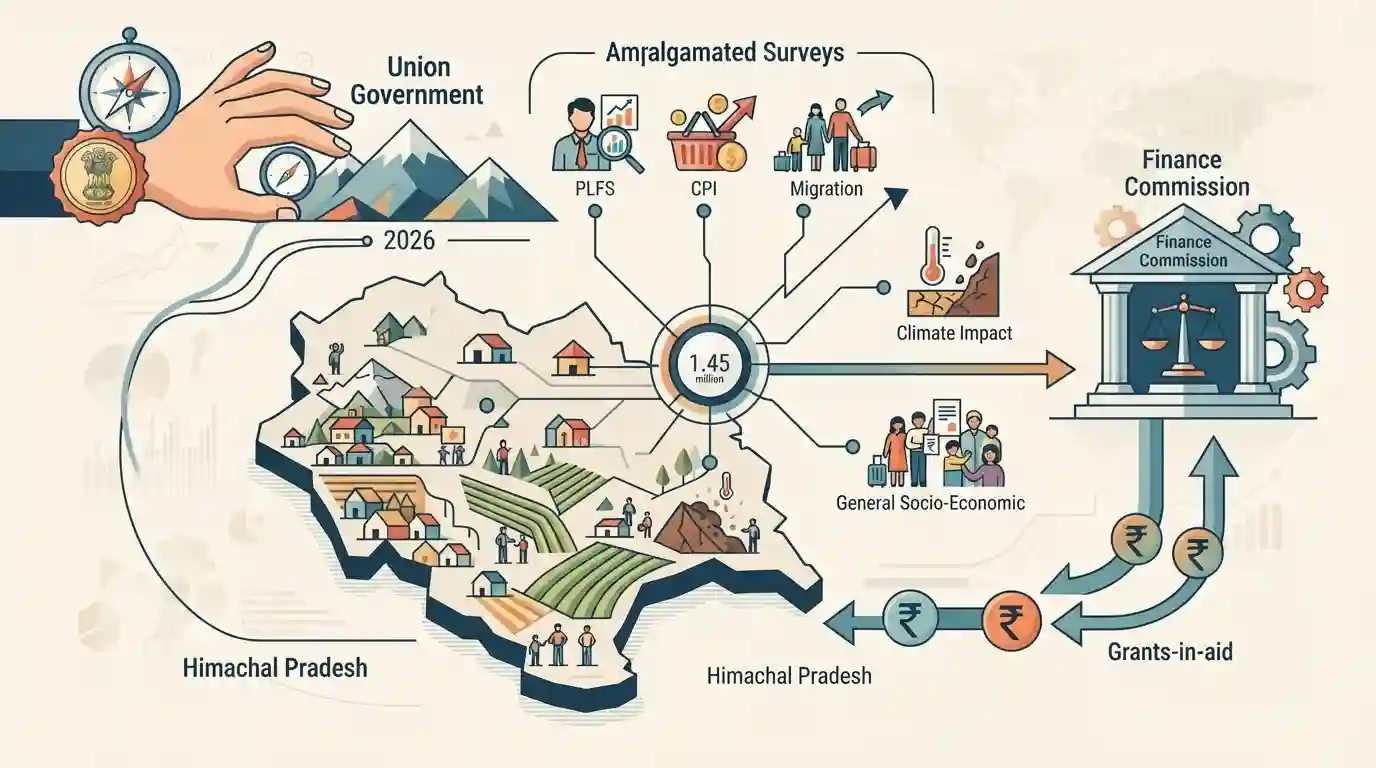
The Union Government, through the National Statistical Office (NSO) under the Ministry of Statistics and Programme Implementation (MoSPI), is set to conduct a comprehensive Economic Health Survey in Himachal Pradesh starting in 2026. This large-scale exercise will survey approximately 14.5 lakh households, amalgamating five distinct socio-economic assessments, including the PLFS, CPI, and Migration Surveys. The objective is to gauge the precise economic landscape of the hill state, which has been uniquely impacted by climate change, natural disasters, and structural out-migration. The findings are expected to serve as vital empirical inputs for the Finance Commission in devising tailored center-state fiscal support and grants-in-aid mechanisms.
Key Points
- The National Statistical Office (NSO) under MoSPI is launching an extensive economic health survey in Himachal Pradesh in 2026, covering 14.5 lakh households.
- The massive survey integrates five critical indices: the Periodic Labour Force Survey (PLFS), Debt and Investment Survey, Consumer Price Index (CPI), Migration Survey, and Agricultural Household Survey.
- The initiative aims to capture real-time, granular socio-economic data to assess the impact of climate-induced disasters and out-migration on the Himalayan state's economy.
- The empirical data collected will assist the State in targeted policy-making and provide a robust basis for the Union Finance Commission to determine specific grants-in-aid and fiscal interventions.
Important Terms
Finance Commission

A constitutional body established under Article 280, appointed every five years by the President to recommend the distribution of tax revenues between the Centre and states, and determine principles for grants-in-aid.
UPSC context
Crucial for GS Paper 2 (Polity/Federalism) and GS Paper 3 (Economy). Tests centre-state financial relations and fiscal federalism.
National Statistical Office (NSO)
The central statistical agency of India, functioning under MoSPI. Formed in 2019 by merging the CSO and NSSO, it conducts large-scale national surveys and releases key economic data like GDP, CPI, and employment metrics.
UPSC context
Highly relevant for GS Paper 3 (Economy). Tests knowledge of India's macroeconomic data collection, official indices, and apex statistical bodies.
Periodic Labour Force Survey (PLFS)
India's principal employment survey conducted by the NSO since 2017. It estimates key indicators like the Labour Force Participation Rate, Worker Population Ratio, and Unemployment Rate for both rural and urban areas.
UPSC context
Vital for GS Paper 3 (Economy & Employment). Prelims frequently test its issuing agency, methodology, and core labour metrics.
Consumer Price Index (CPI)
A macroeconomic indicator measuring changes over time in the retail prices of a fixed basket of goods and services consumed by households. The NSO compiles it monthly to gauge inflation and inform monetary policy.
UPSC context
Core GS Paper 3 concept (Economy/Inflation). Tests the difference between CPI and WPI, base years, and RBI's inflation-targeting mandate.
Ministry of Statistics and Programme Implementation (MoSPI)
A Union Government ministry that acts as the nodal agency for planning and facilitating the integrated development of the statistical system in India, overseeing the NSO, and monitoring major central infrastructure projects.
UPSC context
Important for GS Paper 2 and 3. Tests the structural administration of data governance, sustainable development goals (SDGs), and MPLADS.
Prelims Trap
"The HP Economic Health Survey is conducted by the State Directorate of Economics to demand grants."
It is conducted by the Union Government's NSO (MoSPI), not the state government, to provide empirical baseline data for the Finance Commission.
Static Concepts Connected
What is the constitutional basis for Centre-State grants-in-aid?
- Statutory Grants: Mandated by the Finance Commission under Article 275, these are charged on the Consolidated Fund of India for states in need of assistance.
- Discretionary Grants: Under Article 282, both the Union and States can make optional grants for any public purpose, irrespective of legislative competence.
What are the major socio-economic surveys conducted by the NSO?
- Periodic Labour Force Survey (PLFS): Tracks employment and unemployment indicators; yields annual rural-urban estimates and quarterly urban estimates using Current Weekly Status (CWS).
- Consumer Price Index (CPI): Measures retail inflation (Rural, Urban, Combined) by tracking the price changes of a basket of goods and services.
- All India Debt & Investment Survey: Assesses the assets, liabilities, and capital expenditure of households across the country to measure rural and urban indebtedness.
Cross-Topic Patterns
Climate vulnerability shaping fiscal federalism
The integration of climate-induced disaster impact into socio-economic data demonstrates how ecology now directly drives Finance Commission tax devolution and grants under Article 275.
Hill state out-migration and labor data
Combining Migration Surveys with the PLFS highlights the unique labor market distortions and demographic challenges in Himalayan states, connecting human geography to economic policy.

Expect a Prelims question merging NSO's data-gathering role (PLFS, CPI) with constitutional provisions for Finance Commission statutory grants.
Linked PYQs · 3
Linked PYQs · 3
- 2025HPAS_PRELIMSGS1
Which of the following is not a constituent body of National Statistics Office ?
- 2016HPAS_PRELIMSGS1
Provision for Grant-in-Aid under Article 243 H for the Panchayats has been made out of which source?
- 2025HPAS_PRELIMSGS1
Match the following inflation metrics with their values for FY 2024-25 (April-December) : | List-I | List-II | |---|---| | (a) CPI Inflation (%) | (i) 2.1 | | (b) Food Inflation (%) | (ii) 8.4 | | (c) Core Inflation (%) | (iii) 5.4 | | (d) WPI Inflation (%) | (iv) 3.5 | Choose the correct answer from the options given below : Code: (a) (b) (c) (d)
