Legislative assembly speaker reviews security ahead of monsoon session
Source:ani ↗
Why It Matters
This article underscores the procedural functioning of state legislatures (starred/unstarred questions, Speaker's administrative role) and frames current socio-geographic issues in Himachal Pradesh (monsoon vulnerability in Chamba, governance challenges) that are highly relevant to state-specific GS preparation.
Summary
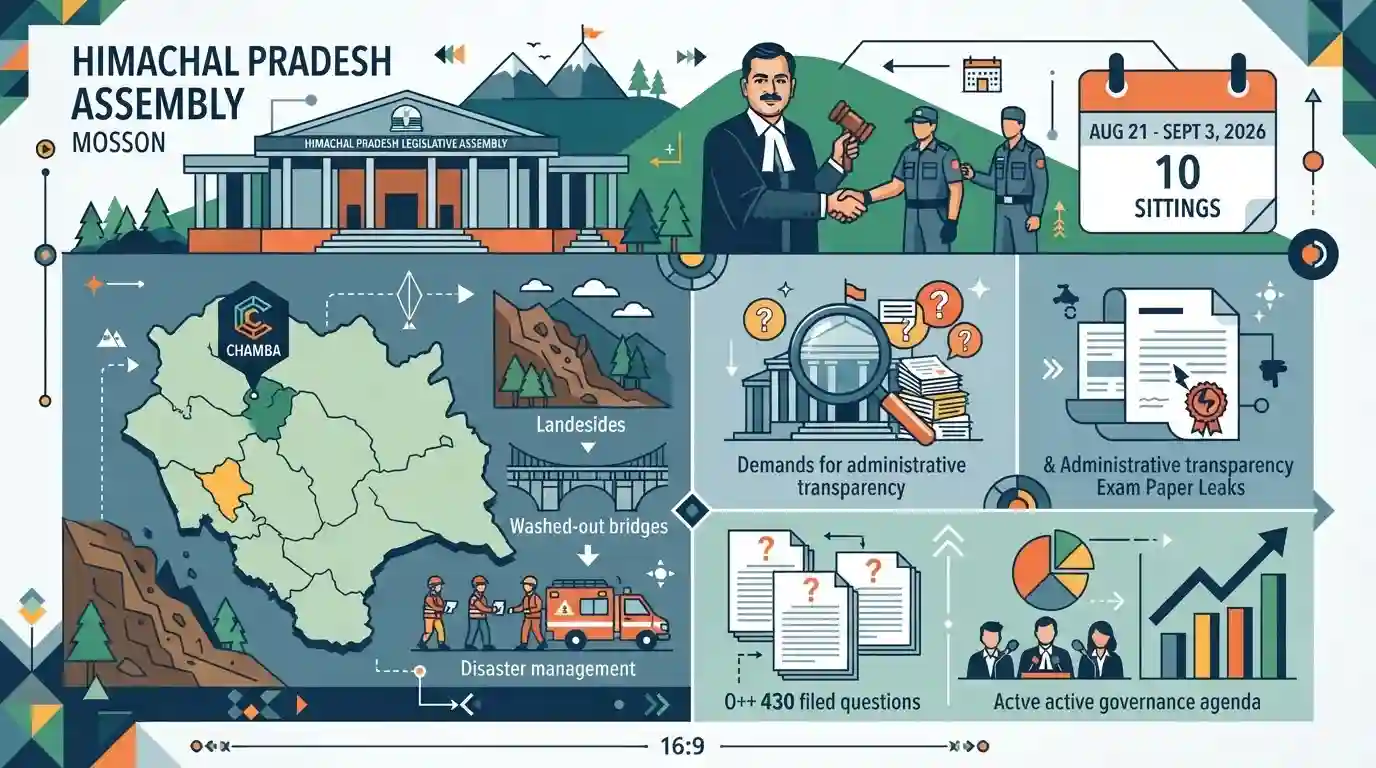
Himachal Pradesh Assembly Speaker Kuldeep Singh Pathania has finalized security and administrative arrangements for the upcoming Monsoon Session (Aug 21 - Sept 3, 2026). The 10-sitting session is expected to heavily deliberate on recent monsoon-induced devastation, particularly in the badly-hit Chamba district, as well as demands for administrative transparency following recent competitive exam paper leaks. Over 430 questions have already been filed by legislators, signaling an active governance agenda.
Key Points
- The Monsoon Session of the 14th Himachal Pradesh Legislative Assembly is scheduled from August 21 to September 3, 2026, comprising 10 proposed sittings.
- Speaker Kuldeep Singh Pathania has conducted extensive security reviews to ensure smooth legislative operations and controlled visitor access in Shimla.
- Over 430 legislative questions (343 starred and 91 unstarred) have been submitted, indicating a heavy roster of legislative business.
- The session is expected to focus heavily on severe monsoon-related damages, notably in Chamba district, alongside governance issues such as transparency in competitive exams following paper leak incidents.
Important Terms
Himachal Pradesh Legislative Assembly

The unicameral law-making body of Himachal Pradesh, comprising 68 directly elected MLAs. Its primary seat is in Shimla, with a secondary winter session campus at Tapovan in Dharamshala.
UPSC context
GS Paper 2 (State Legislature): Tests understanding of state-level legislative structures, unicameral systems, and regional governance dynamics.
Public Works Department
A primary government agency responsible for designing, constructing, and maintaining public infrastructure such as roads, bridges, and state buildings. It also plays a crucial role in disaster recovery operations.
UPSC context
GS Paper 2 & 3 (Governance & Infrastructure): Tests knowledge of state agencies managing public works, disaster recovery, and developmental planning.
Monsoon Session
One of the three conventional sittings of an Indian legislature, typically held from July to September. It serves as a vital democratic forum to enact legislation, debate policies, and question the executive.
UPSC context
GS Paper 2 (State Legislatures): Focuses on the legislative calendar, conduct of parliamentary business, and holding the executive accountable.
Chamba District
A high-altitude district in Himachal Pradesh, characterized by the Ravi River valley and Himalayan ranges. It is ecologically sensitive and highly vulnerable to monsoon-induced devastation and landslides.
UPSC context
GS Paper 1 & 3 (Geography & Disaster Management): Relevant for studying Himalayan river systems, regional geography, and mountainous disaster preparedness.
Disaster Management
The strategic organization of resources and responsibilities to mitigate, prepare for, and respond to emergencies. In Himachal Pradesh, it focuses heavily on addressing monsoon-induced devastation like flash floods.
UPSC context
GS Paper 3 (Disaster Management): Tests frameworks for hazard mitigation, crisis response, and the efficacy of state machinery in disaster-prone regions.
Administrative Transparency
The principle of conducting public sector operations openly to ensure accountability and combat corruption, such as competitive exam paper leaks. It ensures citizens can oversee and trust governance processes.
UPSC context
GS Paper 2 & 4 (Governance & Ethics): Assesses foundational principles of public administration, anti-corruption mechanisms, and institutional integrity.
Prelims Trap
Unstarred questions in the assembly allow for supplementary questions by members.
Unstarred questions require a written reply from the minister, and therefore supplementary questions cannot follow. Only starred questions permit oral answers and subsequent supplementaries.
Static Concepts Connected
What are the types of questions asked during Question Hour?
- Starred Questions: Require an oral answer from the Minister. Because the answer is oral, members are permitted to ask supplementary questions.
- Unstarred Questions: Require a written answer from the Minister. Since the reply is documented and not oral, no supplementary questions can be asked.
- Short Notice Questions: Relate to matters of urgent public importance and are asked with a notice of less than 10 days. They are answered orally.
Why are Himalayan states highly prone to landslides and flash floods?
- Geological vulnerability: The Himalayas are young fold mountains, meaning their slopes are tectonically active, structurally weak, and geologically unstable.
- Anthropogenic factors: Unplanned infrastructure development, such as road widening and hydropower dams, deeply destabilizes fragile mountain slopes.
- Extreme weather: High frequency of localized extreme weather events like cloudbursts during the monsoon triggers massive debris flows.
Cross-Topic Patterns
Legislative oversight on disaster response
State assemblies increasingly dedicate time to climate-induced disasters. UPSC often links legislative accountability mechanisms (like Question Hour) directly with executive action on localized disaster management.
Paper leaks and the new Central Act
State-level paper leaks in HP and elsewhere provide the exact backdrop for the Public Examination (Prevention of Unfair Means) Act, 2024, highlighting federal challenges in governance and educational integrity.

Question Hour mechanics combined with the recent Public Examination Act 2024 make a strong case for a mixed Polity/Governance Prelims MCQ.
Linked PYQs · 4
Linked PYQs · 4
- 2023HPAS_PRELIMSGS1
Under which Article of the Constitution a Speaker allows any member to speak in Parliament in his/her mother language ?
- 2024HPAS_PRELIMSGS1
Consider the following statements : (1) Monkey valley lies in Chamba. (2) Kiarda Dun valley lies in Kangra. (3) The Great Himalayas are referred as Alpine zone in Himachal Pradesh. (4) Churadhar pertain to Zanskar range in Himachal Pradesh Choose the correct answer from the options given below :
- 2023HPAS_PRELIMSGS1
Consider the following statements : (1) The rainiest district in Himachal Pradesh is Kangra. (2) Rainfall in the Alpine region of Himachal Pradesh varies between 300-600 mm. (3) Winter season in Himachal Pradesh extends from October to March. (4) Mandi is the hottest place in Himachal Pradesh. Choose the correct answer from the options given below :
- 2024HPAS_PRELIMSGS1
Arrange the following climatic zones of Himachal Pradesh according to rainfall amount from lowest to highest : (1) Frigid aridic zone (2) Wet temperate zone (3) Humid sub-tropical zone (4) Sub-humid sub-tropical zone Choose the correct answer from the options given below :
