WTO ministerial conference and North-South trade policy divides
Source:Indian Express ↗
Why It Matters
Understanding WTO dynamics is crucial for UPSC aspirants, as it directly impacts India's policy space for agricultural subsidies, food security, and digital industrialization. Questions frequently test India's stand at Ministerial Conferences and the structural reforms needed in the WTO.
Summary
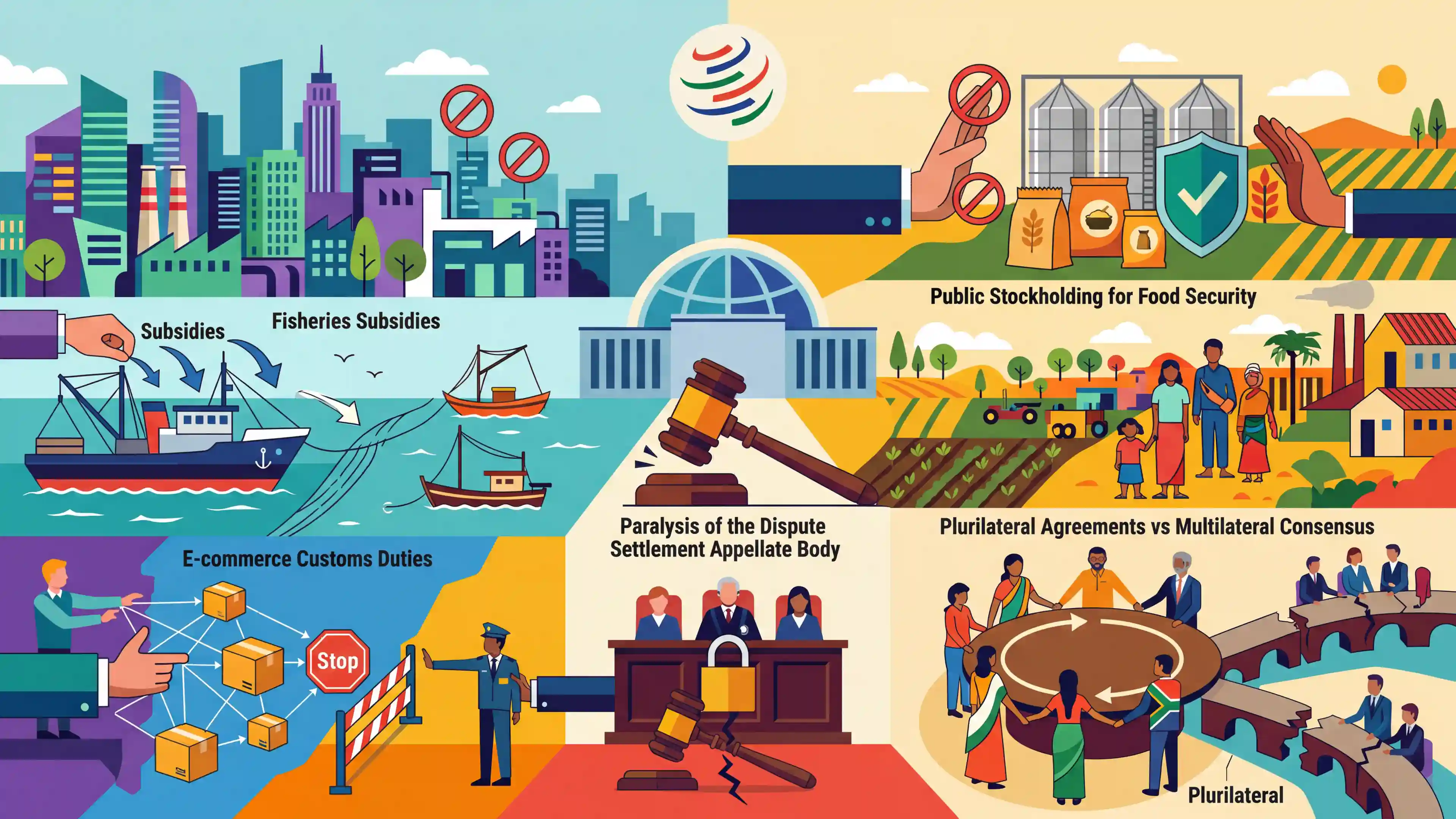
The WTO Ministerial Conference exposes fundamental disagreements between developed and developing nations over the core tenets of global trade. Key flashpoints include the ongoing demand by the Global South for a permanent solution on Public Stockholding for food security, resistance to restrictive fisheries subsidies that harm artisanal fishers, and opposition to the continued moratorium on e-commerce customs duties. Furthermore, developing countries like India and South Africa strongly oppose the Global North's push to legitimize plurilateral agreements, such as the Investment Facilitation for Development (IFD), viewing them as an erosion of the WTO's consensus-based multilateral mandate. Coupled with the continued paralysis of the Dispute Settlement Appellate Body, these divides underscore the challenges in reforming the WTO to reflect equitable development needs.
Key Points
- The WTO Ministerial Conference highlighted a persistent structural divide between the Global North and Global South regarding the future direction of international trade rules.
- Developing nations like India strongly advocate for a permanent solution to Public Stockholding (PSH) for food security, resisting pressure from developed nations that label it trade-distorting under the Agreement on Agriculture.
- Friction exists over the e-commerce moratorium on customs duties; developing countries want to end it to prevent tariff revenue loss, while developed nations push for its extension.
- Developed countries increasingly seek to incorporate plurilateral agreements (like Investment Facilitation for Development) into the WTO framework, which India opposes to protect consensus-based multilateralism.
- The paralysis of the WTO Dispute Settlement Appellate Body (due to the US blocking judge appointments) continues to undermine the organization's efficacy and enforcement mechanism.
Important Terms
Agreement on Agriculture (AoA)

A 1995 WTO treaty aimed at reforming agricultural trade by reducing trade-distorting subsidies and tariffs through three pillars: market access, domestic support, and export competition.
UPSC context
GS Paper III: Agriculture subsidies and MSP; tests understanding of trade-distorting support (Amber Box) versus food security needs.
Investment Facilitation for Development (IFD)
A WTO-led plurilateral agreement designed to streamline investment procedures and improve transparency; India opposes it, citing the lack of a multilateral mandate for non-trade issues.
UPSC context
GS Paper II/III: International institutions and investment models; tests knowledge of plurilateral vs. multilateral agreements.
Peace Clause
An interim mechanism from the 2013 Bali Ministerial shielding developing nations from legal challenges if they breach WTO subsidy limits for public food stockholding programs.
UPSC context
GS Paper III: Food security and PDS; critical for understanding India's legal defense of its rice subsidies at WTO.
Special and Differential Treatment (S&DT)
WTO provisions granting developing nations and LDCs extra flexibilities, such as longer implementation periods and preferential market access, to meet global trade obligations.
UPSC context
GS Paper II: Important international institutions; tests understanding of equity and developmental status (self-declaration) in global trade.
World Trade Organization (WTO)
The global intergovernmental organization (est. 1995) that regulates international trade through consensus-based agreements; its highest decision-making body is the Ministerial Conference.
UPSC context
GS Paper II: International relations; core institution for syllabus topics on global trade and multilateralism.
Global South
A term representing developing and least-developed nations, primarily in the Southern Hemisphere, that advocate for more equitable global economic and political systems.
UPSC context
GS Paper II: International relations; tests India's role as a leader of developing nations in global fora.
Prelims Trap
The WTO Peace Clause provides a permanent exemption for India's Minimum Support Price (MSP) operations from subsidy limits.
The Peace Clause is an interim mechanism shielding developing nations from legal disputes over agricultural subsidies. A permanent solution is still being negotiated.
Static Concepts Connected
How does the WTO Agreement on Agriculture categorize subsidies?
- Green Box: Subsidies causing minimal or no trade distortion (e.g., research, environmental programs). Allowed without limits.
- Amber Box: Trade-distorting subsidies like MSP and fertilizer support. Capped at a de minimis limit of 10% of agricultural production value for developing nations.
- Blue Box: Amber box subsidies tied to programs that limit agricultural production. Currently exempt from reduction commitments.
What distinguishes plurilateral from multilateral agreements at the WTO?
- Multilateral agreements: Rules binding on all WTO members (like GATT or TRIPS), negotiated and adopted by consensus.
- Plurilateral agreements: Agreements binding only on signatory members (e.g., Investment Facilitation for Development). Integrating them into the official WTO rulebook still requires consensus from all members.
Cross-Topic Patterns
WTO PSH vs. National Food Security Act
India's firm WTO stance on Public Stockholding is driven by its domestic statutory obligations under the NFSA, requiring open-ended MSP procurement to sustain the massive Public Distribution System.
E-commerce Moratorium & Digital Sovereignty
The Global South's push to end the e-commerce customs moratorium mirrors broader geopolitical battles over data localization and the protection of nascent domestic digital economies.

Expect a multi-statement Prelims question mixing the WTO Peace Clause, Amber Box limits, and the paralysis of the Dispute Settlement Body.
Linked PYQs · 5
Linked PYQs · 5
- 2016MainsGS2
The broader aims and objectives of WTO are to manage and promote international trade in the era of globalization. But the Doha round of negotiations seem doomed due to differences between the developed and the developing countries." Discuss in the Indian perspective.
- 2014MainsGS2
WTO is an important international institution where decisions taken affect countries in a profound manner. What is the mandate of WTO and how binding are their decisions ? Critically analyse India's stand on the latest round of talks on Food security.
- 2018MainsGS2
What are the key areas of reform if the WTO has to survive in the present context of "Trade War', especially keeping in mind the interest of India?
- 2023MainsGS3
What are the direct and indirect subsidies provided to farm sector in India? Discuss the issues raised by the World Trade Organization (WTO) in relation to agricultural subsidies.
- 2010PrelimsGS1
As regards the use of international food safety standards as reference point for the dispute settlements, which one of the following does WTO collaborate with?
