Feminization of Agriculture and Land Rights Challenges for Women
Source:Indian Express ↗
Why It Matters
The intersection of gender and agriculture is a critical socio-economic issue in India. The feminization of agriculture is a recurring UPSC theme (asked in Mains 2014), emphasizing the structural challenges women face, such as lack of land rights and credit access. Understanding these demographic shifts is vital for questions relating to rural development, society, and agricultural reforms.
Summary
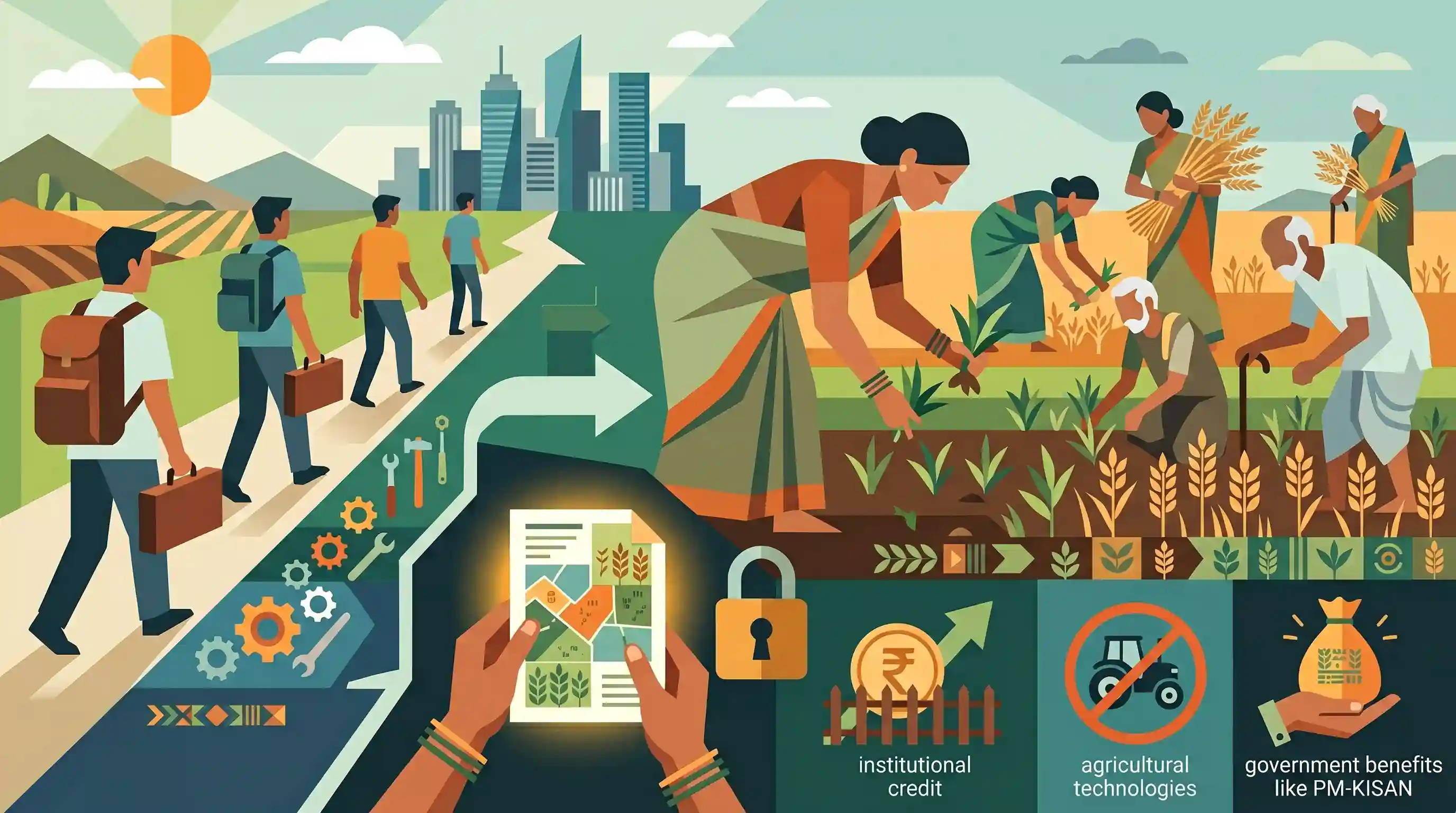
The article explores the dual phenomena of the 'greying' and 'feminization' of India's agriculture. With younger, male demographics migrating to urban centers for non-farm employment, women and the elderly are increasingly taking over the agricultural sector. Despite being the backbone of the rural economy, women farmers suffer from a lack of land ownership, which systematically excludes them from being recognized as formal 'farmers.' This landlessness prevents them from accessing institutional credit, agricultural technologies, and government benefits like PM-KISAN. The piece highlights the urgent need to address these structural inequities through policy reforms, land tenure security, and women-centric schemes to ensure food security and empower female agricultural workers.
Key Points
- Greying of Agriculture: The agricultural sector in India is experiencing a demographic shift with the average age of farmers increasing, driven by the rural-to-urban out-migration of younger populations seeking non-farm employment.
- Feminization of Agriculture: As men migrate for better economic opportunities, women are increasingly left to anchor the rural economy, transitioning into primary roles in farming and agricultural management.
- Systemic Inequities: Despite performing the bulk of agricultural work, women lack land titles, leading to their formal non-recognition as farmers. This deprives them of institutional credit, technology, crop insurance, and extension services.
- Policy Blindspots: Major agricultural welfare schemes, such as PM-KISAN, distribute benefits based on land ownership, inadvertently excluding the vast majority of women agricultural workers from direct financial support.
- Empowerment Initiatives: Bridging the gender gap in agriculture requires targeted interventions like the Mahila Kisan Sashaktikaran Pariyojana (MKSP), expanding land rights, and leveraging Self Help Groups (SHGs) for resource pooling and capacity building.
Important Terms
Feminization of Agriculture

The rising participation of women in agricultural activities and farm management, primarily driven by male out-migration to urban areas for non-farm employment.
UPSC context
GS Paper 1 (Role of Women) and GS Paper 3 (Agriculture); tests understanding of rural demographic shifts and gendered labor.
Mahila Kisan Sashaktikaran Pariyojana (MKSP)
A sub-component of DAY-NRLM designed to empower women farmers through systematic investments that enhance their participation, productivity, and control over production resources.
UPSC context
GS Paper 2 (Welfare Schemes) and GS Paper 3 (Agriculture); tests knowledge of gender-specific agricultural interventions.
PM-KISAN (Pradhan Mantri Kisan Samman Nidhi)
A Central Sector Scheme providing direct income support of ₹6,000 annually to land-holding farmer families to supplement agricultural input costs and domestic needs.
UPSC context
GS Paper 3 (Farm Subsidies/Income Support); tests awareness of schemes and land ownership barriers for women.
Deendayal Antyodaya Yojana-National Rural Livelihoods Mission (DAY-NRLM)
A flagship poverty alleviation program that organizes rural poor households into self-managed Self Help Groups to improve livelihoods through financial inclusion and skill development.
UPSC context
GS Paper 2 (Poverty/Governance) and GS Paper 3 (Inclusive Growth); focuses on community-led rural transformation.
Self Help Groups (SHGs)
Small, voluntary associations of individuals (mostly women) who pool resources to achieve common financial goals, providing collateral-free credit and social empowerment at the grassroots.
UPSC context
GS Paper 2 (Social Justice) and GS Paper 3 (Credit/Agriculture); tests understanding of grassroots mobilization.
Greying of Agriculture
The demographic trend where the average age of the farming population increases as younger individuals migrate away, leaving agricultural management to the elderly.
UPSC context
GS Paper 1 (Demography) and GS Paper 3 (Agriculture); tests impact of migration on rural productivity and labor.
Prelims Trap
"PM-KISAN provides direct income support to all active agricultural workers, including landless women and tenant farmers."
PM-KISAN strictly mandates ownership of cultivable land. Landless agricultural laborers, tenant farmers, and most women cultivators are structurally excluded from its direct income support.
Static Concepts Connected
What drives the 'Feminization of Agriculture' in India?
- Male out-migration: Men increasingly migrate to urban centers for non-farm employment, leaving women to manage rural households and farms.
- Patriarchal land tenure: Historically, women lack land titles, leading to their statistical classification as 'agricultural laborers' rather than 'farmers' or decision-makers.
- Mechanization bias: Women are often pushed into labor-intensive, low-paying tasks (weeding, sowing) while heavy mechanization displaces them from traditional roles.
What are the core features and eligibility exclusions of PM-KISAN?
- Direct Benefit Transfer: Provides Rs 6,000 per year in three equal installments directly to the bank accounts of eligible farmer families.
- Land ownership mandate: Beneficiaries must own cultivable land as per land records; tenant farmers and landless laborers are excluded.
- Key exclusions: Institutional landholders, income taxpayers, professionals (doctors/engineers), and active/retired high-level government employees are ineligible.
Cross-Topic Patterns
SHGs bridging the agrarian credit gap
With landless women denied formal bank credit, SHG bank linkage under DAY-NRLM acts as a critical substitute for financing agricultural inputs and bypassing land-collateral requirements.
Urban-pull creating rural 'greying'
The demographic shift creates a dual economy: a younger, male-dominated urban informal sector, and an aging, female-led agricultural base, impacting India's overall demographic dividend.

Expect a multi-statement Prelims 2026 question linking the legal definition of 'farmer', PM-KISAN land-ownership clauses, and MKSP.
Linked PYQs · 2
Linked PYQs · 2
- 2014MainsGS1
Discuss the various economic and socio-cultural forces that are driving increasing feminization of agriculture in India.
- 2020MainsGS2
Micro-Finance as an anti-poverty vaccine, is aimed at asset creation and income security of the rural poor in India". Evaluate the role of the Self Help Groups in achieving the twin objectives along with empowering women in rural India.
