Potential Macroeconomic Impact of Proposed US Tariffs on India
Source:The Hindu ↗
Why It Matters
The US is one of India's largest trading partners. Shifts in US trade policy directly impact India's export economy, forex reserves, currency stability, and broader macroeconomic indicators, which are core themes in GS3 Economy and GS2 International Relations.
Summary
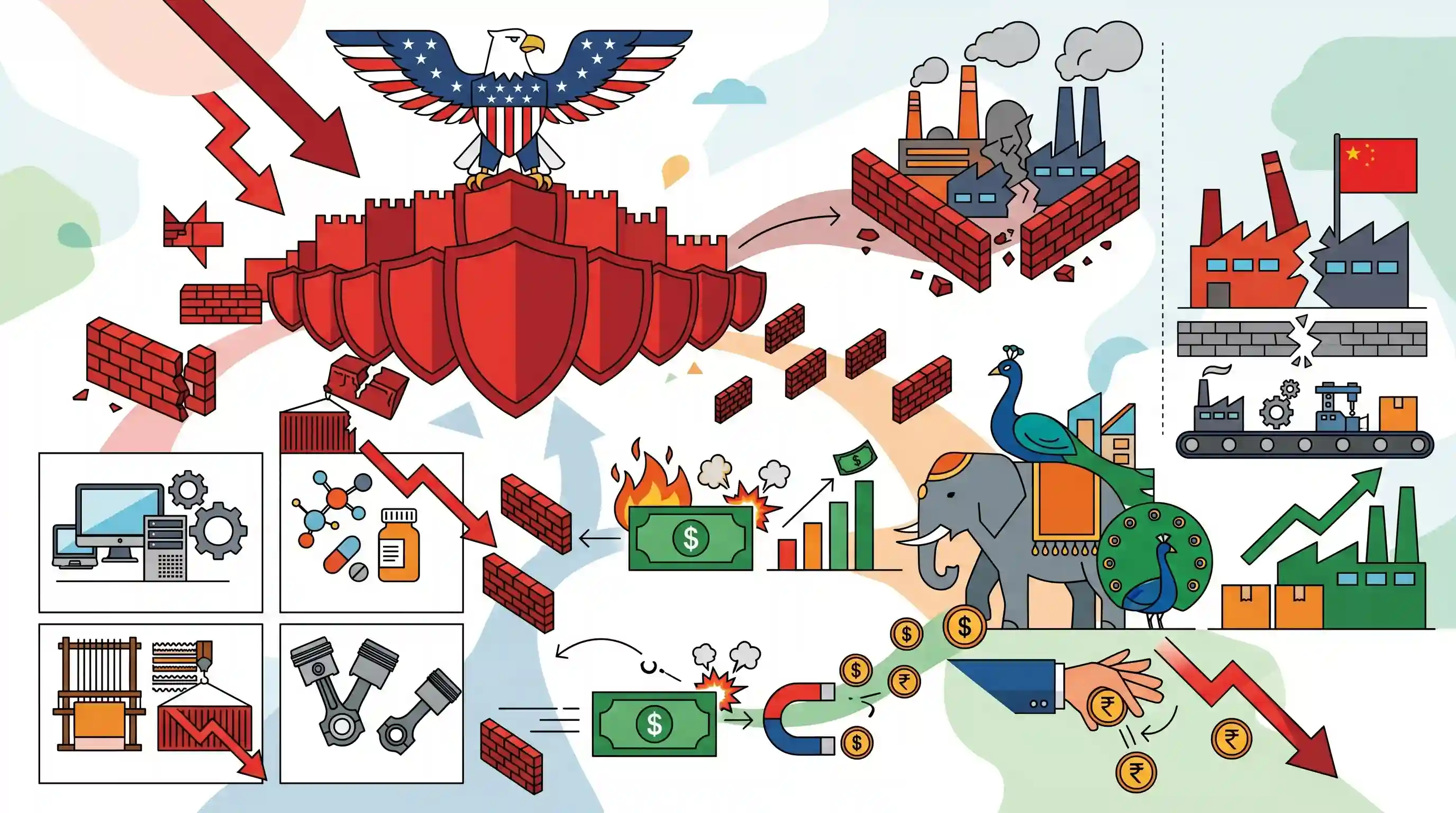
The article analyzes the potential economic impact of proposed US tariffs under a new Donald Trump administration on India. Trump's proposed universal 10-20% baseline tariff and a 60% tariff on Chinese goods signify a sharp pivot toward protectionism. For India, this could dampen exports in crucial, US-reliant sectors such as IT, pharmaceuticals, textiles, and auto components. Furthermore, tariff-induced inflation in the US might keep US interest rates elevated, potentially triggering capital outflows from India and depreciating the Rupee. On the flip side, heightened tariffs on China might accelerate the "China-plus-one" supply chain shift, offering India some manufacturing opportunities, though global protectionism remains a net macroeconomic challenge.
Key Points
- Proposed 10-20% universal US baseline tariffs and 60% tariffs on Chinese goods reflect a global shift away from multilateral free trade toward bilateralism and protectionism.
- Indian export sectors such as IT services, pharmaceuticals, auto components, and textiles face direct risks of reduced competitiveness and lower demand in the US market.
- Tariff-induced inflationary pressures in the US could keep Federal Reserve interest rates high, risking capital flight from emerging markets like India.
- Resulting capital outflows would likely cause Rupee depreciation, importing inflation into India and forcing the RBI to intervene in forex markets to ensure macroeconomic stability.
- As a potential silver lining, severe US tariffs on Chinese imports might accelerate the global "China-plus-one" strategy, presenting India with opportunities to capture shifting manufacturing supply chains.
Important Terms
China-plus-one strategy

A business strategy to reduce supply chain over-dependence on China by diversifying manufacturing into other countries, such as India or Vietnam, to mitigate geopolitical and operational risks.
UPSC context
GS Paper 3 (Economy): Relevant for manufacturing, supply chain resilience, and India's 'Make in India' initiative.
World Trade Organization (WTO)
The only global international organization dealing with trade rules between nations, aiming to ensure trade flows as smoothly, predictably, and freely as possible through negotiated agreements.
UPSC context
GS Paper 2 (IR): Vital for understanding multilateral trade governance and challenges like rising protectionism.
Free Trade Agreements (FTAs)
Formal treaties between two or more countries to reduce or eliminate trade barriers like tariffs and quotas on goods and services, facilitating easier cross-border commerce.
UPSC context
GS Paper 3 (Economy): Key for trade policy, export competitiveness, and regional economic integration.
US Federal Reserve
The central banking system of the United States, responsible for managing monetary policy; its interest rate decisions significantly influence global liquidity and capital flows.
UPSC context
GS Paper 3 (Economy): Tests understanding of global economic spillovers on India's capital markets and inflation.
Reserve Bank of India (RBI)
India's central bank that regulates monetary policy, manages foreign exchange reserves, and intervenes in forex markets to maintain the Rupee's stability and control inflation.
UPSC context
GS Paper 3 (Economy): Core to monetary stability, exchange rate management, and external sector resilience.
Prelims Trap
"Tariff-induced Fed rate hikes will increase foreign portfolio investments (FPI) into India due to its emerging market status."
Higher US interest rates actually trigger massive FPI outflows from emerging markets to safe US treasuries, leading to currency depreciation, not inflows.
Static Concepts Connected
How do US Federal Reserve rate hikes impact the Indian economy?
- Capital Flight: Higher US yields pull Foreign Portfolio Investment (FPI) out of emerging markets like India as investors seek safer, high-return assets.
- Rupee Depreciation: The sudden selling of Indian assets for US dollars spikes dollar demand, causing the Indian Rupee to depreciate against the greenback.
- Imported Inflation: A weaker rupee makes imports (like crude oil) more expensive, transmitting global inflationary pressures directly into India's domestic economy.
- RBI Intervention: The RBI sells dollars from its forex reserves to absorb excess rupee liquidity and stabilize the exchange rate.
What is the difference between unilateral tariffs and WTO trade remedies?
- WTO Trade Remedies: Measures like Anti-Dumping or Countervailing Duties are legal under WTO to counter proven unfair trade practices (like export subsidies).
- Unilateral Tariffs: Blanket tariffs imposed without dispute settlement mechanisms violate the WTO's core Most-Favored-Nation (MFN) principle and spark retaliatory trade wars.
Cross-Topic Patterns
China-Plus-One + PLI Schemes
The US tariff wall against China directly aligns with India's Production Linked Incentive (PLI) schemes, which are explicitly designed to absorb the migrating electronics and pharmaceutical supply chains under "China-Plus-One".
Currency Dynamics + Imported Inflation
Rupee depreciation resulting from FPI capital flight makes crucial imports like crude oil costlier. This widens the Current Account Deficit (CAD) and forces imported inflation into the domestic economy.

Expect a multi-statement Prelims question linking US Fed rate hikes, FPI outflows, Rupee depreciation, and RBI's sterilization actions.
Linked PYQs · 5
Linked PYQs · 5
- 2018MainsGS3
How would the recent phenomena of protectionism and currency manipulations in world trade affect macroeconomic stability of India?
- 2025MainsGS3
What are the challenges before the Indian economy when the world is moving away from free trade and multilateralism to protectionism and bilateralism? How can these challenges be met?
- 2012MainsGS2
Discuss the likely negative impact of the protectionist measures proposed by the US on India's software industry.
- 2021PrelimsGS1
Consider the following statements : The effect of devaluation of a currency is that it necessarily 1. improves the competitiveness of the domestic exports in the foreign markets 2. increases the foreign value of domestic currency 3. improves the trade balance Which of the above statements is/are correct?
- 2022PrelimsGS1
With reference to the Indian economy, consider the following statements: 1. If the inflation is too high, Reserve Bank of India (RBI) is likely to buy government securities. 2. If the rupee is rapidly depreciating, RBI is likely to sell dollars in the market. 3. If interest rates in the USA or European Union were to fall, that is likely to induce RBI to buy dollars. Which of the statements given above are correct?
