India updated nationally determined contributions and climate targets
Source:The Hindu ↗
Why It Matters
NDCs are the foundation of global climate action under the Paris Agreement. India's evolving commitments directly impact national energy policy, economic planning, and its diplomatic stance in global climate negotiations, making it a critical recurring theme in UPSC GS3.
Summary
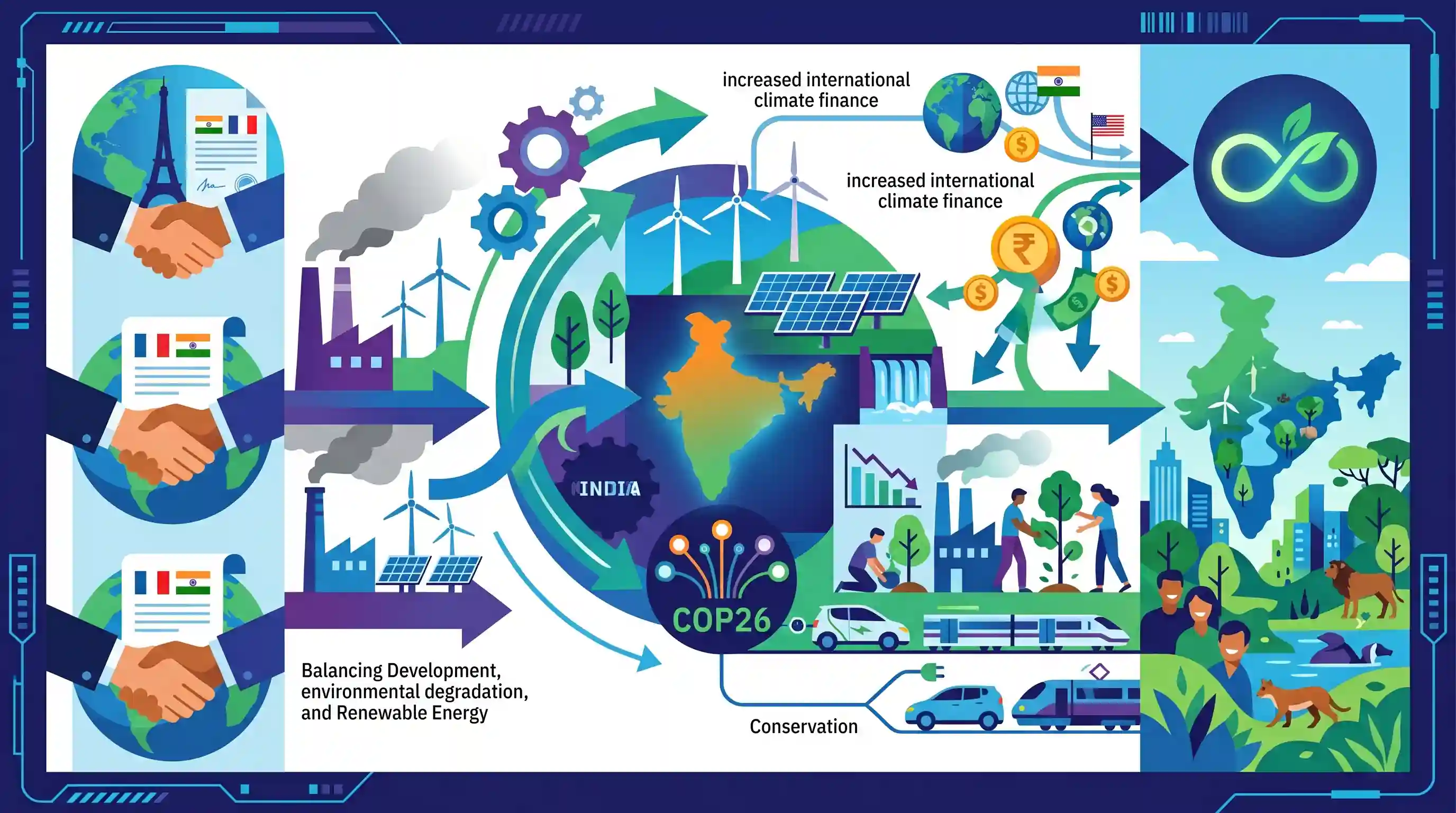
The article analyzes India's recently updated Nationally Determined Contribution (NDC) under the Paris Agreement, highlighting how the new targets will accelerate domestic climate action. It examines the progression of India's commitments from the original 2015 pledges to the 'Panchamrit' goals announced at COP26, and details the implications of the new targets for India's renewable energy transition, emission intensity reduction, and path to achieving net-zero emissions by 2070. The new NDC reflects India's efforts to balance economic development with global climate goals and underscores the need for increased international climate finance.
Key Points
- India's new Nationally Determined Contribution (NDC) builds upon previous targets to outline climate action goals for the 2035 timeframe under the Paris Agreement framework.
- The updated targets aim to further reduce the emission intensity of India's GDP and increase the share of non-fossil fuel-based energy resources in its installed capacity.
- Meeting these ambitious targets will require significant expansion of renewable energy infrastructure and mobilization of international climate finance and technology transfer.
- The new commitments are aligned with India's long-term strategy to achieve net-zero emissions by 2070 while ensuring sustainable economic development and energy security.
Important Terms
Paris Agreement

A 2015 legally binding international treaty under the UNFCCC aiming to limit global temperature rise to well below 2°C (preferably 1.5°C) above pre-industrial levels.
UPSC context
GS Paper III (Environment). Tests global governance, mitigation targets, and the shift from top-down to bottom-up climate frameworks.
Nationally Determined Contributions (NDCs)
Five-yearly self-defined climate action plans submitted by countries under the Paris Agreement, detailing domestic targets for emission reductions and climate adaptation.
UPSC context
GS Paper III (Environment). Essential for analyzing India’s specific climate goals and its commitment to international environmental protocols.
Panchamrit
A five-point climate pledge announced by India at COP26 (2021), including a 2070 net-zero target and enhanced 2030 renewable energy goals.
UPSC context
GS Paper III (Environment). Key for examining India’s domestic climate strategy and leadership role among developing nations.
Net-Zero Emissions
A state where greenhouse gas emissions are entirely balanced by carbon removals (like forests or capture technology), resulting in no net addition to the atmosphere.
UPSC context
GS Paper III (Environment/Energy). Tests understanding of India’s 2070 roadmap and the economic transition toward deep decarbonization.
Emission Intensity
The volume of greenhouse gas emissions generated per unit of Gross Domestic Product (GDP), measuring the carbon efficiency of a nation's economic growth.
UPSC context
GS Paper III (Environment/Economy). Crucial for discussing green growth and decoupling economic development from environmental degradation.
UNFCCC
The 1992 foundational framework treaty for global climate action, providing the legal basis and principles for subsequent agreements like the Paris Accord.
UPSC context
GS Paper III (Environment). Foundational for understanding the history of climate diplomacy and the annual Conference of Parties (COP).
Prelims Trap
"India's updated NDC aims to reduce its absolute carbon emissions by 47% and achieve 60% non-fossil fuel electricity generation by 2035."
India targets emission INTENSITY of GDP, allowing absolute emissions to grow as the economy expands. Also, the 60% target applies to installed CAPACITY, not actual electricity generation.
Static Concepts Connected
How does the Paris Agreement mechanism for NDCs operate?
- Binding vs Voluntary: The Paris Agreement itself is a legally binding international treaty, but the specific NDC targets submitted by nations are voluntary and self-determined.
- Ratchet Mechanism: Countries must submit updated, progressively more ambitious NDCs every five years to keep the 1.5°C goal alive.
- Global Stocktake: A process that assesses collective global progress towards Paris Agreement goals every five years to inform the next round of NDCs.
What is the difference between Emission Intensity and Absolute Emissions?
- Absolute emissions: The total volume of greenhouse gases released into the atmosphere by a country over a specific period.
- Emission intensity: The volume of emissions per unit of economic output (GDP). It implies emissions can still grow, but at a slower, more efficient rate than the economy.
Cross-Topic Patterns
NDCs, Climate Finance and CBDR-RC
India's ambitious NDCs heavily invoke the UN principle of Common But Differentiated Responsibilities (CBDR-RC), legally anchoring its climate targets to the promised delivery of low-cost international climate finance by developed nations.
Carbon Sinks vs Land Use Constraints
The 3.5-4.0 billion tonnes carbon sink target intersects with recent amendments to the Forest Conservation Act and the compensatory afforestation fund (CAMPA), creating a recurrent mains theme of ecology vs. development.

Expect a multi-statement Prelims question testing the exact numbers and baselines of the 2035 NDCs (intensity vs absolute emissions).
Linked PYQs · 5
Linked PYQs · 5
- 2025MainsGS3
Write a review on India's climate commitments under the Paris Agreement (2015) and mention how these have been further strengthened in COP26 (2021). In this direction, how has the first Nationally Determined Contribution intended by India been updated in 2022?
- 2021MainsGS3
Describe the major outcomes of the 26th session of the Conference of the Parties (COP) to the United Nations Framework Convention on Climate Change (UNFCCC). What are the commitments made by India in this conference?
- 2016PrelimsGS1
The term 'Intended Nationally Determined Contributions' is sometimes seen in the news in the context of
- 2025PrelimsGS1
Consider the following statements : Statement I: Article 6 of the Paris Agreement on climate change is frequently discussed in global discussions on sustainable development and climate change. Statement II: Article 6 of the Paris Agreement on climate change sets out the principles of carbon markets. Statement III : Article 6 of the Paris Agreement on climate change intends to promote inter-country non-market strategies to reach their climate targets. Which one of the following is correct in respect of the above statements?
- 2022PrelimsGS1
"Climate Action Tracker" which monitors the emission reduction pledges of different countries is a :
