India updated Nationally Determined Contribution for climate goals
Source:The Hindu ↗
Why It Matters
India's climate commitments and NDCs are central to its environmental policy and global diplomatic posture. Questions directly addressing the evaluation of India's progress under the Paris Agreement and renewable energy targets frequently appear in GS3 and Prelims.
Summary
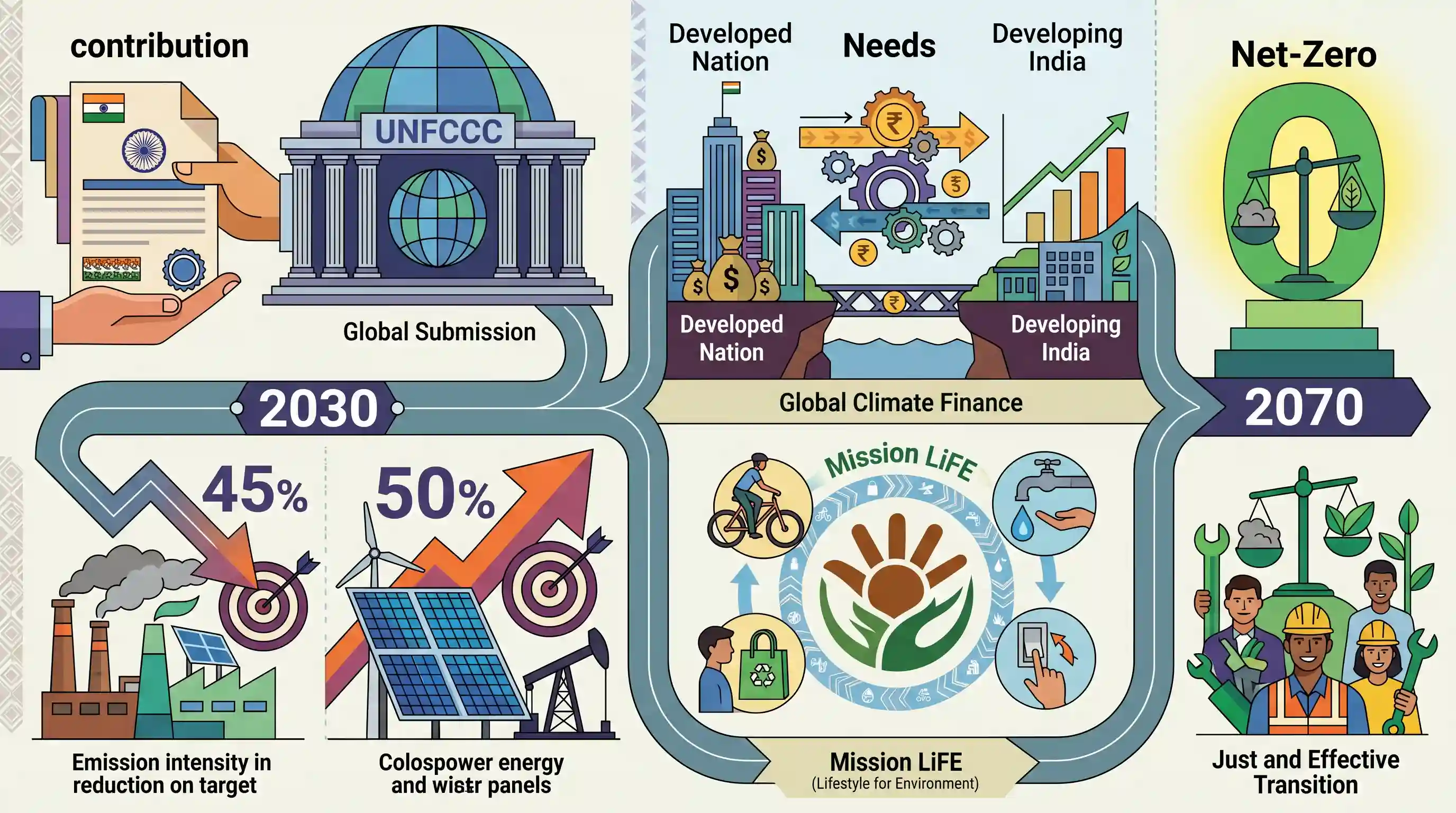
The article examines India's newly updated Nationally Determined Contribution (NDC) submitted to the UNFCCC, analyzing its potential to accelerate domestic climate action. It highlights the elevated targets for reducing emission intensity and expanding non-fossil fuel energy capacity by 2030, which are stepping stones toward the net-zero by 2070 goal. The piece also underscores the critical need for global climate finance and the promotion of sustainable consumption patterns (LiFE) to ensure a just and effective energy transition.
Key Points
- India's updated Nationally Determined Contribution (NDC) under the Paris Agreement aims to significantly accelerate the country's climate action and energy transition.
- The updated targets include a deeper reduction in the emissions intensity of India's GDP and a higher proportion of cumulative electric power installed capacity from non-fossil fuel-based energy resources by 2030.
- These goals build upon the 'Panchamrit' commitments, charting a definitive pathway towards achieving net-zero emissions by 2070.
- A major component of India's strategy involves the mass adoption of sustainable practices through the 'LiFE' (Lifestyle for Environment) movement.
- The fulfillment of these ambitious targets relies heavily on the availability of adequate climate finance and low-cost technology transfer from developed nations, aligning with the principle of Common but Differentiated Responsibilities (CBDR).
Important Terms
Nationally Determined Contribution (NDC)

Climate action plans submitted by countries under the Paris Agreement, outlining their individual targets for emission reductions and adaptation to climate change.
UPSC context
GS Paper 3 (Environment); central to global climate governance and India's 2030 climate pledges.
Paris Agreement
A legally binding international treaty adopted at COP21 (2015) aiming to limit global warming to well below 2°C, preferably 1.5°C, through bottom-up national commitments.
UPSC context
GS Paper 2 & 3; provides the legal and operational framework for modern international climate cooperation.
Panchamrit
A five-point climate action strategy announced by India at COP26, including targets for non-fossil energy, emission reductions, and a 2070 net-zero goal.
UPSC context
GS Paper 3 (Environment); the cornerstone of India's current domestic and international climate policy trajectory.
Lifestyle for Environment (LiFE)
An India-led global movement promoting 'Pro-Planet People' (P3) by encouraging individual behavior change and mindful consumption to combat environmental degradation.
UPSC context
GS Paper 3 (Environment); emphasizes individual responsibility and sustainable development goals (SDGs) in climate action.
UNFCCC
The primary multilateral treaty adopted at the 1992 Rio Earth Summit, providing the foundation for international climate negotiations and subsequent agreements like Paris.
UPSC context
GS Paper 2 & 3; the apex international body governing global environmental law and climate diplomacy.
Prelims Trap
India's updated NDC commits to generating 50% of its electricity from non-fossil fuel sources by 2030.
The target refers to cumulative 'installed capacity', not actual 'generation'. Because renewables have lower Plant Load Factors (PLF), 50% capacity yields significantly less than 50% actual electricity generation.
Static Concepts Connected
What is the CBDR-RC principle under the UNFCCC framework?
- Origin: Formalized at the 1992 Earth Summit (Rio Declaration) and deeply embedded in the Kyoto Protocol and Paris Agreement.
- Core Meaning: Acknowledges all states share environmental responsibility, but differing historical contributions to emissions dictate different burdens.
- Obligations: Requires developed nations to take the lead in mitigation and provide climate finance/technology to developing countries.
What are the key pillars of India's 'Panchamrit' climate strategy from COP26?
- Non-fossil Capacity: Reach 500 GW of non-fossil energy installed capacity by the year 2030.
- Absolute Reductions: Reduce total projected carbon emissions by one billion tonnes between now and 2030.
- Emission Intensity: Reduce the carbon intensity of the economy by 45% by 2030 (over 2005 levels).
- Net Zero: Achieve the ultimate target of net-zero emissions by the year 2070.
Cross-Topic Patterns
Climate Finance & Sovereign Debt
India's NDC explicitly links targets to global finance, echoing GS3 Economy themes of Sovereign Green Bonds, blended finance, and the developing world's climate debt-trap debates.
LiFE Movement & Behavioral Economics
The 'LiFE' movement leverages 'Nudge theory' to shift mass consumer behavior, bridging GS3 environmental conservation goals with GS4 ethics, governance, and behavioral economics.

Expect a multi-statement Prelims question mixing 2030 NDC targets, installed capacity vs generation traps, and the 2005 baseline year.
Linked PYQs · 4
Linked PYQs · 4
- 2025MainsGS3
Write a review on India's climate commitments under the Paris Agreement (2015) and mention how these have been further strengthened in COP26 (2021). In this direction, how has the first Nationally Determined Contribution intended by India been updated in 2022?
- 2022MainsGS3
Do you think India will meet 50 percent of its energy needs from renewable energy by 2030 ? Justify your answer. How will the shift of subsidies from fossil fuels to renewables help achieve the above objective ? Explain.
- 2021MainsGS3
Describe the major outcomes of the 26th session of the Conference of the Parties (COP) to the United Nations Framework Convention on Climate Change (UNFCCC). What are the commitments made by India in this conference?
- 2016PrelimsGS1
The term 'Intended Nationally Determined Contributions' is sometimes seen in the news in the context of
