Genetic mapping of Indians for precision medicine
Source:The Hindu ↗
Why It Matters
Biotechnology and its applications (like genome sequencing, CRISPR, and DNA barcoding) are recurring themes in UPSC Prelims and Mains. Understanding how India is leveraging genomics for public health, precision medicine, and disease management is crucial for answering questions on applied biotechnology and health security.
Summary
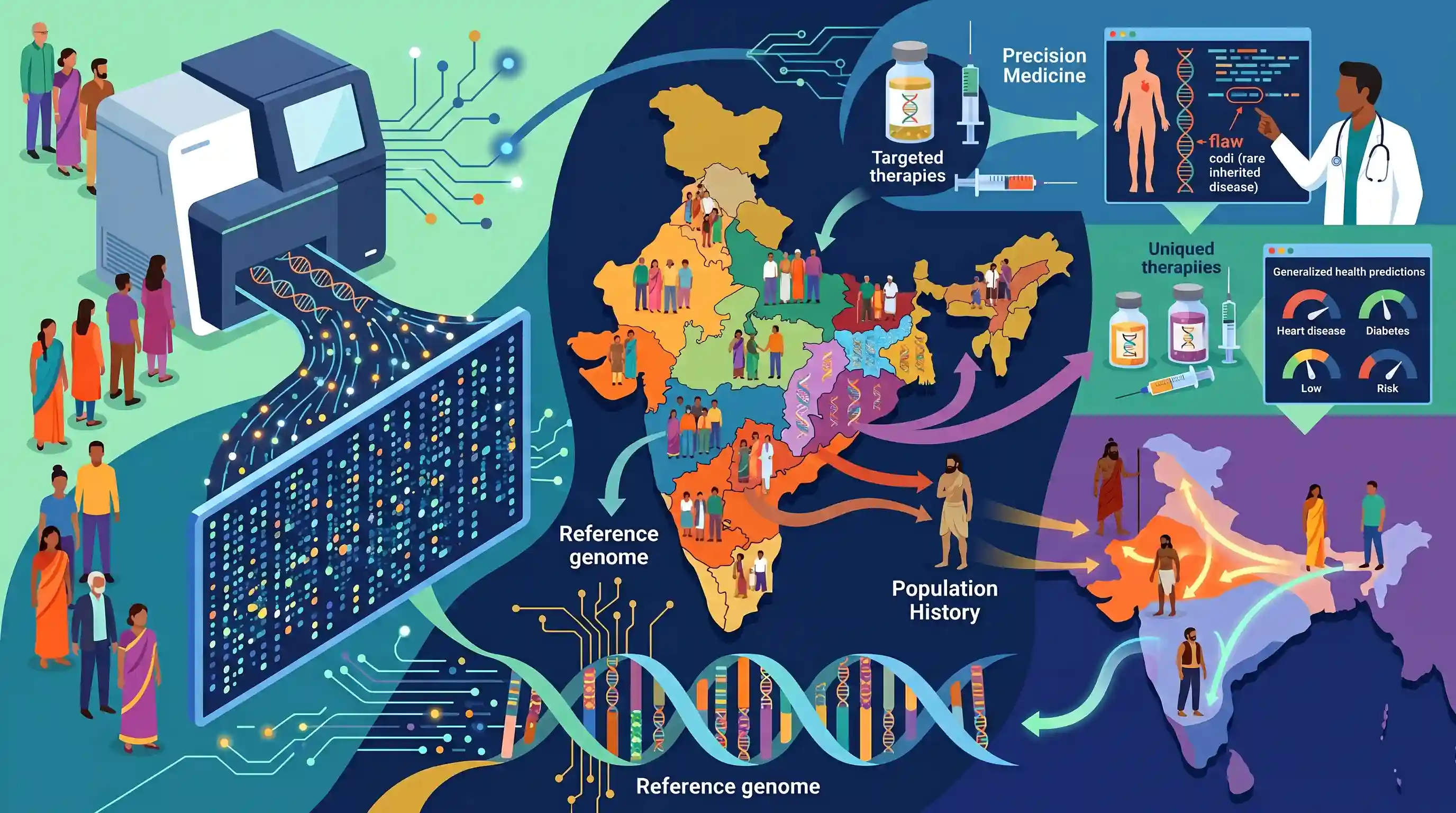
The article explores the significance of genetic mapping in India, primarily through initiatives like the Genome India Project which recently achieved the milestone of sequencing 10,000 whole genomes. Due to deep-rooted practices of endogamy, the Indian population exhibits vast genetic diversity with unique population-specific genetic mutations. Creating an Indian reference genome is crucial because standard global reference genomes often do not accurately represent this diversity. This mapping enables a shift towards precision medicine, allowing for the identification of rare inherited diseases, the development of targeted therapies, and more accurate predictions of disease susceptibility. Furthermore, genomic data holds substantial value for understanding historical migration patterns and population genetics.
Key Points
- The Genome India Project aims to sequence genomes of thousands of individuals across India to create a reference genome specific to the Indian population.
- India's high genetic diversity, shaped by centuries of endogamy (like the caste system), preserves unique genetic mutations, increasing the prevalence of rare inherited diseases in specific groups.
- Genetic mapping paves the way for precision medicine, allowing treatments to be tailored to an individual's specific genetic makeup rather than relying on generalized therapies.
- A diverse genetic database improves the accuracy of identifying disease-causing mutations, advancing early diagnostics and targeted drug development.
- Beyond healthcare, genomic data aids in tracing human migration patterns, population genetics, and understanding evolutionary biology.
Important Terms
Genome India Project (GIP)

A flagship Department of Biotechnology initiative to sequence 10,000 individuals from 99 ethnic groups, creating a comprehensive database of India's unique genetic diversity for medical research.
UPSC context
GS Paper III: Science and Technology (Biotechnology). Vital for questions on indigenous scientific initiatives and healthcare revolutions.
Whole Genome Sequencing (WGS)
A laboratory process that decodes an organism's complete DNA sequence (3.2 billion base pairs in humans) to identify genetic variations, mutations, and markers for diseases.
UPSC context
GS Paper III: Biotechnology applications. Essential technical concept for understanding personalized medicine and genetic research.
Endogamy
The practice of marrying within specific social, caste, or religious groups, which in India has resulted in unique population-specific genetic mutations and hereditary diseases.
UPSC context
GS Paper I (Society) and Paper III (Science). Tests understanding of how social structures influence biological health outcomes.
Precision Medicine
An emerging healthcare approach that tailors medical treatment and prevention to the individual's genetic makeup, lifestyle, and environment, rather than a generalized 'one-size-fits-all' model.
UPSC context
GS Paper III: Science and Technology. Focuses on the future of healthcare delivery and drug efficacy.
Reference Genome
A digital DNA sequence database used as a representative template of a species; a specific Indian version is necessary for accurate diagnosis in diverse local populations.
UPSC context
GS Paper III: Biotechnology. Critical for understanding the need for domestic genomic data over standard global databases.
Indian Biological Data Centre (IBDC)
India’s first national repository for life science data, established by the DBT in Faridabad, which stores and shares data from projects like Genome India.
UPSC context
GS Paper III: Science and Technology. Important for questions on institutional framework and digital public goods.
Department of Biotechnology (DBT)
An Indian government department under the Ministry of Science and Technology responsible for promoting biotechnology through research, infrastructure development, and international collaborations.
UPSC context
GS Paper III: Institutional development in S&T. Nodal body for major biotech schemes like GIP.
Prelims Trap
Genome sequencing involves editing the Indian population's DNA to cure rare inherited diseases.
Sequencing merely 'reads' or maps the genetic code to build a database or identify mutations. Altering or correcting the code is gene editing (e.g., CRISPR).
Static Concepts Connected
What is the difference between Whole Genome and Exome Sequencing?
- Whole Genome (WGS): Maps all 3 billion DNA base pairs, covering both coding (genes) and non-coding regions (regulatory elements).
- Exome Sequencing: Sequences only the protein-coding regions (exons), which make up about 1-2% of the genome.
- Diagnostic Scope: WGS is more comprehensive but costlier, essential for detecting mutations in non-coding regions often missed by targeted exome sequencing.
How do endogamy and the 'founder effect' impact Indian genetics?
- Endogamy & Homozygosity: Marrying strictly within closed community groups increases the probability of offspring inheriting identical recessive disease-causing alleles.
- Founder Effect: Occurs when a new population is established by a very small number of individuals, leading to a loss of genetic variation.
- UPSC Significance: These factors explain why the Indian population harbors unique, community-specific genetic mutations and high rates of specific rare diseases.
Cross-Topic Patterns
IBDC and Genomic Data Sovereignty
The Indian Biological Data Centre (IBDC) ensures genomic data remains within India, bridging biotechnology milestones with digital data sovereignty, localization policies, and national security frameworks.
Genomics and Ancient Migration Theories
GIP's genetic mapping overlaps with ancient history, offering biological data to complement archaeological findings (like Rakhigarhi DNA) on early subcontinental migrations and Indus Valley population shifts.

Expect a 2026 prelims question distinguishing between genome mapping and gene editing, paired with the IBDC data localization mandate.
Linked PYQs · 3
Linked PYQs · 3
- 2017PrelimsGS1
With reference to agriculture in India, how can the technique of 'genome sequencing', often seen in the news, be used in the immediate future? 1. Genome sequencing can be used to identify genetic markers for disease resistance and drought tolerance in various crop plants. 2. This technique helps in reducing the time required to develop new varieties of crop plants. 3. It can be used to decipher the host-pathogen relationships in crops. Select the correct answer using the code given below:
- 2022PrelimsGS1
DNA Barcoding can be a tool to: 1. assess the age of a plant or animal. 2. distinguish among species that look alike. 3. identify undesirable animal or plant materials in processed foods. Which of the statements given above is/are correct?
- 2021MainsGS3
What are the research and developmental achievements in applied biotechnology? How will these achievements help to uplift the poorer sections of the society?
