West Bengal Model of Special Investment Regions
Source:Indian Express ↗
Why It Matters
Land acquisition remains one of the largest bottlenecks for industrialization and infrastructure development in India. Understanding different state-level models (competitive federalism) for establishing Special Investment Regions provides critical insights into balancing economic growth with social equity and agrarian rights.
Summary
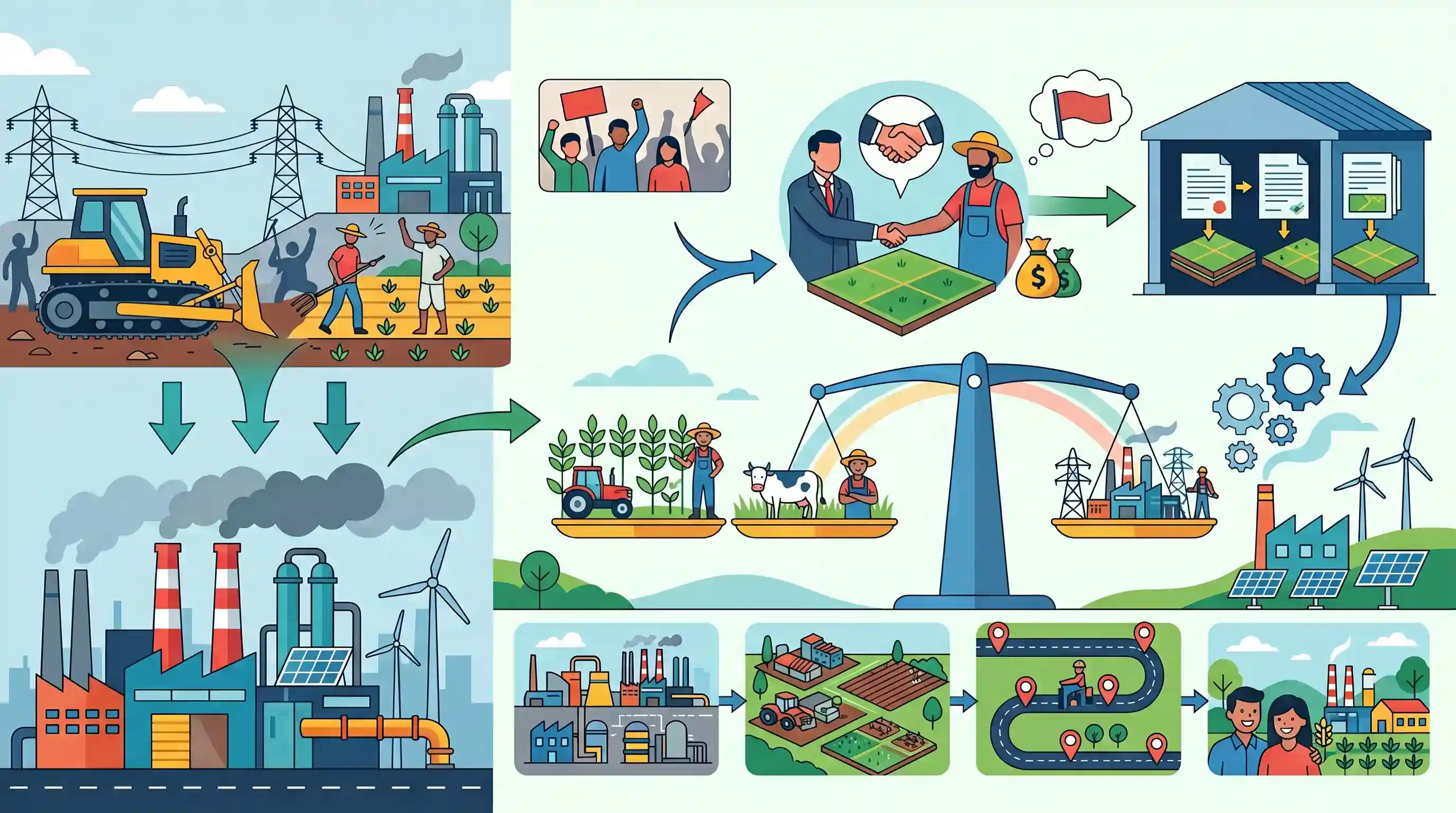
The article analyzes West Bengal's distinct approach to developing Special Investment Regions (SIRs) and its implications for India's broader industrial policy. While other states often rely on robust state intervention and forcible land acquisition or town-planning schemes to aggregate land for mega-industrial hubs, West Bengal employs a strictly non-coercive model. Influenced by its history of fierce anti-land acquisition protests, the state government relies entirely on direct, voluntary land purchases and its existing land bank. This unique model highlights a crucial balance between driving industrial infrastructure and protecting agrarian livelihoods, offering the rest of the country a sustainable, albeit potentially slower, blueprint for conflict-free land aggregation and industrialization.
Key Points
- Special Investment Regions (SIRs) are designated zones with world-class infrastructure designed to attract large-scale manufacturing and private investment.
- Unlike states like Gujarat which heavily utilize state-driven land pooling and acquisition (e.g., Dholera SIR), West Bengal's SIR model strictly avoids forcible land acquisition.
- Driven by the legacy of anti-land acquisition movements in Singur and Nandigram, West Bengal relies on direct, voluntary land purchases from farmers or the utilization of vested government land banks.
- While potentially slower in aggregating large contiguous land parcels, this non-coercive approach prevents agrarian distress and political backlash.
- West Bengal's unique land strategy serves as a critical case study for the rest of India, offering an alternative, conflict-free blueprint for industrialization in land-scarce, highly populated regions.
Important Terms
Special Investment Region (SIR) Act

A legislative framework for creating mega-industrial hubs (typically >100 sq km) that integrate manufacturing, urban planning, and logistics. It enables large-scale land pooling to attract global investment.
UPSC context
GS-3 (Infrastructure/Investment Models). Tests knowledge of regional development strategies and state-led industrialization frameworks beyond traditional SEZs.
Amritsar-Kolkata Industrial Corridor (AKIC)
A 1,839 km economic corridor under the National Industrial Corridor program, spanning seven states along the Eastern Dedicated Freight Corridor to boost manufacturing and job creation in North-East India.
UPSC context
GS-3 (Infrastructure). Tests awareness of major logistics corridors and their impact on regional economic disparities and supply chain efficiency.
Special Economic Zones (SEZ) Act
A 2005 law establishing duty-free enclaves treated as foreign territory for trade purposes. It provides tax breaks and simplified procedures to boost exports and foreign direct investment.
UPSC context
GS-3 (Economy/Industrial Policy). Tests understanding of export-promotion models and the transition toward domestic-focused hubs like the DESH Bill.
West Bengal Industrial Development Corporation (WBIDC)
The premier nodal agency (est. 1967) responsible for facilitating investment, developing industrial parks, and managing land aggregation to drive industrial growth in West Bengal.
UPSC context
GS-3 (Industrial Policy). Tests the role of state-level institutions in executing specific development models and handling land acquisition challenges.
Land Bank
A repository of government-owned land available for immediate industrial allotment, used to bypass the socio-political conflicts and delays typical of fresh, coercive land acquisition.
UPSC context
GS-3 (Land Reforms/Industrial Growth). Tests non-coercive strategies for infrastructure development and ease of doing business in a sensitive agrarian landscape.
Prelims Trap
"Special Investment Regions (SIRs) are centrally notified massive economic zones governed by the Union Ministry of Commerce."
Unlike Special Economic Zones (SEZs) which are regulated by a central Act, SIRs are state-specific initiatives established and governed by respective State Acts.
Static Concepts Connected
How do SEZs, NIMZs, and SIRs fundamentally differ?
- SEZs: Export-oriented enclaves treated as foreign territory for trade and tariff purposes, governed centrally.
- NIMZs: Conceived under the National Manufacturing Policy as massive industrial clusters integrated with urban infrastructure.
- SIRs: State-notified, self-governed mega regions integrating industrial, urban, and logistics infrastructure under state-specific laws.
What are the consent requirements under the RFCTLARR Act 2013?
- Government Projects: Exempted from mandatory landowner consent, though a Social Impact Assessment (SIA) may still be required.
- PPP Projects: Requires the prior consent of at least 70% of affected land-owning families.
- Private Projects: Requires the prior consent of at least 80% of affected land-owning families.
Cross-Topic Patterns
Land Pooling in Urbanization
Contrasts with eminent domain by treating landholders as partners who receive developed land back, linking GS-3 industrial policy to GS-1 urban planning models (e.g., Delhi's Land Pooling Policy).
Land alienation and extremism
Coercive land acquisition in agrarian/tribal belts has historically fueled LWE. West Bengal's non-coercive model connects GS-3 industrialization directly to GS-3 internal security management.

Expect a GS-3 Mains question contrasting state-led land pooling with voluntary acquisition models for developing Industrial Corridors.
Linked PYQs · 4
Linked PYQs · 4
- 2015MainsGS3
There is a clear acknowledgement that Special Economic Zones (SEZs) are a tool of industrial development, manufacturing and exports. Recognizing this potential, the whole instrumentality of SEZs requires augmentation. Discuss the issues plaguing the success of SEZs with respect to taxation, governing laws and administration.
- 2024MainsGS3
What were the factors responsible for the successful implementation of land reforms in some parts of the country? Elaborate.
- 2021MainsGS3
“Investment in infrastructure is essential for more rapid and inclusive economic growth.” Discuss in the light of India's experience.
- 2016PrelimsGS1
Recently, India's first 'National Investment and Manufacturing Zone' was proposed to be set up in
