US Semiconductor Export Controls and Global Tech Supply Chains
Source:The Hindu ↗
Why It Matters
Crucial for understanding the intersection of international geopolitics, technology denial regimes, and the restructuring of critical semiconductor supply chains relevant for India's domestic tech ambitions.
Summary
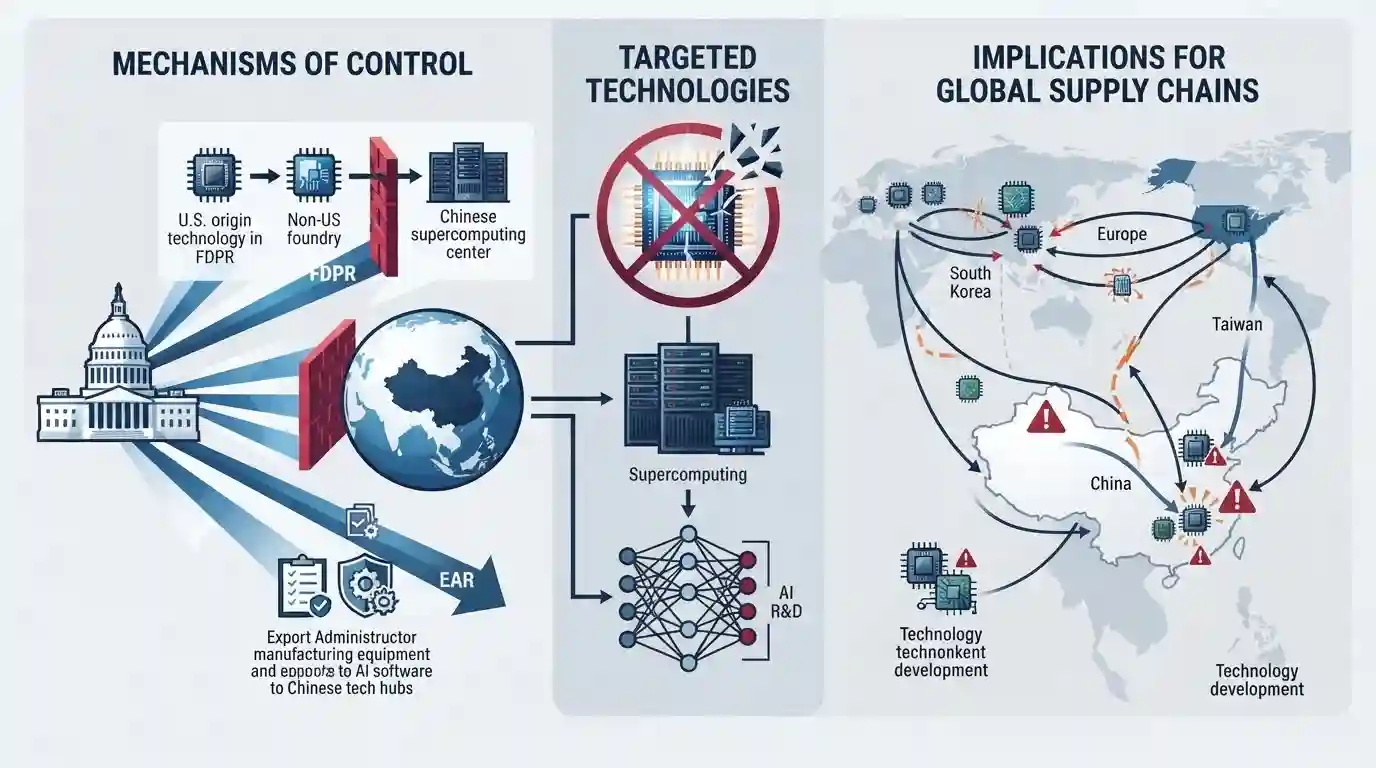
An examination of the mechanisms, including the Foreign Direct Product Rule and Export Administration Regulations, by which the United States restricts China's access to advanced semiconductors, supercomputing, and artificial intelligence tech, and the implications for global technology supply chains.
Key Points
- The U.S. controls advanced technology and semiconductor flows to China using regulatory mechanisms like Export Administration Regulations (EAR) and the Foreign Direct Product Rule (FDPR).
- Geopolitical competition has transformed semiconductor supply chains into strategic chokepoints, affecting compute power and AI development in China.
- Export controls target not just direct exports from the U.S. but items manufactured abroad using U.S. software or machinery, impacting global foundries like TSMC.
- India can leverage shifts in global semiconductor manufacturing supply chains while navigating geopolitical technology restrictions.
Important Terms
Export Administration Regulations

Regulations managed by the U.S. government that control the export, re-export, and transfer of items, software, and technology to protect national security interests and foreign policy goals.
UPSC context
GS Paper III (Technology / International Relations): Important for understanding strategic trade controls, tech nationalism, and great power competition.
United States Department of Commerce
A principal agency of the U.S. federal government responsible for promoting economic development, international trade, and regulating export controls through specialized bureaus.
UPSC context
GS Paper II/III: Illustrates institutional mechanisms used by superpowers to shape global trade regimes and enforce unilateral tech sanctions.
Bureau of Industry and Security
A bureau under the U.S. Department of Commerce that administers and enforces export controls on sensitive dual-use technologies, advanced chips, and computing items.
UPSC context
GS Paper III (Science & Tech): Key agency driving semiconductor choke points and export curbs targeting strategic competitors like China.
Static Concepts Connected
What is the extraterritorial scope of the U.S. Foreign Direct Product Rule (FDPR)?
- Jurisdiction expansion: Extraterritorial Reach: Applies U.S. export controls to foreign-made items produced using specific U.S. software, technology, or semiconductor manufacturing equipment.
- Enforcing agency: BIS Authority: Enforced by the Bureau of Industry and Security (BIS) under the U.S. Department of Commerce to restrict sensitive tech flows.
Cross-Topic Patterns
Tech Decoupling + WTO National Security Exceptions
U.S. export controls on semiconductors intersect with WTO national security exemptions (Article XXI) and India's semiconductor mission (ISM) strategies.

FDPR extraterritorial reach + EAR export controls will likely feature in a multi-statement Prelims question on US-China tech decoupling.
Linked PYQs · 2
Linked PYQs · 2
- 2025MainsGS3
India aims to become a semiconductor manufacturing hub. What are the challenges faced by the semiconductor industry in India? Mention the salient features of the India Semiconductor Mission.
- 2024MainsGS2
‘The West is fostering India as an alternative to reduce dependence on China's supply chain and as a strategic ally to counter China's political and economic dominance.’ Explain this statement with examples.
