US Export Controls on Advanced Semiconductors and Tech Flow to China
Source:The Hindu ↗
Why It Matters
Crucial for understanding global techno-geopolitics, supply chain weaponization, semiconductor manufacturing dependencies, and India's strategic positioning amid US-China tech decoupling.
Summary
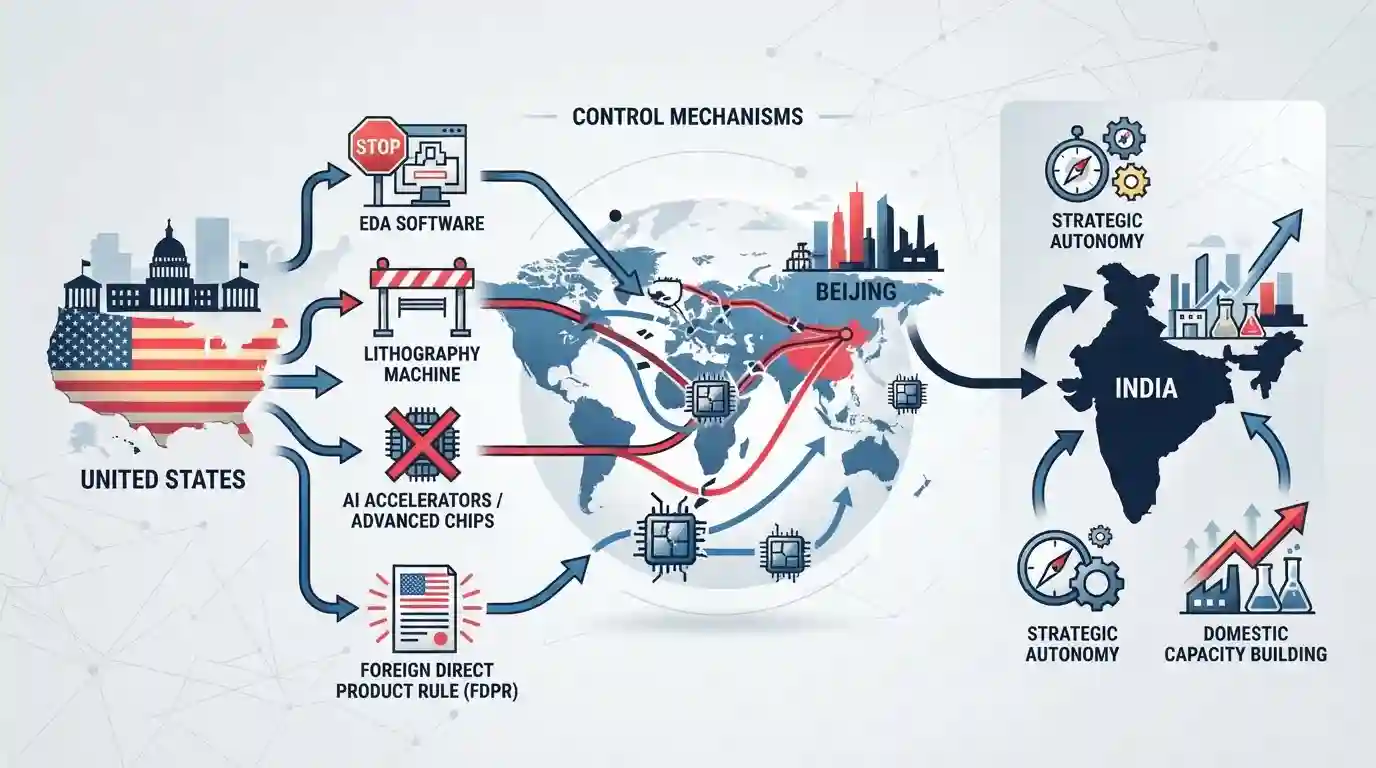
The article explains the mechanisms through which the United States controls the flow of advanced technology, semiconductor chips, and computing power to China. By weaponizing critical nodes in the global tech supply chain—such as EDA software, lithography equipment, and AI accelerators—and enforcing regulations like the Foreign Direct Product Rule (FDPR), Washington seeks to restrict Beijing's military and technological rise. This tech-war dynamic underlines global semiconductor vulnerabilities and shapes strategic autonomy imperatives for emerging tech hubs like India.
Key Points
- The United States controls advanced technology flow to China by utilizing extra-territorial export controls, specifically leveraging its dominance over critical components like Electronic Design Automation (EDA) software, extreme ultraviolet (EUV) lithography tools, and advanced computing chips.
- Export control frameworks restrict the sale of advanced AI chips and computing capacity to China to curb its military modernization and technological hegemony, impacting major chip designers like Nvidia.
- These controls extend globally through the Foreign Direct Product Rule (FDPR), which allows the U.S. to regulate foreign-made items that incorporate even a minor amount of U.S.-origin software or technology.
- The geopolitical tech decoupling highlights vulnerabilities in global supply chains and pushes nations like India to secure indigenous semiconductor capabilities through initiatives like the India Semiconductor Mission.
Important Terms
Export Administration Regulations (EAR)

Regulations administered by the U.S. Department of Commerce that govern and restrict the export, reexport, and transfer of sensitive goods, software, and technology to safeguard U.S. national security.
UPSC context
UPSC GS Paper II (International Relations) & GS Paper III (Tech/Global Supply Chains). Tests understanding of geopolitical trade restrictions and weaponized interdependencies.
Foreign Direct Product Rule (FDPR)
A rule within U.S. export regulations granting Washington extraterritorial authority to restrict foreign-made goods if they are produced using U.S. software, technology, or equipment.
UPSC context
UPSC GS Paper III (Science & Technology / International Trade). Tests how superpowers weaponize critical technology choke points in global semiconductor supply chains.
U.S. Department of Commerce
The U.S. cabinet department responsible for administering trade policies, export controls, and regulations that oversee commercial access to advanced semiconductors and computing tech.
UPSC context
UPSC GS Paper II (International Relations / US-China Tech War). Relevant for tracking state-led economic statecraft and technology governance mechanisms.
Prelims Trap
The Foreign Direct Product Rule (FDPR) regulates only those semiconductor items that are physically manufactured within U.S. territory.
Aspirants often believe the Foreign Direct Product Rule (FDPR) only applies to goods physically manufactured inside the United States, whereas its extra-territorial reach covers foreign-made items using U.S. software or design tech anywhere in the world.
Static Concepts Connected
What are the core stages and critical choke-points in the global semiconductor value chain?
- Design Phase: Chip design relies heavily on Electronic Design Automation (EDA) software and intellectual property cores, dominated by a few U.S. and Western firms.
- Fabrication Phase: Semiconductor fabrication requires advanced lithography machines (like EUV systems made exclusively by ASML in the Netherlands) and ultra-pure silicon wafers.
- Assembly & Test: Outsourced Semiconductor Assembly and Test (OSAT) handles packaging and testing; while geographically diversified, it remains vulnerable to upstream bottlenecks.
Cross-Topic Patterns
Semiconductor Controls & WTO Security Exceptions
U.S. export controls on advanced chips directly connect to WTO exceptions for national security, testing the limits of global trade rules against sovereign techno-nationalism.
Techno-Nationalism & Global Supply Chain Choke-points
The weaponization of EDA software and lithography highlights how globalized supply chains become instruments of geoeconomic coercion and great-power rivalry.

U.S. tech controls + FDPR + critical software choke-points like EDA are prime fodder for a multi-statement Prelims/Mains question.
Linked PYQs · 2
Linked PYQs · 2
- 2025MainsGS3
India aims to become a semiconductor manufacturing hub. What are the challenges faced by the semiconductor industry in India? Mention the salient features of the India Semiconductor Mission.
- 2026PrelimsGS1
Which one of the following pairs of semiconductor plants in India and their locations is not correctly matched ?
