Undersea Telegraph Cables Served as Tools of Imperial Communication
Source:Indian Express ↗
Why It Matters
Understanding the historical precedent of communication networks as tools of imperial power provides crucial context for analyzing modern geopolitical conflicts over critical infrastructure, such as internet cables in the Indo-Pacific, which is a frequent theme in GS-2 (IR) and GS-3 (Security).
Summary
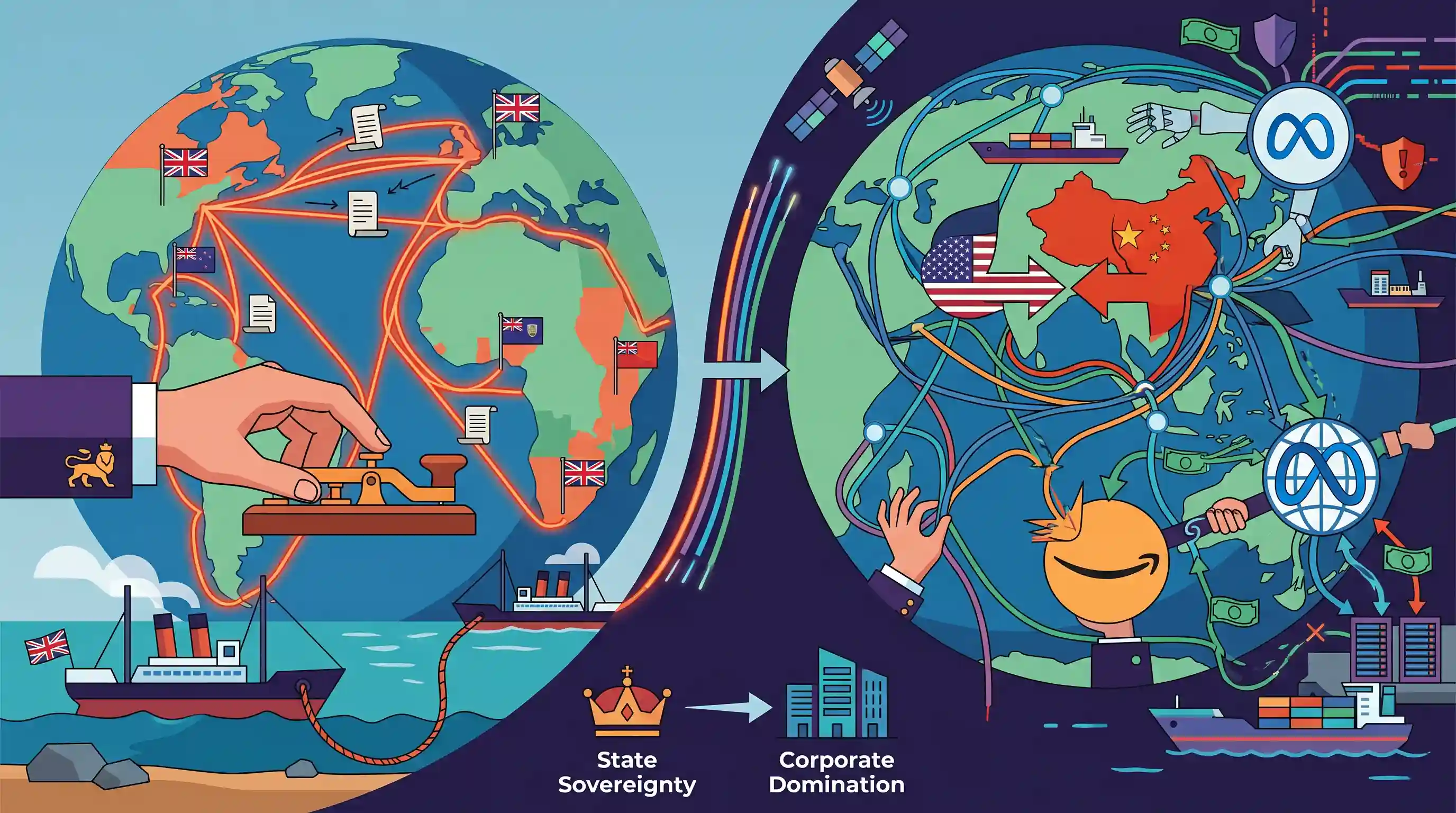
The article draws parallels between the 19th-century British Empire's 'All-Red Line'—a strategic global network of undersea telegraph cables—and the modern geopolitical contest over submarine internet cables. While Britain used telegraphy to solidify its imperial and commercial dominance, today's critical undersea infrastructure is the battleground for strategic competition between the US and China, especially in the Indo-Pacific. A key distinction in the contemporary era is the rising dominance of private technology conglomerates like Meta and Amazon, which are increasingly replacing nation-states as the primary investors and owners of this critical global communication backbone.
Key Points
- The first successful transatlantic telegraph cable in 1858 dramatically reduced communication times and sparked a global connectivity revolution.
- Britain established the 'All-Red Line', a strategic and highly secure global network of submarine cables that cemented its imperial and commercial dominance.
- Today, undersea fiber-optic cables carry 99% of global internet traffic, serving as modern critical infrastructure.
- A new geopolitical contest is underway between the US and China over control and routing of submarine cables, particularly in the Indo-Pacific.
- Unlike the state-driven monopolies of the 19th century, today's undersea cable infrastructure is increasingly funded and controlled by private technology giants like Meta and Amazon.
Important Terms
All-Red Line

A 19th-century British network of undersea telegraph cables designed for secure, exclusive communication between imperial territories without crossing foreign-controlled land.
UPSC context
GS Paper 1 (World History); tests understanding of historical imperial strategy and communications revolutions.
Submarine Cable System
Fiber-optic cables laid on the ocean floor that carry over 95% of international data traffic, forming the backbone of global communications.
UPSC context
GS Paper 3 (Infrastructure/Security); examines critical infrastructure protection and global connectivity vulnerabilities.
Critical Information Infrastructure (CII)
Computer resources whose incapacitation would severely impact national security, economy, or public health; defined in India under Section 70 of the IT Act, 2000.
UPSC context
GS Paper 3 (Internal Security); relevant for cybersecurity frameworks and NCIIPC's role in protecting vital assets.
Digital Sovereignty
A nation's capacity to control its digital infrastructure, data flows, and technology ecosystem according to domestic laws, free from foreign influence.
UPSC context
GS Paper 3 (IT & Economy); key to debates on data localization and strategic autonomy.
Indo-Pacific
The strategic maritime region spanning the Indian and Pacific Oceans, currently the primary theater for US-China competition over critical undersea infrastructure.
UPSC context
GS Paper 2 (IR); vital for maritime security and India’s strategic role in regional stability.
Big Tech (in Infrastructure)
Large private technology conglomerates (e.g., Meta, Google) increasingly owning and operating global undersea networks, shifting infrastructure control from nation-states.
UPSC context
GS Paper 2 (IR); highlights the rising influence of non-state actors in managing global strategic assets.
Prelims Trap
Low-Earth Orbit satellites now carry the majority of global intercontinental internet traffic.
Despite the massive news coverage of Starlink and LEO constellations, 95-99% of global intercontinental internet traffic is still carried by submarine fiber-optic cables, not satellites.
Static Concepts Connected
How do submarine fiber-optic cables transmit data across oceans?
- Total Internal Reflection: Cables use this optical phenomenon to keep light bouncing continuously within the glass core, preventing signal loss.
- Signal Amplification: Undersea repeaters are physically integrated into the cables at regular intervals to boost the optical signals across vast transoceanic distances.
- Latency Advantage: Compared to satellites, fiber optics provide vastly higher bandwidth and lower latency because signals travel a more direct physical route.
What is Critical Information Infrastructure (CII) under Indian Law?
- IT Act 2000: The IT Act defines CII as a computer resource whose incapacitation would have a debilitating impact on national security, economy, or public health.
- NCIIPC: The National Critical Information Infrastructure Protection Centre is the designated nodal agency for protecting India's CII, including telecom networks and submarine landing stations.
- Protected Sectors: Designated sectors include Telecom, Power, Transport, Finance, e-Governance, and Strategic Enterprises.
Cross-Topic Patterns
Maritime chokepoints double as cyber vulnerabilities
Cable routing directly mirrors maritime trade routes. Geopolitical instability in the Red Sea or the Strait of Malacca simultaneously threatens both global shipping logistics and the physical internet backbone.
Big Tech monopolies vs. digital sovereignty
The shift in cable ownership from telecom PSUs to giants like Meta and Amazon connects to India's data localization debate, highlighting sovereign risks when private entities control critical data pipelines.
Neo-imperialism through tech infrastructure routing
Just as Britain's "All-Red Line" bypassed rival territories to secure communications, modern US-China initiatives like the "Clean Network" aim to physically route cables around rival nations to prevent espionage.

Expect a GS3 question in 2026 linking undersea cable vulnerabilities to data sovereignty and the US-China tech war in the Indo-Pacific.
Linked PYQs · 4
Linked PYQs · 4
- 2015MainsGS1
Why did the industrial revolution first occur in England? Discuss the quality of life of the people there during the industrialization. How does it compare with that in India at present?
- 2021MainsGS2
The newly tri-nation partnership AUKUS is aimed at countering China's ambitions in the Indo-Pacific region. Is it going to supersede the existing partnerships in the region? Discuss the strength and impact of AUKUS in the present scenario.
- 2021MainsGS2
“The USA is facing an existential threat in the form of a China, that is much more challenging than the erstwhile Soviet Union.” Explain.
- 2020MainsGS3
Discuss different types of cyber crimes and measures required to be taken to fight the menace.
