Integration Challenges and Grid Stability in Solar Heavy Power Systems
Source:Indian Express ↗
हे का महत्त्वाचे आहे
As India scales up its non-fossil fuel capacity toward its 2030 and net-zero targets, managing intermittency, grid stability, and energy storage economics becomes a central policy and economic challenge for sustainable infrastructure development.
सारांश
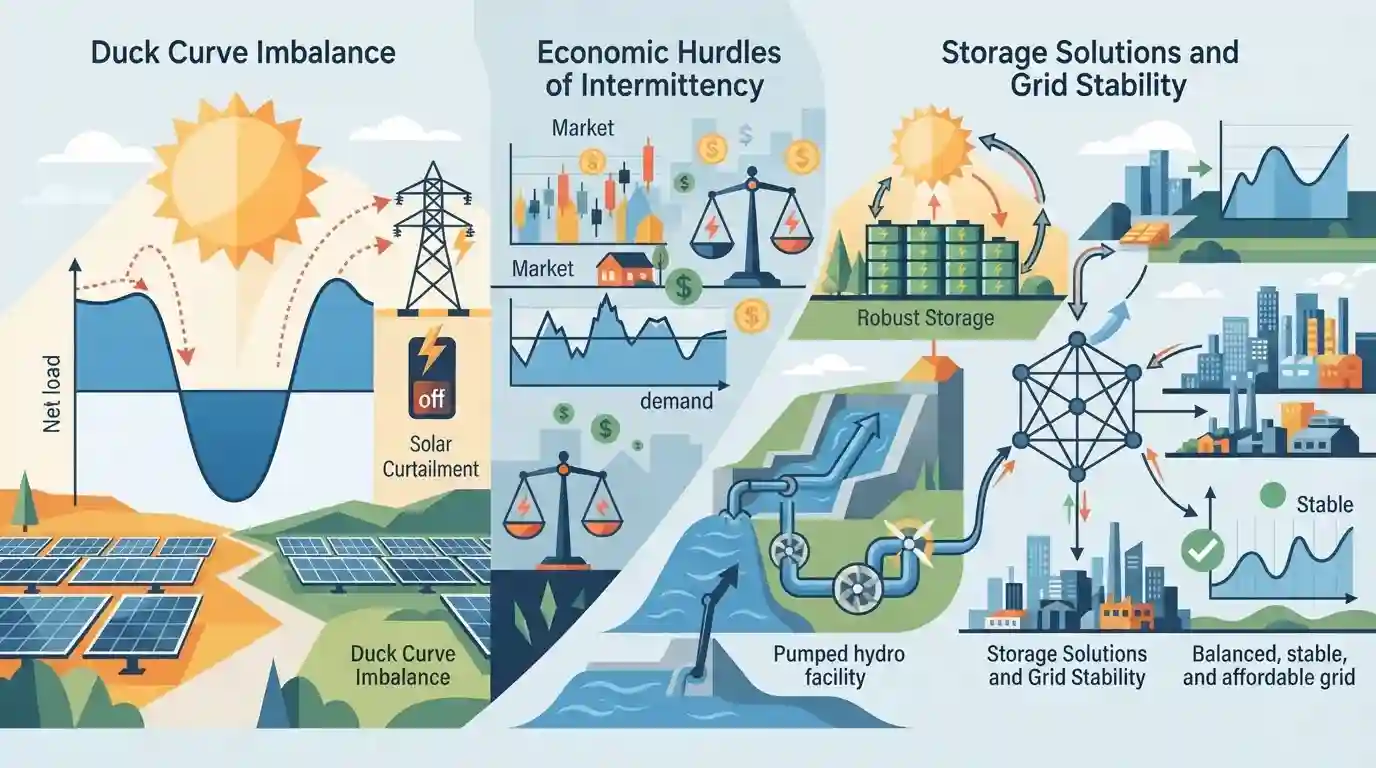
The article discusses the structural challenges of integrating large-scale solar power into India's electricity grid. It highlights issues such as duck curve imbalances, solar curtailment, and the economic hurdles of intermittency, emphasizing the need for robust energy storage solutions (like batteries and pumped hydro) and market-based pricing mechanisms to keep the grid stable and affordable.
मुख्य मुद्दे
- Rapid expansion of solar energy creates grid stability challenges, including daytime oversupply and evening peak demand mismatches.
- Battery Energy Storage Systems (BESS) and Pumped Storage Hydropower (PSH) are crucial for shifting solar power to peak hours.
- Market-based solutions like dynamic pricing, time-of-day tariffs, and flexible grid operations are essential to prevent solar curtailment and ensure affordability.
- Balancing a solar-heavy grid requires policy frameworks that incentivize storage co-location and transparent ancillary market structures.
महत्त्वाच्या संज्ञा
Central Electricity Authority

A statutory body under the Ministry of Power that advises the government on electricity policy, formulates national plans, and sets technical standards for grid connectivity and infrastructure.
UPSC context
Important for UPSC CSE GS Paper III (Energy Infrastructure, Governance, and Renewable Energy Integration policies).
पूर्वपरीक्षा सापळा
Solar curtailment in India's grid is primarily caused by interstate transmission line bottlenecks rather than thermal plant operational limits.
Aspirants often assume solar curtailment occurs due to transmission congestion alone, overlooking the operational rigidities of thermal plants like the 55% Minimum Technical Load (MTL) limit.
संबंधित स्थिर संकल्पना
What are the key technical challenges and interventions in integrating large-scale renewable energy into India's grid?
- Duck Curve Phenomenon:: Characterized by midday oversupply and a steep evening demand ramp, forcing sudden shifting requirements.
- Minimum Technical Load:: Thermal plants cannot ramp down below 55% capacity without destabilizing combustion, causing midday RE curtailment.
- Storage Interventions:: PSH and BESS store surplus solar energy during peak generation hours for discharge during evening peak hours.
आंतर-विषय नमुने
Renewables Integration + Discom Financial Distress
Rapid renewable scaling without adequate storage leads to high thermal cycling costs, complicating India's net-zero transition targets and fiscal health of discoms under Revamped Distribution Sector Scheme (RDSS).
Energy Storage Financing + Green Taxonomy
Grid frequency management under high solar penetration intersects with RBI's climate risk taxonomies and green bond financing frameworks for capital-intensive storage infrastructure.

Duck curve challenges + Minimum Technical Load (MTL) constraints in thermal plants likely to be tested in a multi-statement prelims Q.
संबंधित PYQ · 1
संबंधित PYQ · 1
- 2022MainsGS3
Do you think India will meet 50 percent of its energy needs from renewable energy by 2030 ? Justify your answer. How will the shift of subsidies from fossil fuels to renewables help achieve the above objective ? Explain.
