Disaster Management Framework and Technology Integration in UP
Source:organiser ↗
Why It Matters
Disaster management is a critical component of the GS syllabus. The article provides highly relevant localized examples (e.g., treating human-wildlife conflict as a disaster, integrating AI/GIS in early warning systems, Aapda Mitra expansion) of how UP is handling its specific geographical vulnerabilities. This information is vital for Prelims questions on state initiatives and statutory bodies (like SDMA/NDMA), as well as for enriching Mains answers in GS3.
Summary
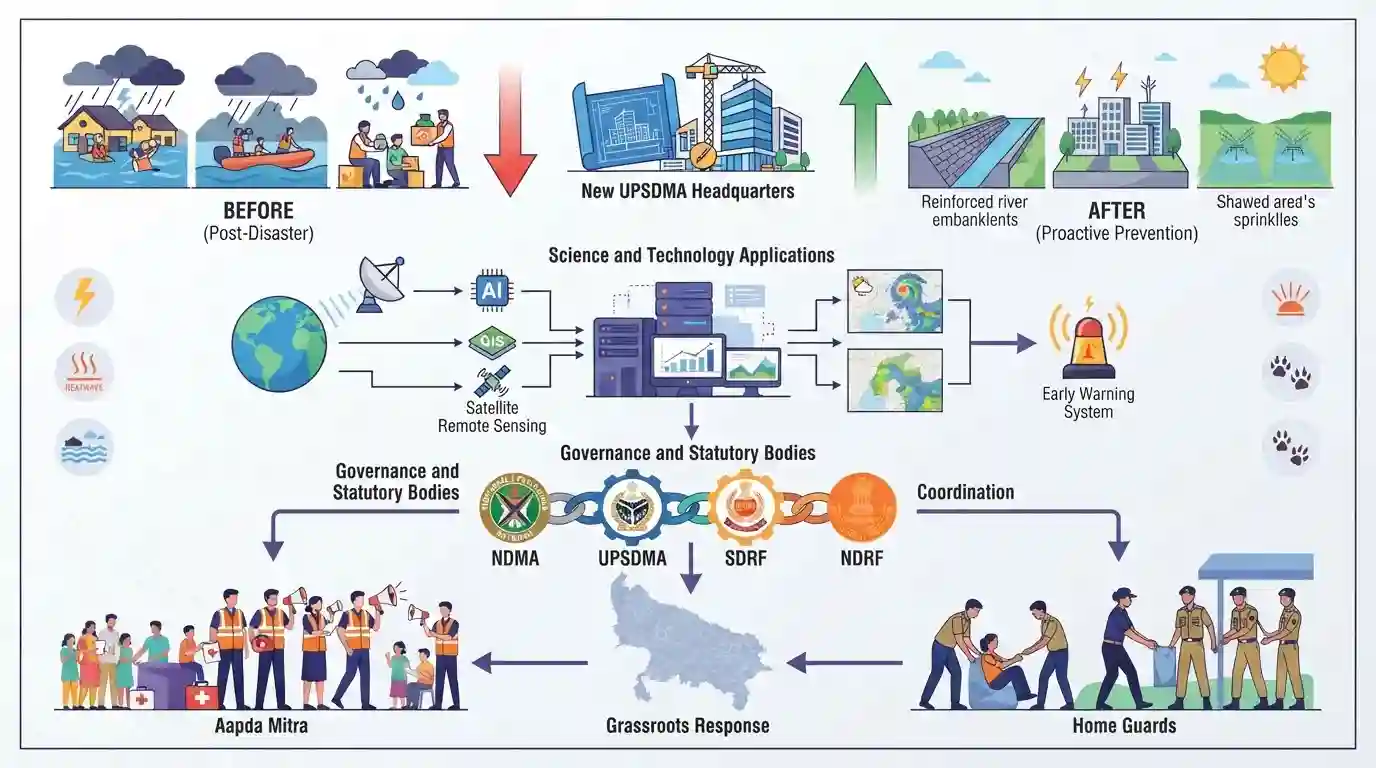
Uttar Pradesh is overhauling its disaster management framework under the Yogi Adityanath government by shifting focus from post-disaster relief to proactive prevention and mitigation. At the center of this transformation is the construction of a new headquarters for the UP State Disaster Management Authority (UPSDMA) and a heavy reliance on technology, including AI, GIS, and satellite remote sensing for predictive analytics and early warnings. Grassroots response is being strengthened by expanding the Aapda Mitra programme and involving Home Guards. The state is addressing its complex vulnerability profile—which includes floods, heatwaves, lightning, and human-wildlife conflict—through seamless coordination between state and national agencies such as the NDMA, SDRF, and NDRF.
Key Points
- The Uttar Pradesh government is constructing a modern headquarters for the UP State Disaster Management Authority (UPSDMA) in Lucknow to centralize and enhance disaster response coordination.
- There is a strategic policy shift from a relief-centric model to a proactive prevention, mitigation, and preparedness-driven framework.
- Grassroots disaster resilience is being built by expanding the Aapda Mitra programme and integrating disaster response training into Home Guard recruitments.
- Advanced technologies such as AI for risk mapping, GIS, satellite remote sensing, predictive analytics, and drone networks are being integrated into the state's Early Warning Systems and rescue operations.
- The state's disaster management strategy is being broadened to address a wide range of vulnerabilities, notably including floods, earthquakes, heatwaves, and the growing issue of human-wildlife conflicts.
Important Terms
National Disaster Management Authority (NDMA)

India's apex statutory body for disaster management, established under the Disaster Management Act, 2005. It is chaired by the Prime Minister and formulates national policies, plans, and guidelines to ensure effective disaster response.
UPSC context
GS Paper III (Disaster Management); tests knowledge of statutory frameworks, institutional disaster response, policy planning, and mitigation strategies.
National Disaster Response Force (NDRF)
A specialized, multi-disciplinary Indian force constituted under the Disaster Management Act, 2005, for prompt and specialist response during natural and man-made disasters. It consists of battalions drawn from Central Armed Police Forces.
UPSC context
GS Paper III (Disaster Management); tests operational mechanisms, first-responder coordination, and the role of specialized central forces in disaster mitigation.
Uttar Pradesh State Disaster Management Authority (UPSDMA)
Uttar Pradesh's apex disaster management body, established under the Disaster Management Act, 2005. Chaired by the Chief Minister, it formulates state-level disaster policies, coordinates mitigation efforts, and integrates risk-reduction technologies.
UPSC context
GS Paper III (Disaster Management) & State PSCs; tests regional disaster governance, federal institutional frameworks, and state-specific mitigation planning.
State Disaster Response Force (SDRF)
State-level specialized forces in India raised to provide rapid, localized response during natural and man-made disasters. They operate under the State Disaster Management Authority and cooperate closely with central forces.
UPSC context
GS Paper III (Disaster Management); tests state-level rapid-response apparatus, cooperative federalism, and division of disaster relief duties.
Aapda Mitra programme
A central sector scheme by the NDMA aimed at identifying and training local community volunteers as first responders in disaster-prone districts across India to enhance grassroots resilience.
UPSC context
GS Paper III (Disaster Management); tests community-led disaster risk reduction, volunteer-driven decentralization, and active mitigation at the local level.
Provincial Armed Constabulary (PAC)
A specialized armed police force of Uttar Pradesh, organized along military lines, serving as a reserve force for maintaining law and order, riot control, and emergency disaster relief operations.
UPSC context
GS Paper III (Internal Security & Disaster Management); tests state police machinery, reserve force deployments during crises, and local emergency handling.
Prelims Trap
State Disaster Response Funds (SDRF) can exclusively be utilized for the 12 nationally-notified disasters, preventing states from funding local hazards.
Under Ministry of Home Affairs guidelines, state governments are permitted to use up to 10% of their SDRF allocation for local, state-specific disasters.
Static Concepts Connected
What is the three-tier institutional structure established under the Disaster Management Act, 2005?
- National level: NDMA, chaired by the Prime Minister, lays down national policies; the National Executive Committee (NEC) assists in coordinating implementation.
- State level: SDMA, chaired by the Chief Minister, formulates state disaster plans; the State Executive Committee (SEC) coordinates execution.
- District level: DDMA, co-chaired by the District Magistrate and the elected head of the local authority, serves as the district-level planning body.
What are the four priorities of action under the Sendai Framework (2015-2030)?
- Priority 1: Understanding disaster risk in all its dimensions of vulnerability, capacity, exposure of persons and assets.
- Priority 2: Strengthening disaster risk governance to manage disaster risk through clear institutional and regulatory frameworks.
- Priority 3: Investing in disaster risk reduction for resilience through structural, non-structural, and functional measures.
- Priority 4: Enhancing disaster preparedness for effective response and to 'Build Back Better' in recovery and rehabilitation.
Cross-Topic Patterns
Human-wildlife conflict + federal disaster funds
UP's classification of wildlife conflict as a disaster connects ecological conservation (WPA, 1972) to federal disaster relief (DM Act, 2005), showcasing cross-sectoral administrative adaptation.
AI & GIS + grassroots adaptation
Integrating early warning technologies with schemes like Aapda Mitra translates advanced technology (GIS, remote sensing) directly into decentralized, community-led climate resilience.

The 10% SDRF flexibility for state-specific disasters like human-wildlife conflict will likely be tested alongside NDMA/SDMA statutory rules in 2026.
Linked PYQs · 2
Linked PYQs · 2
- 2021UPPSC_PRELIMSGS1
The National Disaster Management Division in India is the nodal division in the Ministry of Home Affairs for disaster management. Who is the Ex-officio Chairman of the National Disaster Management Authority?
- 2020UPPSC_PRELIMSGS1
During the 'lockdown', the extraordinary powers used by the Government of India received legal basis from which of the following laws? 1. Mental Health Care Act, 2017 2. Disaster Management Act, 2005 3. Enemy Property Act, 1968 4. Epidemic Diseases Act, 1897 Select the correct answer using the codes given below.
