Artificial Intelligence Energy Demands and Net Zero Targets
Source:The Hindu ↗
Why It Matters
The energy intensity of AI and data centers exposes the friction between technological progress and environmental sustainability. Understanding this dynamic is crucial for formulating policies around energy security, green digital infrastructure, and national net-zero commitments.
Summary
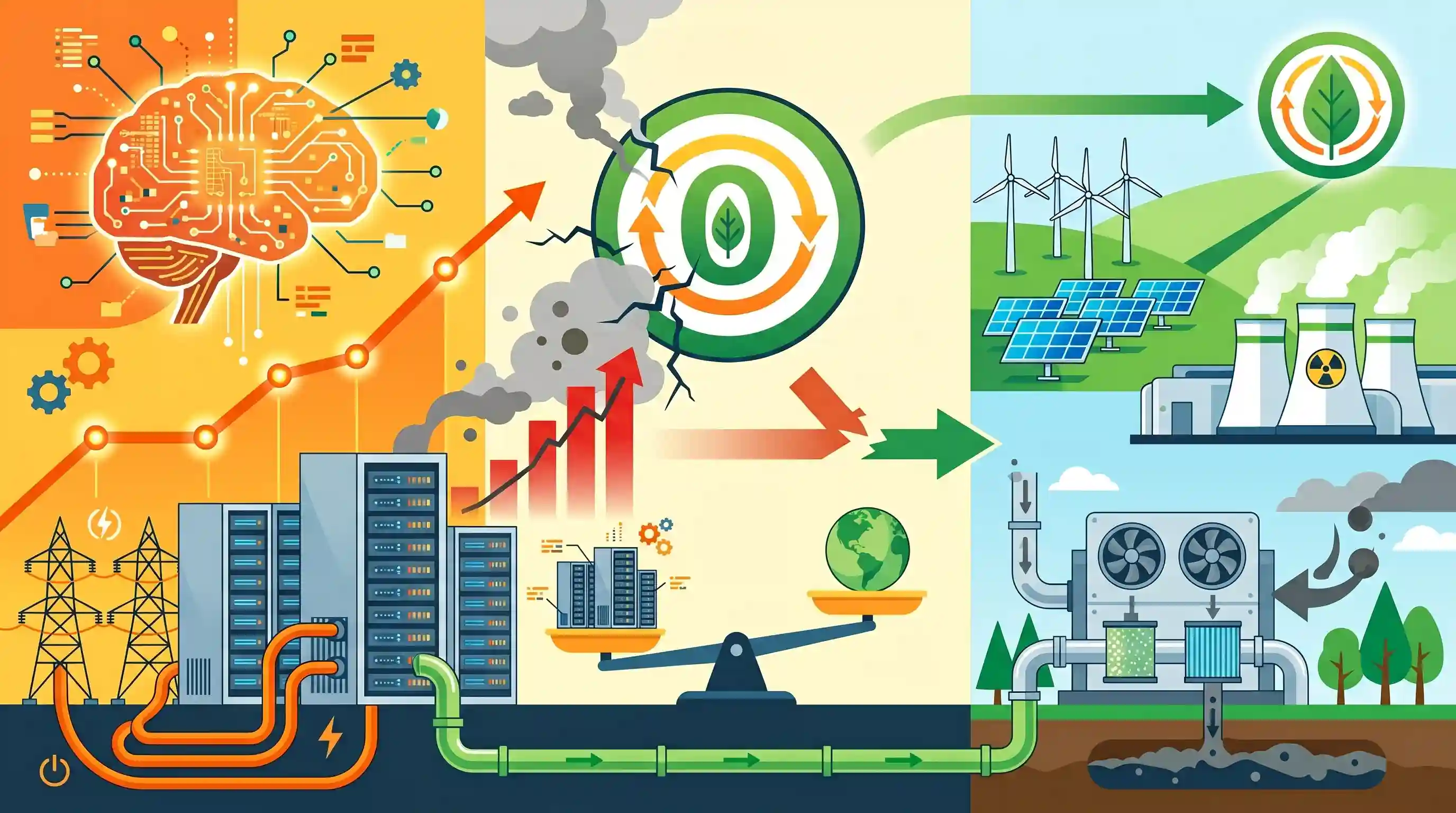
The rapid advancement and integration of Artificial Intelligence (AI) have triggered an unprecedented surge in the energy demands of the technology industry, jeopardizing companies' ambitious climate pledges. Tech giants like Google, Microsoft, and Amazon rely on massive data centers to power large language models, requiring enormous electricity for both computation and cooling. Consequently, their carbon emissions have climbed significantly, threatening their 'net-zero' targets. To reconcile the AI race with environmental sustainability, the industry is accelerating investments in renewable energy, alternative baseload power such as Small Modular Reactors (SMRs), and carbon removal technologies.
Key Points
- The training and deployment of large language models (LLMs) and generative AI demand massive computational power, drastically increasing the energy consumption of data centers.
- Cooling systems required to prevent servers from overheating consume large volumes of electricity and water, exacerbating the environmental footprint of digital infrastructure.
- Major tech companies are seeing a surge in their greenhouse gas emissions, threatening their self-imposed 'net-zero' and carbon neutrality targets for 2030.
- To offset their carbon footprint, the tech industry is investing heavily in renewable energy procurement, advanced liquid cooling, carbon capture and removal technologies, and emerging baseload power like Small Modular Reactors (SMRs).
- The energy intensity of AI highlights a core friction between rapid technological advancement and global climate change mitigation efforts.
Important Terms
Net-Zero Emissions

A state where the greenhouse gases emitted into the atmosphere are balanced by an equivalent amount being removed or absorbed, typically through carbon sinks or technology.
UPSC context
GS Paper III (Environment); vital for discussing India's 2070 climate target and global mitigation strategies under UNFCCC.
Small Modular Reactors (SMRs)
Advanced nuclear reactors with a power capacity of up to 300 MW(e) per unit, designed for modular, factory-based manufacturing and flexible deployment at diverse sites.
UPSC context
GS Paper III (Science & Technology/Energy); represents a low-carbon baseload power alternative to fossil-fuel-heavy energy grids.
Artificial Intelligence (AI)
Computer systems designed to perform tasks requiring human intelligence, such as reasoning or language processing. Their high energy demand for training models is a growing environmental concern.
UPSC context
GS Paper III (Science & Technology); tests understanding of emerging tech's multi-dimensional impacts, including the 'energy-water nexus.'
Paris Agreement
A 2015 legally binding international treaty aiming to limit global warming to well below 2°C, preferably 1.5°C, compared to pre-industrial levels through voluntary national targets.
UPSC context
GS Paper III (Environment); the core framework for climate diplomacy and Nationally Determined Contributions (NDCs).
Data Centers
Physical facilities housing servers and storage systems for digital processing. They consume massive electricity and water for computation and cooling, especially for AI-intensive workloads.
UPSC context
GS Paper III (Infrastructure/Economy); relevant for discussing the sustainability of digital infrastructure and energy security.
Carbon Removal Technologies
Technologies like Carbon Capture, Utilization, and Storage (CCUS) designed to capture CO2 from industrial sources or the air to prevent its release or permanently store it.
UPSC context
GS Paper III (Environment/S&T); focuses on technological solutions for 'hard-to-abate' sectors and reaching net-zero goals.
Prelims Trap
Small Modular Reactors (SMRs) are advanced nuclear fusion devices that provide low-carbon baseload power with zero radioactive waste.
SMRs use nuclear fission, not fusion. While they are low-carbon and possess enhanced passive safety features, they still generate spent nuclear fuel and radioactive waste requiring safe long-term disposal.
Static Concepts Connected
What are the key characteristics of Small Modular Reactors (SMRs)?
- Capacity limit: They have a power capacity of up to 300 MW(e) per unit, which is about one-third of traditional nuclear power reactors.
- Modularity: Components are factory-assembled and transported as modules to the site, reducing construction time, site preparation, and capital costs.
- Passive safety: They employ passive safety systems relying on natural circulation, gravity, and convection to shut down safely without external power or human intervention.
How do Carbon Capture (CCUS) and Carbon Removal differ?
- Point-source capture (CCUS): Captures CO2 emissions directly from industrial point sources (like power plants) before they enter the atmosphere, preventing new emissions.
- Carbon Removal (CDR): Extracts CO2 that is already present in the ambient atmosphere (e.g., via Direct Air Capture or afforestation) to reduce historical carbon concentrations.
- Storage requirement: Both pathways require captured CO2 to be compressed and either stored in deep geological formations or utilized in industrial processes.
Cross-Topic Patterns
AI Data Centers & Water Stress
The intense water footprint of liquid cooling systems in AI data centers connects digital infrastructure expansion directly to localized water scarcity and groundwater depletion themes.
Nuclear Revival via Big Tech
The search for stable, 24/7 low-carbon baseload power for digital infrastructure is driving corporate investments into Small Modular Reactors (SMRs), creating a new private-sector push for nuclear energy.

Expect a 2026 multi-statement question on SMRs, pairing their capacity limits (<300MW) with passive safety features and corporate adoption.
Linked PYQs · 4
Linked PYQs · 4
- 2023MainsGS3
Introduce the concept of Artificial Intelligence (AI). How does Al help clinical diagnosis? Do you perceive any threat to privacy of the individual in the use of Al in healthcare?
- 2022MainsGS3
Do you think India will meet 50 percent of its energy needs from renewable energy by 2030 ? Justify your answer. How will the shift of subsidies from fossil fuels to renewables help achieve the above objective ? Explain.
- 2022MainsGS3
Discuss global warming and mention its effects on the global climate. Explain the control measures to bring down the level of greenhouse gases which cause global warming, in the light of the Kyoto Protocol, 1997.
- 2023MainsGS3
What is the status of digitalization in the Indian economy? Examine the problems faced in this regard and suggest improvements.
