Caspian Sea Water Level Decline And Regional Ecological Challenges
Source:Indian Express ↗
Why It Matters
This article is highly relevant for UPSC because it bridges world physical geography (littoral countries, rivers, and the nature of endorheic lakes), environmental conservation (treaties like the Tehran Convention and climate impacts on closed basins), and international relations (regional geopolitics, transport corridors like the INSTC, and Eurasian strategic dynamics).
Summary
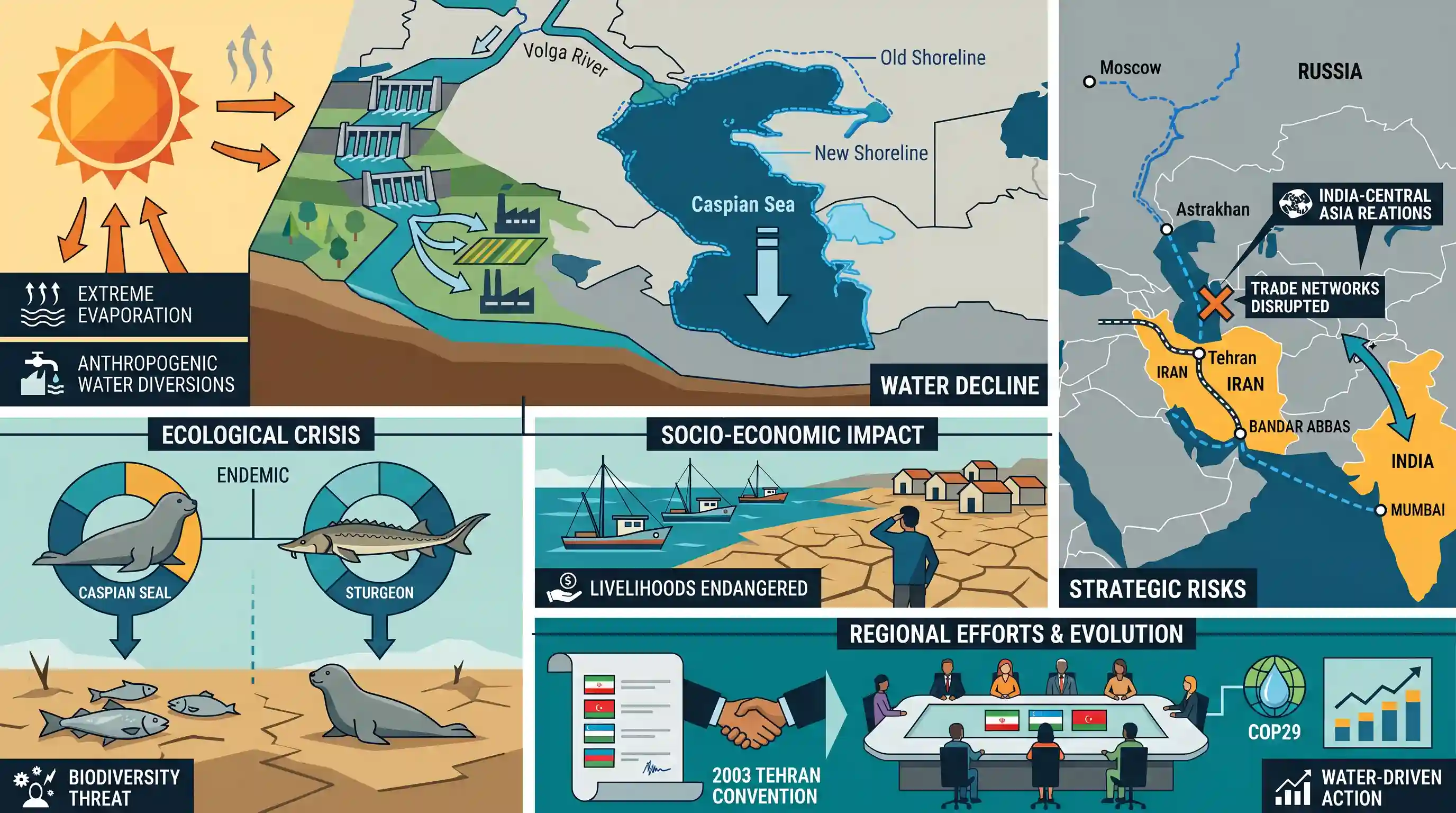
The Caspian Sea—the world's largest landlocked water body—is undergoing rapid and severe shrinkage due to the dual pressures of climate-induced extreme evaporation and upstream anthropogenic water diversions (primarily on the Volga River). This ecological crisis threatens the basin's rich, endemic biodiversity (such as the Caspian seal and sturgeon), endangers the livelihoods of coastal communities, and poses strategic risks by disrupting vital trade networks like India's International North-South Transport Corridor (INSTC). Regional efforts, historically driven by the 2003 Tehran Convention, are now evolving to tackle climate-driven water decline, as formalized by the COP29 declaration in 2024.
Key Points
- Geographical Profile: The Caspian Sea is the Earth's largest landlocked water body (often classified as a lake) spanning ~371,000 sq km, with a 6,819 km coastline shared by Azerbaijan, Iran, Russia, Turkmenistan, and Kazakhstan. It has no natural outlets and relies on freshwater inflow, primarily from Russia's Volga River (nearly 80% of total inflow).
- Causes of Shrinkage: The Caspian Sea has lost 5.5% of its surface area since the mid-1990s due to a combination of: (a) Anthropogenic factors (dams, reservoirs, and agricultural diversions upstream on the Volga River) and (b) Climate change (a 1°C rise in regional temperatures driving extreme evaporation rates that vastly exceed freshwater inputs).
- Ecological & Socio-Economic Impacts: Shrinking water levels threaten endemic biodiversity (such as the endangered Caspian Seal and Beluga Sturgeon, which produces 90% of black caviar), trigger toxic dust/salt storms from the exposed seabed, cause harmful algal blooms (monitored via rising chlorophyll-a concentrations), and devastate local fisheries and coastal livelihoods.
- Geopolitical & Trade Vulnerabilities: Lowered water levels compromise marine navigability, impacting regional trade and energy transport networks. This directly disrupts Eurasian connectivity corridors, including China's Belt and Road Initiative and India's strategic International North-South Transport Corridor (INSTC) aspirations.
- Governance Responses: The legally binding, UN-backed Tehran Convention (2003) serves as the primary regional framework for pollution prevention and environmental protection among the five littoral states, supported by specialized protocols (Aktau, Moscow, Ashgabat, EIA). Additionally, the COP29 (2024) Declaration aims to address climate-induced sea-level decline through enhanced scientific research and a regional working group.
Important Terms
Tehran Convention

A legally binding regional environmental agreement signed in 2003 by the five Caspian littoral states to protect the marine environment and promote sustainable resource management.
UPSC context
GS Paper 2 (International Treaties) & Paper 3 (Environment); tests transboundary environmental governance frameworks.
Declaration on Strengthening Cooperation to Address the Caspian Sea Water Level Decline (COP29)
A ministerial declaration adopted in November 2024 by Caspian littoral states, establishing a working group to study climate-induced water decline and formulate transboundary adaptation measures.
UPSC context
GS Paper 3 (Climate Change); tests knowledge of regional responses to climate-induced ecological crises.
Protocol on Environmental Impact Assessment
A Tehran Convention protocol that entered into force in November 2025, legally requiring Caspian states to assess transboundary environmental impacts of major planned infrastructure projects.
UPSC context
GS Paper 3 (Environmental Impact Assessment); tests knowledge of transboundary ecological safety mandates.
International North-South Transport Corridor (INSTC)
A 7,200-kilometer multimodal trade network connecting India, Iran, and Russia via the Caspian Sea, significantly reducing cargo transit times compared to the Suez Canal route.
UPSC context
GS Paper 2 (Regional Connectivity); tests strategic and economic trade corridors crucial to India's foreign policy.
Ashgabat Protocol
A protocol to the Tehran Convention adopted in 2014, specifically focusing on the conservation of biological diversity and protection of endemic and endangered species in the Caspian Sea.
UPSC context
GS Paper 3 (Biodiversity Conservation); tests familiarity with regional instruments protecting transboundary marine ecosystems.
Aktau Protocol
A protocol under the Tehran Convention concerning regional preparedness, response, and cooperation in combating oil pollution incidents in the Caspian Sea.
UPSC context
GS Paper 3 (Environmental Pollution); tests understanding of transboundary frameworks for managing marine hazards and pollution.
Prelims Trap
The Caspian Sea is governed by standard UNCLOS maritime zoning regulations, as it is legally recognized as an international inland sea.
The 2018 Caspian Sea Treaty classified it as a 'special legal status' body, neither sea nor lake, explicitly bypassing standard UNCLOS maritime boundary divisions.
Static Concepts Connected
What defines an endorheic basin, and how does it react to climatic stressors?
- Closed drainage system: An endorheic basin is a closed drainage system that retains water and has no active outflow to external oceans or seas.
- Evaporation dominated: Water loss occurs primarily through evaporation and seepage, making the water level highly sensitive to temperature rises and rainfall fluctuations.
- Accumulated minerals: Inflows carry minerals without exit, which can result in high salinity over time, although regional variations exist near river mouths.
How does the 2018 Convention define the legal status of the Caspian Sea?
- Sui generis class: It defines the Caspian as a body of water with 'special legal status', meaning standard UNCLOS maritime boundary rules do not automatically apply.
- Military exclusion: The treaty explicitly bans any non-littoral armed forces from accessing or patrolling the Caspian Sea waters.
- Surface-seabed split: The treaty allows joint use of the water surface while dividing seabed resources through bilateral agreements among the five littoral nations.
Cross-Topic Patterns
Endorheic shrinkage + INSTC supply chains
The drying Caspian Sea reduces draft levels at key ports, choking maritime segments of India's INSTC corridor and forcing reliance on alternative land routes.
Transboundary ecology + Sovereignty disputes
Transboundary ecological regimes like the Tehran Convention face gridlocks as national resource extraction priorities clash with collective conservation mandates.

2018 Caspian Treaty's special legal status combined with Volga diversion impacts on INSTC ports will likely form a 2026 prelims question.
Linked PYQs · 2
Linked PYQs · 2
- 2019PrelimsGS1
Consider the following pairs: Sea Bordering country 1. Adriatic Sea : Albania 2. Black Sea : Croatia 3. Caspian Sea : Kazakhstan 4. Mediterranean Sea : Morocco 5. Red Sea : Syria Which of the pairs given above are correctly matched?
- 2024MainsGS2
Critically analyse India's evolving diplomatic, economic and strategic relations with the Central Asian Republics (CARs) highlighting their increasing significance in regional and global geopolitics.
