Impact of global bond sell off on Indian macroeconomic stability
Source:The Hindu ↗
কেন এটি গুরুত্বপূর্ণ
Understanding global financial spillover effects is critical for UPSC aspirants studying external sector stability, capital account convertibility, monetary policy transmissions, and macroeconomic management in India.
সারসংক্ষেপ
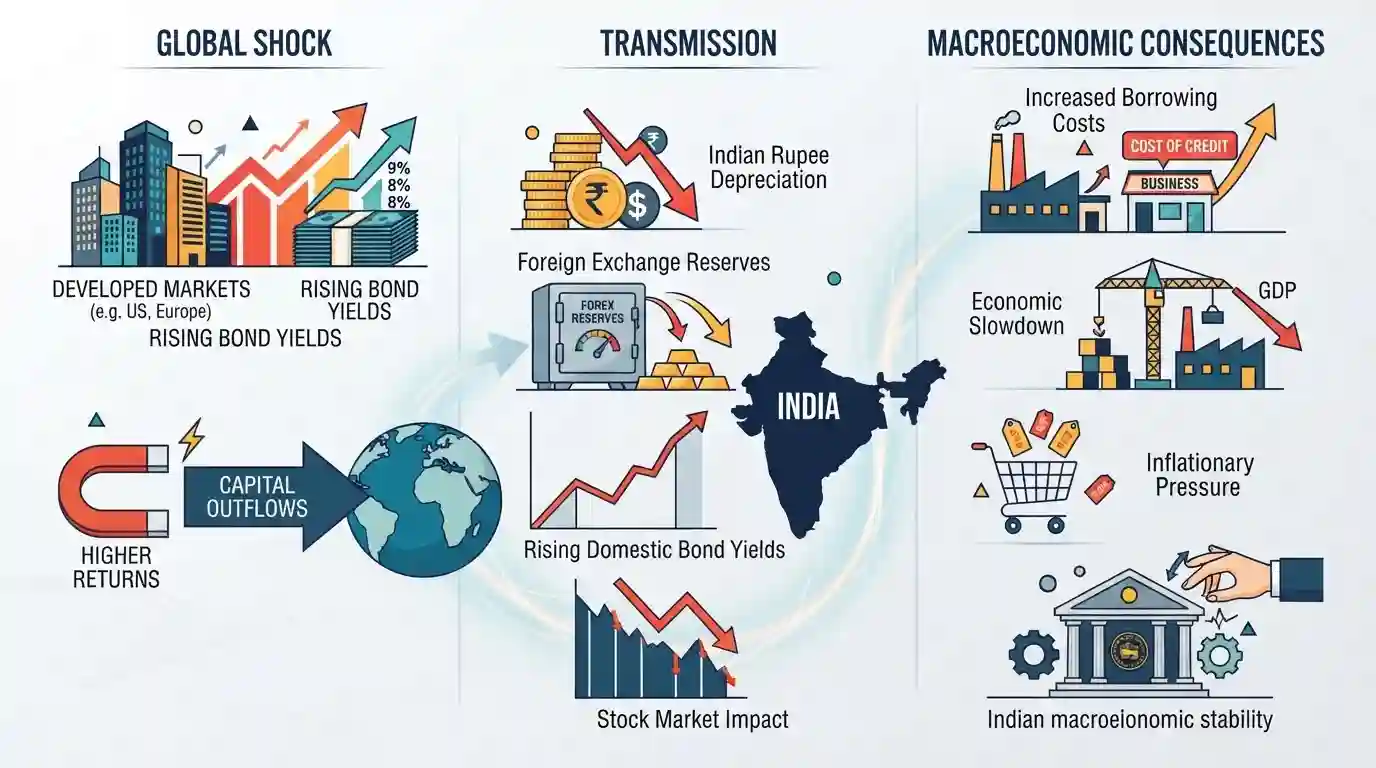
The article explains the mechanics of a global bond sell-off, where rising yields in developed nations trigger capital outflows from emerging economies like India, affecting the domestic currency, foreign exchange reserves, bond yields, and overall macroeconomic stability.
মূল বিষয়
- Global bond sell-offs lead to rising bond yields in advanced economies like the U.S., making them more attractive to international investors.
- This triggers capital outflows (FPI) from emerging markets like India as investors chase higher, safer returns abroad.
- Capital outflows exert downward pressure on the Indian rupee against the U.S. dollar, increasing imported inflation and import bills (especially for oil).
- Domestic bond yields in India may face upward pressure as borrowing costs rise globally, impacting corporate borrowing and government debt management.
গুরুত্বপূর্ণ শব্দ
Reserve Bank of India

The central banking institution of India responsible for regulating the monetary system, issuing currency, managing foreign exchange reserves, and maintaining financial stability under the RBI Act, 1934.
UPSC context
UPSC GS Paper III (Indian Economy): Tests understanding of central banking functions, monetary policy formulation, inflation targeting, and macroeconomic management.
RBI
India's apex monetary authority and central bank, which formulates monetary policy, regulates commercial banks, and manages government debt and liquidity.
UPSC context
UPSC GS Paper III (Indian Economy): Frequently tested regarding its policy instruments (repo rate, CRR, OMO) and role in maintaining financial stability.
সংযুক্ত স্থির ধারণা
What is the inverse relationship between bond prices and bond yields in financial markets?
- Price-Yield Inverse: Inverse movement: When bond prices rise in the secondary market, their effective yields fall, and conversely, when bond prices drop (sell-off), yields increase.
- Fixed Coupon: Coupon rate: The fixed interest paid by a bond does not change, but the yield adjusts based on the price paid by the investor in the market.
- Global Benchmark: Opportunity cost: Rising yields in safe-haven bonds (like U.S. Treasuries) raise global borrowing benchmarks and attract capital away from emerging markets.
আন্তঃবিষয় প্যাটার্ন
Capital Outflows vs. Monetary Policy Autonomy
Global bond sell-offs and rising U.S. yields trigger FPI outflows, forcing central banks to balance domestic growth with exchange rate stability and reserve management.
External Debt Servicing and Macro-Stability
Higher bond yields in advanced economies increase external commercial borrowing costs for Indian firms and raise sovereign debt servicing burdens.

Global bond yield spikes + FPI outflows + Rupee depreciation will likely feature in a multi-statement macroeconomic linkages question.
সংযুক্ত PYQ · 3
সংযুক্ত PYQ · 3
- 2018MainsGS3
How would the recent phenomena of protectionism and currency manipulations in world trade affect macroeconomic stability of India?
- 2024MainsGS3
What are the causes of persistent high food inflation in India? Comment on the effectiveness of the monetary policy of the RBI to control this type of inflation.
- 2015MainsGS3
Craze for gold in Indians has led to a surge in import of gold in recent years and put pressure on balance of payments and external value of rupee. In view of this, examine the merits of the Gold Monetization Scheme.
