Fiscal and ecological costs of fertilizer subsidies and controls
Source:Indian Express ↗
Why It Matters
Directly maps to the GS3 syllabus topic "Issues related to direct and indirect farm subsidies." It highlights the economic, ecological, and fiscal consequences of prolonged government intervention in agricultural input pricing, which is crucial for both Mains and Prelims.
Summary
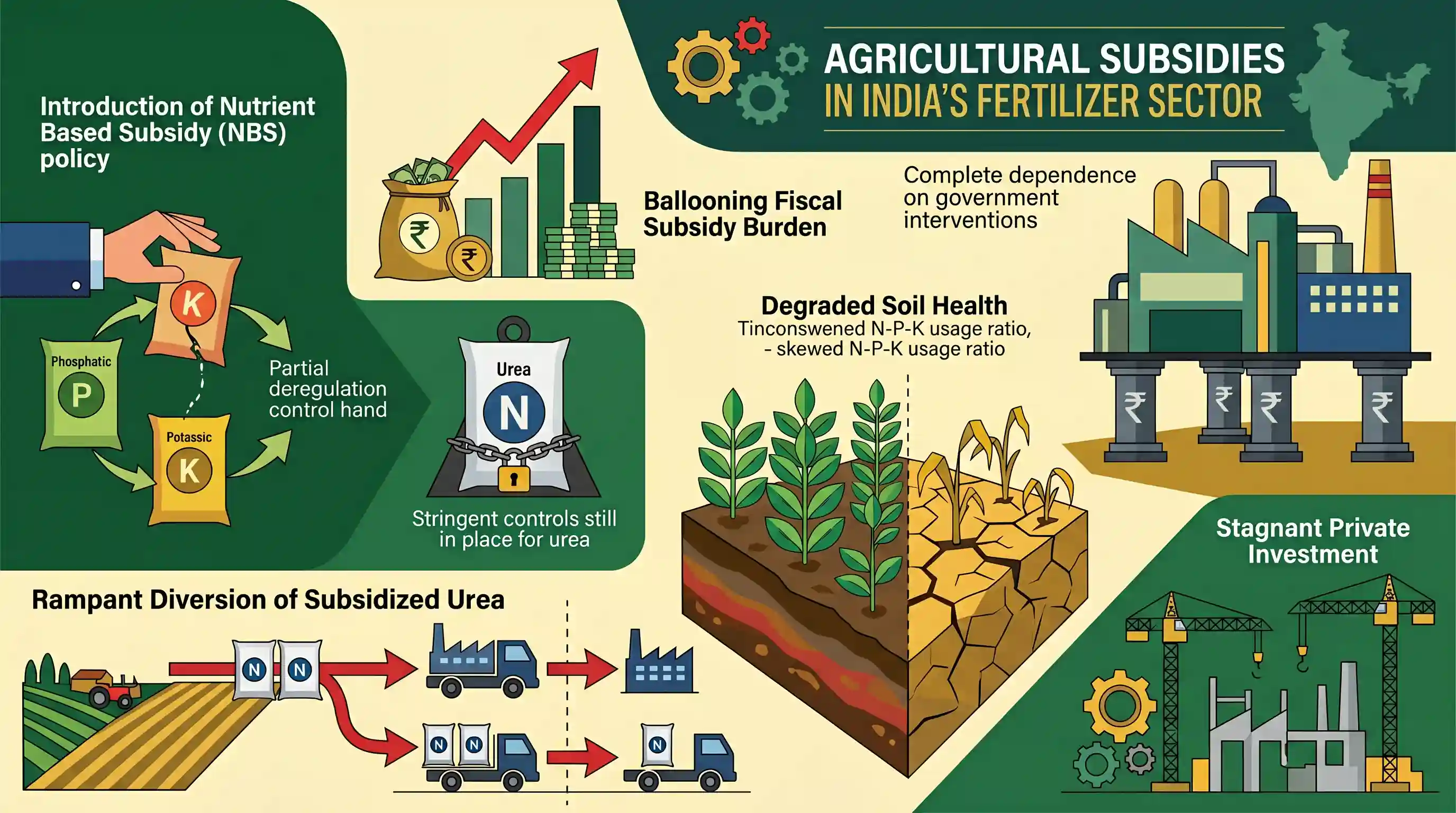
The article analyzes the deep-rooted price controls and subsidies in India's fertilizer sector, highlighting how the industry has become entirely dependent on government interventions. Despite the introduction of the Nutrient Based Subsidy (NBS) in 2010 to partially deregulate Phosphatic and Potassic (P&K) fertilizers, stringent controls remain, particularly on urea. The "costs" of this regulatory regime are multifaceted: a ballooning fiscal subsidy burden, a heavily skewed N-P-K usage ratio that degrades soil health, stagnant private investment in domestic fertilizer manufacturing, and the rampant diversion of subsidized urea for non-agricultural uses.
Key Points
- The Indian fertilizer industry is heavily regulated, with urea being the most subsidized fertilizer and its Maximum Retail Price (MRP) strictly fixed by the government.
- Although the Nutrient Based Subsidy (NBS) scheme was introduced in 2010 to partially deregulate Phosphatic and Potassic (P&K) fertilizers, informal price controls continue to persist.
- Artificially depressed urea prices have led to a heavily skewed Nitrogen-Phosphorus-Potassium (N-P-K) application ratio by farmers, causing severe soil degradation.
- The pervasive control regime imposes a massive fiscal burden on the government, with the annual fertilizer subsidy bill expanding significantly.
- Price controls and subsidies have deterred fresh private investments in domestic manufacturing and incentivized the illicit diversion of agricultural urea for industrial purposes.
Important Terms
Nutrient Based Subsidy (NBS) Scheme

A central scheme launched in 2010 providing a fixed-rate subsidy per kilogram of nutrients (N, P, K, S) in non-urea fertilizers to promote balanced soil nutrition and market-linked pricing.
UPSC context
GS-3 Agriculture/Economics. Crucial for understanding fertilizer pricing distortions, soil health, and the debate over decontrolling urea to reduce the fiscal deficit.
Retention Pricing Scheme (RPS)
A historical "cost-plus" subsidy regime (1977–2003) where the government paid manufacturers the difference between their unit-specific production cost and a fixed retail price.
UPSC context
GS-3 Agriculture. Illustrates the evolution of fertilizer controls and the inherent inefficiencies (lack of cost-reduction incentives) that led to modern pricing reforms.
Neem Coated Urea (NCU)
Urea coated with neem oil to slow the release of nitrogen into the soil and prevent its illegal diversion to industrial sectors like plywood or resin.
UPSC context
GS-3 Agriculture/Environment. Tests knowledge of nutrient-use efficiency, groundwater protection from nitrate leaching, and administrative reforms to curb leakages.
Ideal NPK Ratio
The benchmark nitrogen-phosphorus-potassium balance (4:2:1) recommended for Indian soil; current usage is heavily skewed towards nitrogen due to excessive urea subsidies.
UPSC context
GS-3 Agriculture/Soil Health. Highlighting the environmental costs of skewed subsidies and their impact on long-term agricultural sustainability and crop yields.
Direct Benefit Transfer (DBT) in Fertilizers
A system where fertilizer subsidies are released to companies only after actual sales are verified at retail points using Aadhaar-authenticated Point of Sale (PoS) devices.
UPSC context
GS-3 Agriculture/E-Governance. Focuses on transparency, reducing leakages, and the potential transition toward direct cash transfers to farmers.
Urea Diversion
The illegal siphoning of subsidized agricultural urea for non-farm industrial uses (e.g., plastics, adhesives) or smuggling, driven by the significant price gap with industrial urea.
UPSC context
GS-3 Agriculture/Internal Security. Addresses challenges in subsidy targeting, leakage prevention, and the rationale behind reforms like Neem Coating.
Ministry of Chemicals and Fertilizers
The nodal central ministry responsible for the manufacturing, pricing, and distribution of fertilizers in India, primarily through its Department of Fertilizers.
UPSC context
GS-2 Government Policies. Important for identifying the executive authority behind major fertilizer schemes and industrial regulations.
Prelims Trap
The Nutrient Based Subsidy (NBS) scheme determines the subsidy for all fertilizers, including Urea.
Urea is completely excluded from NBS. Urea MRP is statutorily fixed by the government, whereas NBS applies only to Phosphatic and Potassic (P&K) fertilizers based on nutrient content.
Static Concepts Connected
How does the Nutrient Based Subsidy (NBS) scheme function?
- Mechanism: Provides a fixed subsidy amount per kg of nutrient (N, P, K, S) rather than subsidizing the final product price.
- Coverage: Applies to 28 grades of Phosphatic and Potassic (P&K) fertilizers; completely excludes Urea.
- Objective: Aims to promote balanced fertilization (correcting the skewed N-P-K ratio) and reduce the government's fiscal subsidy burden.
Why is 100% Neem-coated urea mandated in India?
- Slower Release: Neem coating slows the dissolution of urea in soil, improving Nitrogen Use Efficiency (NUE) and enhancing crop yields.
- Prevent Diversion: Makes the highly-subsidized agricultural urea unsuitable for industrial use (e.g., plastics, adhesives), thereby curbing illegal diversion.
- Environmental Protection: Reduces nitrogen runoff and leaching, minimizing long-term soil acidification and preventing groundwater eutrophication.
Cross-Topic Patterns
Fertilizers + PM-PRANAM Scheme
The chronic overuse of subsidized urea directly birthed PM-PRANAM, which incentivizes States to reduce their chemical fertilizer consumption and promote alternative, bio-fertilizers.
Input Subsidies + WTO Amber Box
India's massive fertilizer subsidies are classified under the WTO's Amber Box (trade-distorting), frequently causing friction with developed nations during WTO Ministerial Conferences over agricultural support.

Expect a multi-statement Prelims question contrasting Urea's statutory pricing with the NBS scheme for P&K, alongside soil health impacts.
Linked PYQs · 4
Linked PYQs · 4
- 2020PrelimsGS1
With reference to chemical fertilizers in India, consider the following statements : 1. At present, the retail price of chemical fertilizers is market-driven and not administered by the Government. 2. Ammonia, which is an input of urea, is produced from natural gas. 3. Sulphur, which is a raw material for phosphoric acid fertilizer, is a by-product of oil refineries. Which of the statements given above is/are correct?
- 2016PrelimsGS1
Why does the Government of India promote the use of 'Neem-coated Urea' in agriculture?
- 2017MainsGS3
How do subsidies affect the cropping pattern, crop diversity and economy of farmers? What is the significance of crop insurance, minimum support price and food processing for small and marginal farmers?
- 2023MainsGS3
What are the direct and indirect subsidies provided to farm sector in India? Discuss the issues raised by the World Trade Organization (WTO) in relation to agricultural subsidies.
