Anti-Defection Law Application in AIADMK Crisis
Source:The Hindu ↗
Why It Matters
The Anti-Defection Law is a frequent focal point in UPSC exams due to its recurring relevance in Indian politics. Understanding the distinction between splits and mergers, the powers of the Speaker versus the Election Commission, and the limits of judicial intervention is crucial for answering GS2 questions on constitutional safeguards against political defection and the stability of state governments.
Summary
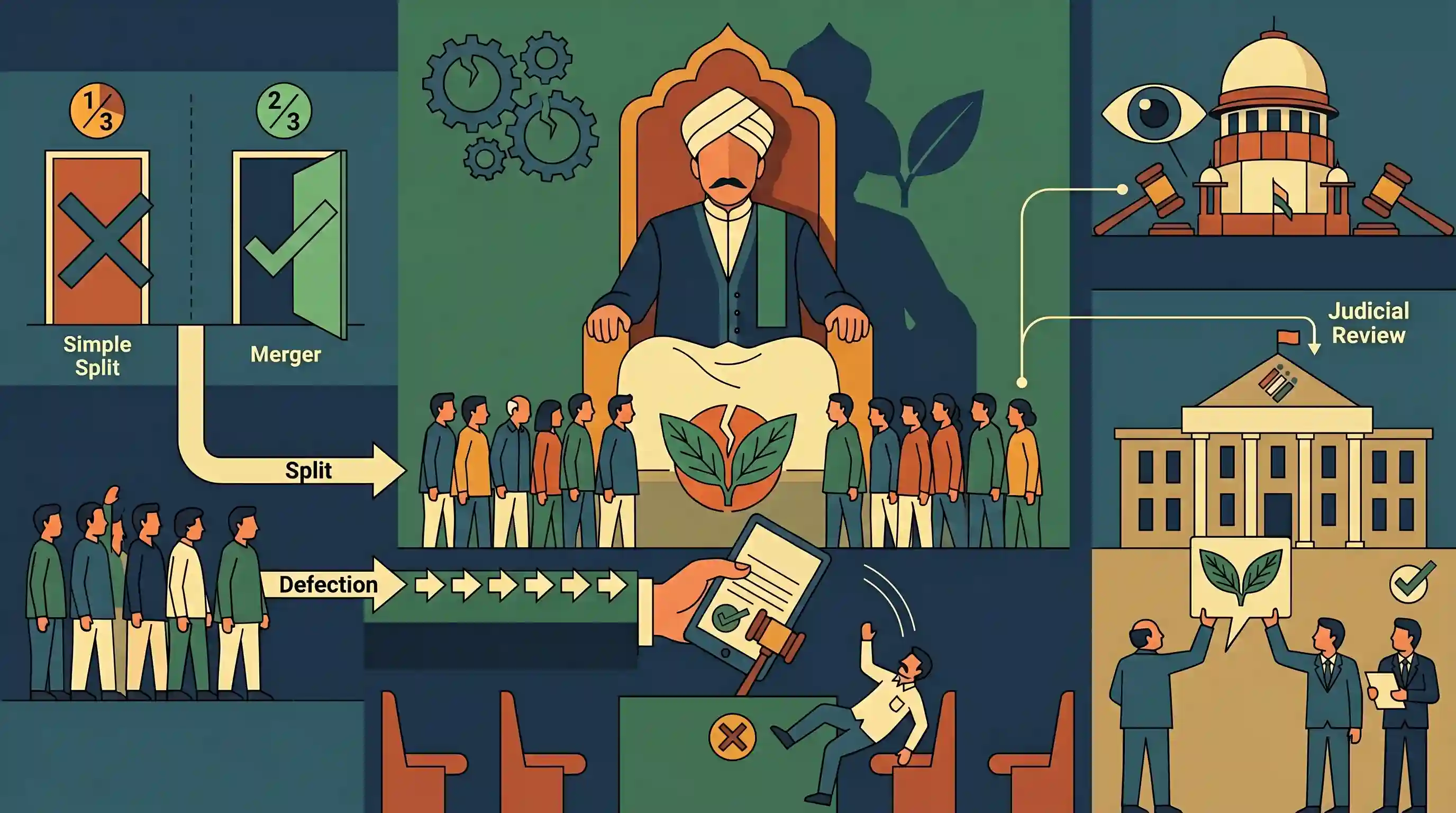
The article analyzes the operation of the Anti-Defection Law (Tenth Schedule) amid the leadership crisis and factional split in Tamil Nadu's AIADMK party. It highlights the pivotal role of the Legislative Assembly Speaker in deciding disqualification petitions against MLAs, the impact of the 91st Amendment which outlawed simple party splits, and the parallel role of the Election Commission in determining the rightful party faction. The scenario underscores ongoing constitutional debates regarding internal party democracy, the partisan potential of the Speaker's office, and the scope of judicial review in defection cases.
Key Points
- The article examines the constitutional mechanisms of the Anti-Defection Law (Tenth Schedule) as applied to the leadership tussle and factional split within the AIADMK in Tamil Nadu.
- Under the Tenth Schedule, the Speaker of the Legislative Assembly holds the adjudicatory power to decide on disqualification petitions against MLAs defying party whips or voluntarily giving up membership.
- The 91st Constitutional Amendment Act (2003) deleted the provision that protected a one-third 'split' from disqualification, requiring instead a two-thirds majority for a valid 'merger'.
- The situation highlights the complex dual jurisdiction where the Election Commission decides which faction is the 'real' party for symbol allocation, while the Speaker decides disqualification.
- The Speaker's adjudicatory decisions on anti-defection are subject to judicial review (as per Kihoto Hollohan 1992), though courts typically intervene only after a final decision is made, raising concerns about deliberate delays.
Important Terms
Tenth Schedule of the Indian Constitution

Added by the 52nd Amendment (1985), this schedule provides for the disqualification of MPs and MLAs on grounds of defection, such as voluntarily quitting a party or defying a whip.
UPSC context
GS Paper 2 (Polity); fundamental for understanding legislative stability, party discipline, and the constitutional framework for elected representatives.
91st Constitutional Amendment Act (2003)
A 2003 amendment that strengthened the Tenth Schedule by removing the 'one-third split' protection and limiting the size of the Council of Ministers to 15% of the House.
UPSC context
GS Paper 2 (Significant Amendments); tests knowledge of electoral reforms aimed at preventing unprincipled splits and the misuse of ministerial posts.
Speaker of the Legislative Assembly
The presiding officer of a state legislature who acts as a quasi-judicial tribunal with the primary authority to decide disqualification petitions under the Anti-Defection Law.
UPSC context
GS Paper 2 (Constitutional Posts); concerns the neutrality of the Speaker's office and its role in adjudicating internal party disputes.
Election Commission of India (ECI)
A constitutional body (Article 324) empowered to resolve disputes between rival factions of a political party over recognition, official names, and the allotment of election symbols.
UPSC context
GS Paper 2 (Constitutional Bodies); critical for distinguishing between the legislative role of the Speaker and organizational role of the ECI.
Kihoto Hollohan v. Zachillhu (1992)
A landmark 1992 Supreme Court judgment that upheld the validity of the Anti-Defection Law but ruled that the Speaker’s decisions are subject to judicial review.
UPSC context
GS Paper 2 (Landmark Judgments); essential for understanding the quasi-judicial nature of the Speaker and the scope of court intervention.
Judicial Review
The power of the High Courts and Supreme Court to examine the legality of the Speaker's final decision in defection cases to check for mala fides or perversity.
UPSC context
GS Paper 2 (Basic Structure); focuses on the check-and-balance mechanism between the judiciary and the legislature in political disputes.
Prelims Trap
"A split by one-third of legislative party members protects them from disqualification."
The 91st Amendment (2003) deleted the exemption for a 'split'. Currently, disqualification is avoided only via a 'merger' involving at least two-thirds of the legislative party.
Static Concepts Connected
How do Speaker and ECI jurisdictions differ during a party split?
- Speaker's Role: Decides MLA/MP disqualification petitions under the Tenth Schedule, acting as a quasi-judicial tribunal.
- ECI's Role: Determines which faction is the 'real' party and allocates the election symbol under Paragraph 15 of the Election Symbols Order, 1968.
- Parallel Independence: The proceedings are legally parallel and independent; the ECI's symbol ruling does not automatically bind the Speaker's disqualification verdict.
What is the scope of judicial review under the Anti-Defection Law?
- Kihoto Hollohan (1992): The 1992 SC judgment ruled that the Speaker acts as a tribunal, making final defection decisions subject to judicial review.
- No Premature Review: Courts generally cannot intervene at the interlocutory stage; they must wait for the Speaker to make a final adjudicatory decision.
- Limited Grounds: Judicial review is restricted to jurisdictional errors like mala fides, perversity, or violation of constitutional mandates.
Cross-Topic Patterns
Tenth Schedule + Election Symbols Order
Dual jurisdiction between the Speaker (disqualification) and ECI (party symbol) is a recurring constitutional friction point, echoing the Maharashtra Shiv Sena crisis.
Speaker's Discretion + Judicial Intervention
Delays by Speakers in defection rulings push the Supreme Court to mandate timeframes (e.g., Keisham Meghachandra case), prompting debates on separation of powers.

Expect a multi-statement question in 2026 contrasting the Speaker's Tenth Schedule powers with the ECI's Election Symbols Order mandate.
Linked PYQs · 4
Linked PYQs · 4
- 2014PrelimsGS1
Which one of the following Schedules of the Constitution of India contains provisions regarding anti-defection?
- 1998PrelimsGS1
Which one of the following Schedules of the Constitution of India contains provisions regarding Anti-Defection Act?
- 2025PrelimsGS1
Consider the following statements : I. If any question arises as to whether a Member of the House of the People has become subject to disqualification under the 10th Schedule, the President's decision in accordance with the opinion of the Council of Union Ministers shall be final. II. There is no mention of the word 'political party' in the Constitution of India. Which of the statements given above is/are correct?
- 2020MainsGS2
Once a Speaker, Always a Speaker' ! Do you think this practice should be adopted to impart objectivity to the office of the Speaker of Lok Sabha ? What could be its implications for the robust functioning of parliamentary business in India?
