India Ethanol Blending Push Raises Food and Water Security Concerns
Source:The Hindu ↗
কেন এটি গুরুত্বপূর্ণ
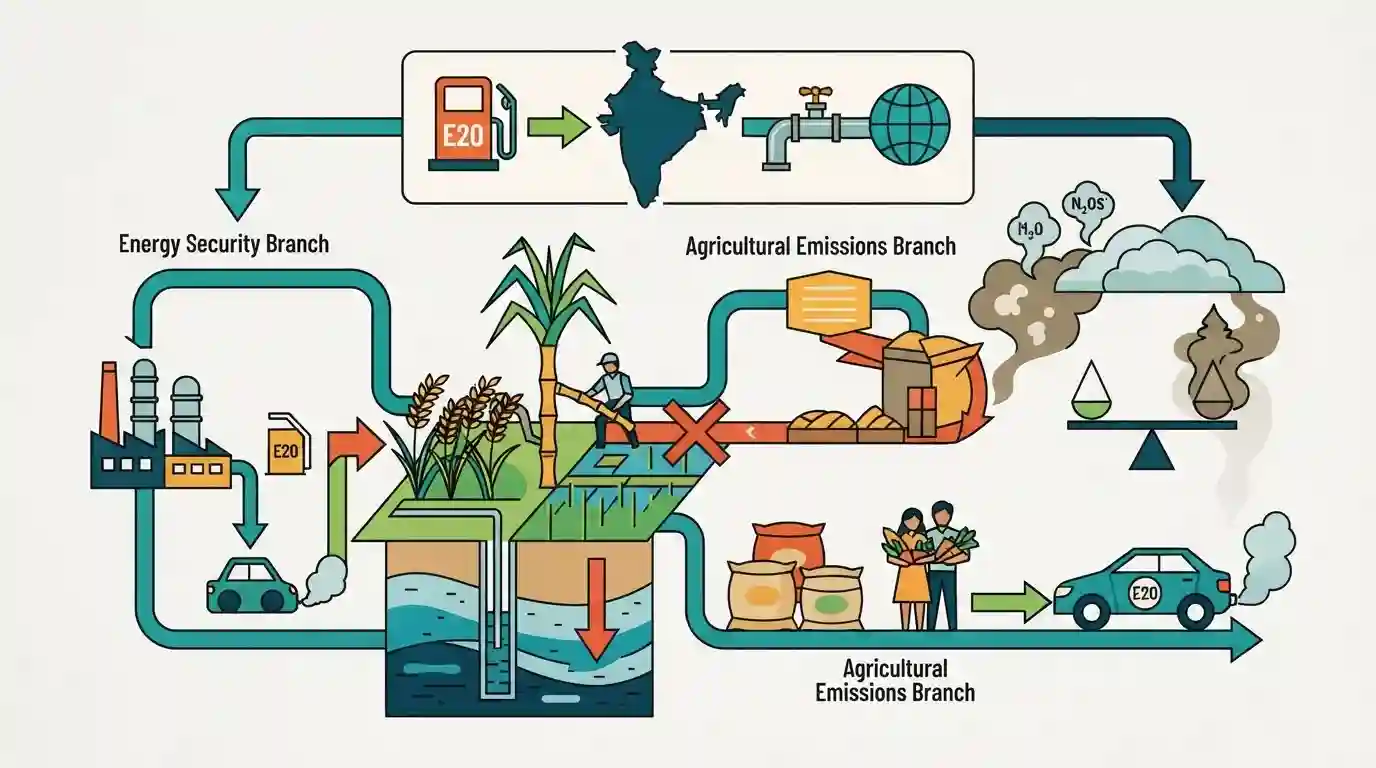
The transition to biofuels is a crucial part of India's climate commitments and energy security strategy. However, the E20 push presents a classic UPSC dilemma evaluating trade-offs: balancing energy independence against water scarcity, agricultural sustainability, and food security.
সারসংক্ষেপ
India's ambitious push to achieve 20% ethanol blending in petrol (E20) by 2025 highlights a critical trade-off within the food-water-energy nexus. While the policy aims to bolster energy security, reduce reliance on imported crude oil, and lower vehicular emissions, its sustainability is widely debated. The program heavily relies on water-intensive feedstocks like sugarcane and rice, exacerbating India's groundwater depletion crisis. Furthermore, utilizing food crops for biofuel risks long-term food security and may lead to agricultural emissions (methane and nitrous oxide) that offset the environmental benefits of lower tailpipe emissions.
মূল বিষয়
- India advanced its target to achieve 20% ethanol blending in petrol (E20) from 2030 to 2025, aiming to reduce crude oil imports, save foreign exchange, and lower carbon emissions.
- The primary feedstocks for India's ethanol production are water-intensive crops like sugarcane and paddy (broken rice), alongside maize.
- The heavy reliance on sugarcane and rice for ethanol poses severe risks to groundwater depletion, contradicting sustainable agriculture goals.
- Diverting edible food grains for fuel production creates a food-versus-fuel dilemma, potentially threatening food security and driving up food inflation.
- While ethanol blending reduces tailpipe emissions, the associated agricultural practices—such as paddy cultivation and fertilizer use—increase emissions of potent greenhouse gases like methane and nitrous oxide.
গুরুত্বপূর্ণ শব্দ
Ethanol Blended Petrol (EBP) Programme

An Indian government initiative launched in 2003 to blend ethanol with petrol. It aims to reduce import dependence on crude oil, cut carbon emissions, and boost farmer incomes by converting crops like sugarcane and maize into biofuel.
UPSC context
Important for GS Paper III (Economy & Environment). Evaluates India's energy transition, climate action, and agricultural resource trade-offs.
National Policy on Biofuels
A 2018 framework (amended in 2022) promoting domestic biofuel production. The amendment crucially advanced the 20% ethanol blending target (E20) from 2030 to 2025-26 and expanded the list of permissible feedstocks.
UPSC context
Highly relevant for GS Paper III (Energy). Tests candidates' knowledge on biofuel targets, feedstock expansions, and the food vs. fuel debate.
Food-Water-Energy Nexus
A conceptual framework describing the complex dependencies between agriculture, water resources, and energy production. In India, promoting biofuel crops like sugarcane directly strains groundwater and risks long-term food security.
UPSC context
A foundational concept for GS Papers I and III, testing analytical views on sustainable development, dryland farming, and resource optimization.
E20 Fuel
A motor fuel blend consisting of 20% ethanol and 80% conventional petrol. It possesses a higher octane number but lower energy density, promoting cleaner combustion while requiring compatible vehicular engine designs.
UPSC context
Tested in GS Paper III and Prelims for understanding green fuel compositions, Research Octane Number (RON), and transitional challenges.
First-Generation Biofuels
Biofuels produced directly from edible food crops and sugars, such as sugarcane, rice, and maize. Their reliance on arable land and freshwater frequently sparks the "food versus fuel" debate.
UPSC context
Crucial for GS Paper III. Prelims frequently probe the classifications of biofuels (1G vs 2G/3G/4G) and their respective raw feedstocks.
প্রিলিমস ফাঁদ
"First-generation (1G) ethanol in India is produced exclusively from non-food crops to prevent the food-versus-fuel conflict."
The National Policy on Biofuels explicitly permits 1G ethanol production from food crops, including sugarcane juice, maize, and damaged food grains like broken rice.
সংযুক্ত স্থির ধারণা
What are the four generations of biofuels?
- 1G (First Gen): Produced directly from food crops like sugarcane, maize, broken rice, and vegetable oils.
- 2G (Second Gen): Produced from non-food crops, agricultural residues (stubble), or municipal solid waste (lignocellulosic biomass).
- 3G (Third Gen): Extracted from micro-algae or seaweeds, boasting high yield without competing for arable land.
- 4G (Fourth Gen): Uses genetically modified organisms/biomass coupled with carbon capture and storage (CCS) for negative emissions.
How does sugarcane pricing policy work in India?
- Fair & Remunerative Price (FRP): Announced by the Central government based on CACP recommendations; it is legally binding on sugar mills to pay this minimum to farmers.
- State Advised Price (SAP): Announced by key sugarcane-producing states (like UP and Punjab); it is typically higher than the FRP.
- Ecological impact: Assured pricing combined with power subsidies creates a perverse incentive to grow water-intensive sugarcane in water-stressed regions like Maharashtra.
আন্তঃবিষয় প্যাটার্ন
Agriculture pricing meets energy policy
Subsidized power and assured FRP for sugarcane incentivize water-intensive farming, directly feeding the E20 target but fundamentally contradicting India's groundwater conservation goals.
The life-cycle emissions paradox
While E20 reduces tailpipe carbon emissions, the methane and nitrous oxide generated from paddy cultivation and fertilizer use can offset these climate gains, exposing a life-cycle emissions paradox.

1G vs 2G biofuel feedstocks, the advanced 2025 E20 target, and water-footprint comparisons of sugarcane vs maize are prime Prelims fodder.
সংযুক্ত PYQ · 4
সংযুক্ত PYQ · 4
- 2020PrelimsGS1
According to India's National Policy on Biofuels, which of the following can be used as raw materials for the production of biofuels ? 1. Cassava 2. Damaged wheat grains 3. Groundnut seeds 4. Horse gram 5. Rotten potatoes 6. Sugar beet Select the correct answer using the code given below:
- 2022PrelimsGS1
Among the following crops, which one is the most important anthropogenic source of both methane and nitrous oxide?
- 2009PrelimsGS1
In the context of alternative sources of energy, ethanol as a viable bio-fuel can be obtained from
- 2025MainsGS3
Examine the factors responsible for depleting groundwater in India. What are the steps taken by the government to mitigate such depletion of groundwater?
