Ethanol Blending Target E20 and Agricultural Resource Sustainability
Source:The Hindu ↗
આ શા માટે મહત્વનું છે
The push for ethanol blending represents a classic policy tradeoff between energy security, environmental sustainability, and food/water security. It is highly relevant for GS3 questions on the sustainability of Indian agriculture, resource management, and the National Policy on Biofuels.
સારાંશ
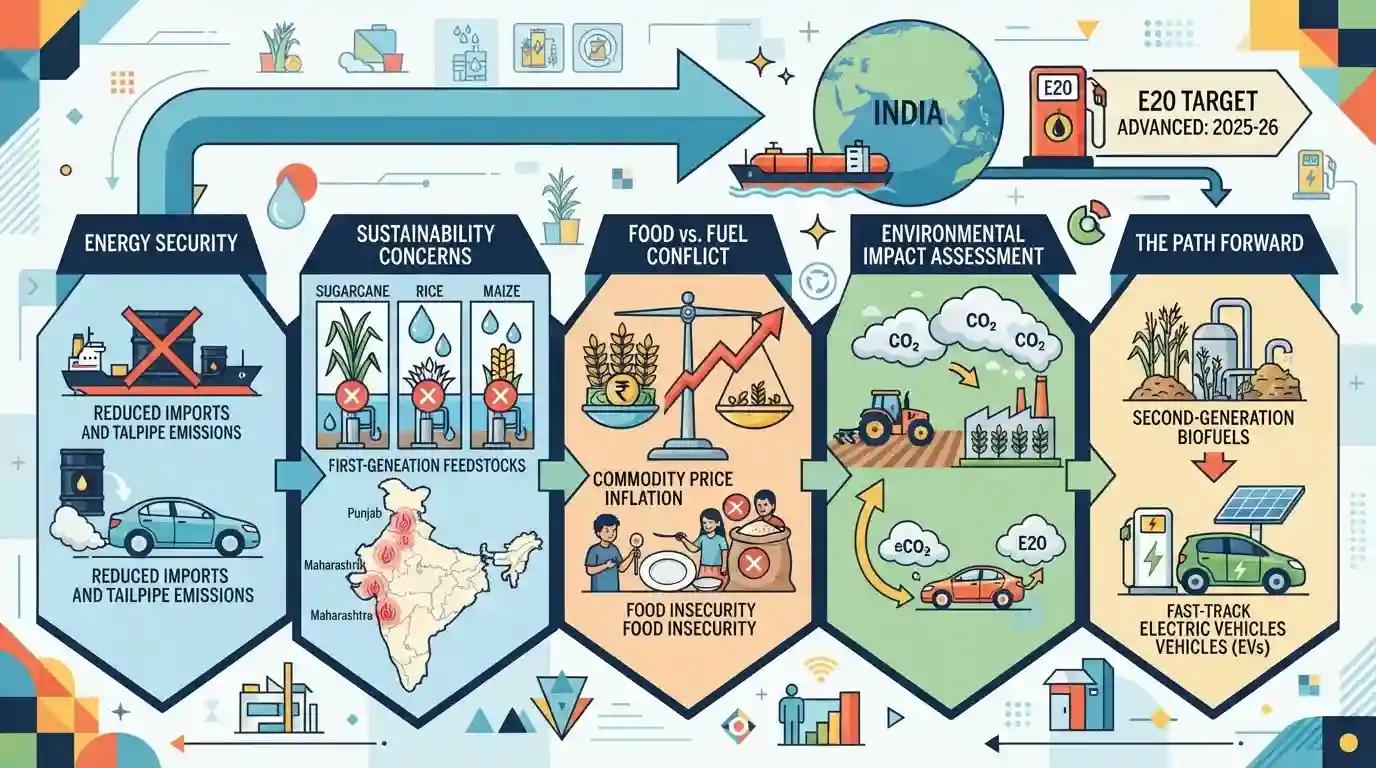
India has advanced its E20 target (20% ethanol blending in petrol) to 2025-26 to curb crude oil imports and reduce tailpipe emissions. However, the program's sustainability is questioned due to its heavy reliance on water-intensive "first-generation" feedstocks like sugarcane, rice, and maize. This threatens to exacerbate severe groundwater depletion in states like Maharashtra and Punjab while creating a 'food vs. fuel' conflict that risks food security and inflates agricultural commodity prices. Furthermore, when factoring in the life-cycle emissions of cultivation and processing, the net environmental benefits of E20 shrink, pointing toward the need for second-generation biofuels or a faster transition to Electric Vehicles (EVs).
મુખ્ય મુદ્દા
- India advanced its target for 20% ethanol blending in petrol (E20) to 2025-26, aiming to reduce dependence on crude oil imports and save foreign exchange.
- The ethanol production heavily relies on first-generation feedstocks, primarily water-intensive crops like sugarcane (juice and molasses) and foodgrains like rice and maize.
- Cultivation of these crops aggravates groundwater depletion in major producing states like Maharashtra, Uttar Pradesh, and Punjab.
- Diverting surplus foodgrains and sugar to fuel production sparks a 'food vs. fuel' debate, posing risks to domestic food security and price stability amid climate-induced agricultural shocks.
- While ethanol blending lowers direct tailpipe emissions, life-cycle greenhouse gas emissions (including fertilizer use and processing) significantly reduce its net environmental benefits.
મહત્વપૂર્ણ શબ્દો
E20 Program

A central initiative to blend 20% ethanol with petrol by 2025-26, advanced from the original 2030 deadline. It aims to reduce crude oil imports and emissions but raises concerns regarding groundwater depletion and food price inflation.
UPSC context
Highly relevant for GS Paper 3 (Energy Security, Environment) to test understanding of import substitution versus ecological and agricultural trade-offs.
National Policy on Biofuels, 2018
A policy promoting domestic biofuel production. Its 2022 amendment advanced the 20% ethanol blending target to 2025-26 and expanded permissible feedstocks to include damaged foodgrains and surplus rice, accelerating India's energy transition.
UPSC context
Key for GS Paper 3 (Government Policies, Energy). Tests knowledge of India's renewable energy framework and feedstock diversification strategies.
Roadmap for Ethanol Blending in India 2020-25
A strategic blueprint (2020-2025) released by NITI Aayog outlining the annual production, marketing, and vehicular transition milestones required to achieve the E20 fuel blending target nationwide by 2025-26.
UPSC context
Essential for GS Paper 3 (Planning, Infrastructure). Highlights inter-ministerial coordination and capacity-building required for large-scale national energy transitions.
Food Corporation of India (FCI)
The central agency responsible for national foodgrain procurement. Under recent mandates, FCI supplies substantial volumes of surplus and broken rice to distilleries at fixed rates to meet ethanol production targets, fueling the food-versus-fuel debate.
UPSC context
Crucial for GS Paper 3 (Agriculture, Food Security). Evaluates the balance between managing public food stocks and industrial energy demands.
પ્રિલિમ્સ ટ્રેપ
India targets 20% ethanol blending by 2030, primarily using advanced 2G (second-generation) biomass feedstocks.
Aspirants often miss that the E20 deadline was advanced to 2025-26, and current Indian ethanol production still overwhelmingly relies on 1G feedstocks (sugarcane, rice), not 2G.
સંલગ્ન સ્થિર ખ્યાલો
What are the four generations of biofuels?
- 1G Biofuels: Produced from food crops like sugarcane, maize, and rice. Their production directly risks 'food vs. fuel' conflicts.
- 2G Biofuels: Derived from agricultural waste (e.g., stubble), non-food biomass, and woody crops, bypassing direct food security threats.
- 3G Biofuels: Extracted from specially engineered algae. High energy density and does not compete with land or freshwater resources.
- 4G Biofuels: Combines genetically engineered biomass/algae with Carbon Capture and Storage (BECCS) technologies to achieve carbon negativity.
How do life-cycle emissions differ from tailpipe emissions in EVs/Biofuels?
- Tailpipe Emissions: Gases directly released from a vehicle's exhaust during combustion. Ethanol blending clearly reduces tailpipe CO and hydrocarbon emissions.
- Life-Cycle Emissions: The total carbon footprint including feedstock cultivation (fertilizer use, paddy methane), fuel processing, transport, and final combustion.
આંતર-વિષય પેટર્ન
FCI Buffer Stocks & Food vs Fuel
Diverting FCI surplus rice to ethanol links public distribution systems directly to energy policy, meaning buffer stock management now dictates both domestic food inflation and fuel blending mandates.
Virtual Water Export via Biofuels
Cultivating water-guzzling sugarcane in Maharashtra and UP for ethanol effectively burns subsidized, depleting groundwater in our petrol tanks, directly linking energy policy to India's agricultural water crisis.

Expect a multi-statement Prelims question testing the advanced E20 2025-26 deadline, 1G vs 2G feedstocks, and life-cycle emissions.
સંલગ્ન PYQ · 4
સંલગ્ન PYQ · 4
- 2020PrelimsGS1
According to India's National Policy on Biofuels, which of the following can be used as raw materials for the production of biofuels ? 1. Cassava 2. Damaged wheat grains 3. Groundnut seeds 4. Horse gram 5. Rotten potatoes 6. Sugar beet Select the correct answer using the code given below:
- 2022PrelimsGS1
Among the following crops, which one is the most important anthropogenic source of both methane and nitrous oxide?
- 2025MainsGS3
Examine the factors responsible for depleting groundwater in India. What are the steps taken by the government to mitigate such depletion of groundwater?
- 2023MainsGS3
Discuss several ways in which microorganisms can help in meeting the current fuel shortage.
