Supreme Court Ruling Redefines Industry Under Labour Law
Source:The Hindu ↗
Why It Matters
Understanding the shifting legal definition of 'industry' is crucial for questions on labour reforms, judicial precedents, and the balance between protecting workers' rights and fostering a conducive environment for institutions. It directly ties into the GS2 syllabus on laws and institutions, and GS3 on employment and industrial policy.
Summary
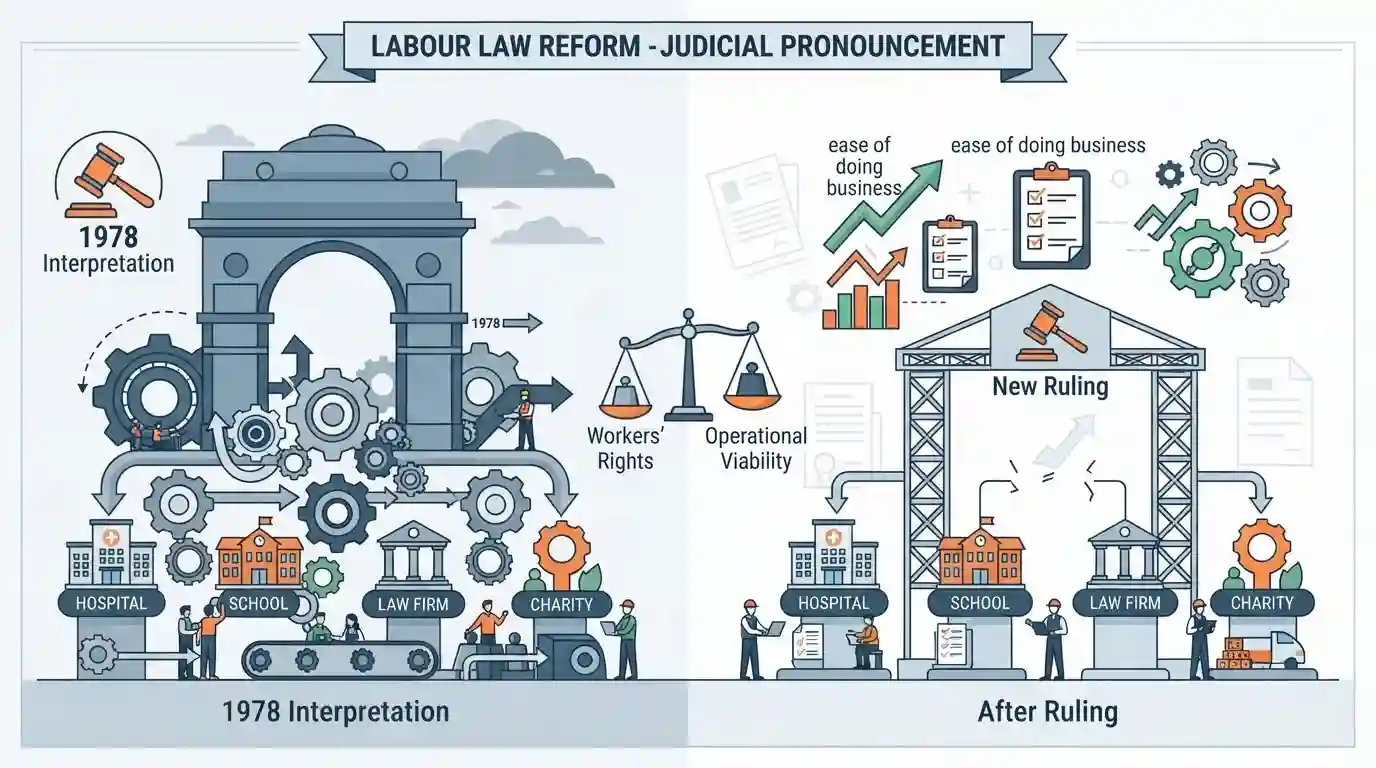
The article explains a landmark ruling by the Supreme Court of India that changes the definition of 'industry' under the Industrial Disputes Act, 1947. By revisiting the broad 'triple test' established in the 1978 Bangalore Water Supply case, the Court has narrowed the scope of what constitutes an industry. This move potentially excludes non-commercial establishments such as charitable, educational, and professional institutions from strict labour regulations. The judgment represents a significant shift in India's labour jurisprudence, seeking to balance workers' rights with the operational viability of public-service and non-profit organizations, while complementing the broader legislative push for labour reforms.
Key Points
- The Supreme Court has reconsidered the 1978 Bangalore Water Supply case, which established a broad 'triple test' for defining an 'industry' under the Industrial Disputes Act, 1947.
- The original 1978 ruling included educational institutions, hospitals, charitable organizations, and clubs within the definition of 'industry', thereby extending strict labour law compliance to them.
- The new ruling narrows this scope, potentially exempting professional, educational, and charitable establishments that do not engage in conventional commercial or manufacturing activities.
- This judicial re-interpretation aims to balance the protection of workers' rights with the need to reduce regulatory and compliance burdens on non-profit and public-service institutions.
- The decision aligns with ongoing national efforts to rationalize labour laws, notably the introduction of the four new Labour Codes.
Important Terms
Industrial Disputes Act, 1947

India's legacy legislation for resolving employer-workman conflicts. Its Section 2(j) defined "industry" broadly after a 1978 ruling, but the Act is now being replaced by the Industrial Relations Code, 2020 to align with contemporary economic dynamics.
UPSC context
Essential for GS Paper 3 (Labour Reforms). Tests knowledge of historical labour protections versus modern ease of doing business.
Labour Codes (Industrial Relations Code, 2020)
A major legislative reform consolidating historical labor laws. The 2020 Code replaces the 1947 Act, providing courts a "clean slate" to interpret the definition of "industry" without being burdened by expansive, pro-worker legacy precedents.
UPSC context
Vital for GS Paper 3 (Economy - Labour Reforms). Tests understanding of India's modern legislative push for industrial growth.
Bangalore Water Supply Case (1978)
A landmark seven-judge Supreme Court ruling that expansively interpreted "industry." It brought non-profits, hospitals, and educational institutions under strict labour regulations, extending legal recourse and collective bargaining rights to millions of workers.
UPSC context
Crucial for GS Paper 2 (Important Judgments). Illustrates judicial activism in expanding constitutional and statutory rights for workers.
Triple Test
The legal criteria established in 1978 to classify an entity as an "industry": 1) systematic activity, 2) organized employer-employee cooperation, and 3) production of goods or services to satisfy human wants, regardless of profit motive.
UPSC context
Important for GS Paper 2 (Judiciary). Demonstrates the application of judicial tests to statutory interpretation in labor disputes.
Supreme Court of India (Constitution Bench)
A larger bench of the Supreme Court convened to decide substantial legal questions. Recently, a nine-judge bench ruled 5:4 to reformulate the 1978 "industry" definition and free future labor cases from its legacy.
UPSC context
Key for GS Paper 2 (Structure and Functioning of the Judiciary). Tests the role of larger benches in modifying legal precedents.
Prelims Trap
The new, narrower definition of 'industry' applies retrospectively to all pending labour disputes.
The Supreme Court explicitly ruled that the new interpretation is prospective. The 1978 Bangalore Water Supply framework will continue to govern all pending disputes under the repealed 1947 Act.
Static Concepts Connected
What was the 'Triple Test' in the Bangalore Water Supply case (1978)?
- Systematic activity: The entity must be engaged in an organized and systematic activity.
- Employer-employee cooperation: There must be organized and structured cooperation between the employer and the employee.
- Irrespective of profit: It must involve the production or distribution of goods/services to satisfy human wants, regardless of any profit motive.
Which entities are excluded from 'industry' under the Industrial Relations Code, 2020?
- Sovereign functions: Core sovereign functions of the government, including defence research, atomic energy, and space.
- Charitable institutions: Institutions that are wholly or substantially engaged in charitable, social, or philanthropic services.
- Domestic services: Employment of individuals for domestic services is strictly excluded from the definition.
Cross-Topic Patterns
Judicial Activism to Textual Deference
The shift from the expansive 1978 ruling to the 2026 judgment highlights a move away from judicial activism toward legislative deference regarding the new Labour Codes.
Labour Reforms & Ease of Doing Business
Exempting charities and non-profits from strict labour compliance aligns with India’s broader strategy to reduce regulatory burdens and improve the Ease of Doing Business.

Expect a multi-statement question contrasting the 1978 'Triple Test' with specific exclusions in the Industrial Relations Code 2020.
Linked PYQs · 3
Linked PYQs · 3
- 2024MainsGS3
Discuss the merits and demerits of the four 'Labour Codes' in the context of labour market reforms in India. What has been the progress so far in this regard?
- 2015MainsGS3
Success of 'Make in India' programme depends on the success of 'Skill India' programme and radical labour reforms." Discuss with logical arguments.
- 2019MainsGS2
From the resolution of contentious issues regarding distribution of legislative powers by the courts, 'Principle of Federal Supremacy' and 'Harmonious Construction' have emerged. Explain.
