India Foreign Policy and Strategic Multi Engagement in Geopolitics
Source:Indian Express ↗
ఇది ఎందుకు ముఖ్యం
Crucial for understanding India's contemporary diplomatic stance, balancing act between Western powers and traditional partners, and its vision of a multipolar world order, which frequently appears in GS Paper 2 (International Relations).
సారాంశం
The article explores the evolution and relevance of India's foreign policy strategy of multi-engagement and strategic autonomy. It highlights how India manages its relations with major global powers, avoiding rigid alliance systems while actively participating in various minilateral and multilateral platforms to safeguard its national interests in a shifting geopolitical landscape.
ముఖ్య అంశాలు
- India's foreign policy has evolved from traditional non-alignment to multi-alignment or strategic multi-engagement, balancing relations with competing global powers.
- Strategic autonomy enables India to pursue national interests independently, cooperating with the US in the Indo-Pacific while maintaining historical and economic ties with Russia.
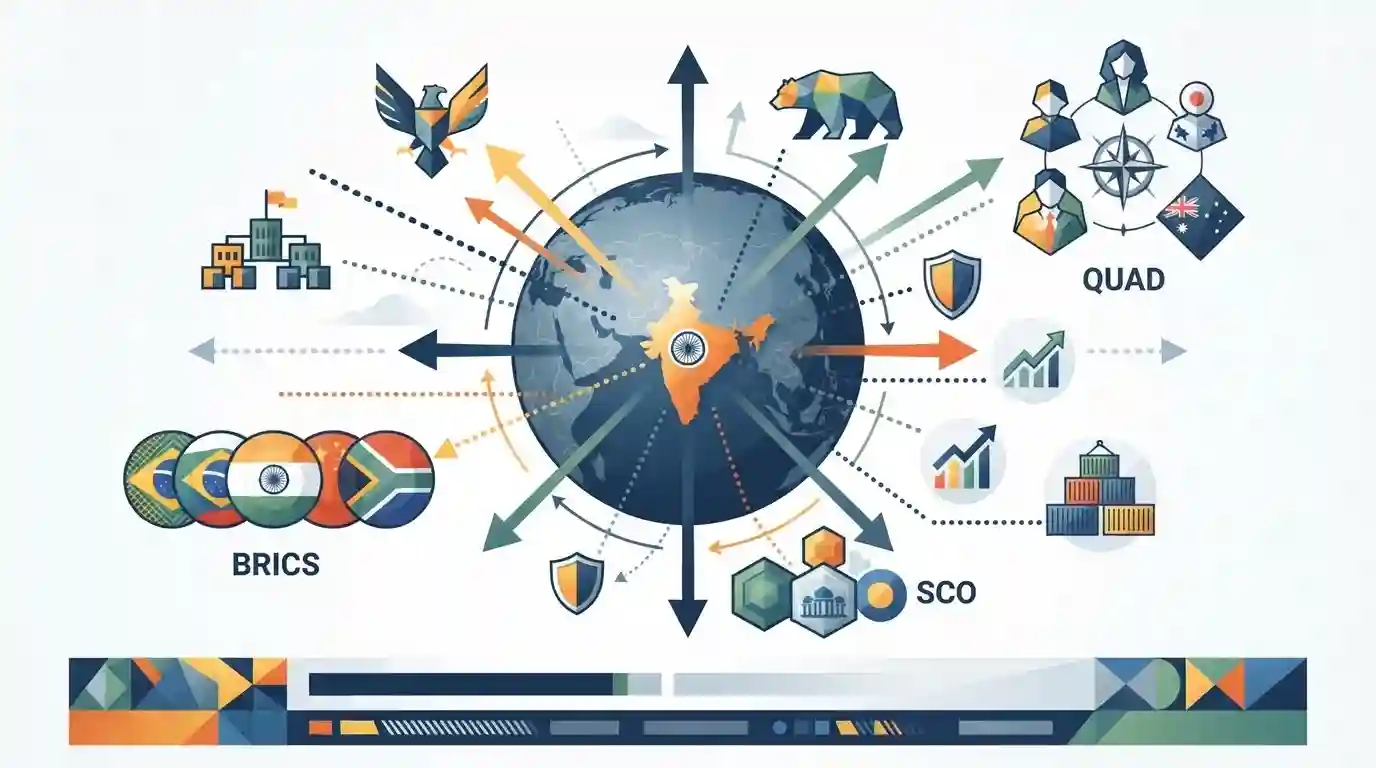
- Engagement in plurilateral groupings like QUAD, BRICS, and SCO reflects India's pragmatic approach to multipolarity.
- Multilateral institutions and minilateral frameworks serve complementary roles in India's diplomatic toolkit to address contemporary geopolitical challenges.
ముఖ్యమైన పదాలు
QUAD

An informal strategic dialogue between India, the United States, Japan, and Australia aimed at ensuring a free, open, and rules-based Indo-Pacific region without functioning as a formal military alliance.
UPSC context
UPSC Mains GS Paper II: Important International institutions, agencies and fora—their structure, mandate, and Indo-Pacific geopolitics.
BRICS
An intergovernmental grouping of major emerging economies that serves as a platform for the Global South to voice concerns on global governance and alternative economic frameworks.
UPSC context
UPSC Mains GS Paper II: Bilateral, regional and global groupings and agreements involving India and/or affecting India's interests.
Shanghai Cooperation Organisation
A permanent Eurasian political, economic, and security organization focused on regional stability, counter-terrorism, and enhancing connectivity across Central and South Asia.
UPSC context
UPSC Mains GS Paper II: Regional groupings involving India, security challenges, and India's Eurasian diplomacy.
అనుసంధానమైన స్థిర భావనలు
How does India's foreign policy transition from Non-Alignment to Strategic Multi-Alignment?
- Cold War NAM: NAM was an ideological and political movement during the Cold War aimed at avoiding military blocs and maintaining moral autonomy.
- Multi-Alignment Shift: Multi-alignment abandons strict equidistance in favor of issue-based coalitions, engaging competing powers simultaneously to maximize national interest and strategic freedom.
- Core Principle: Strategic Autonomy is the persistent core enabling independent choices in defense, trade, and energy without succumbing to bloc discipline.
అంతర-అంశ నమూనాలు
Multi-alignment vs Cold War Non-Alignment
India's simultaneous membership in Western-led groupings like the Quad and Eurasian ones like BRICS and SCO tests traditional definitions of non-alignment and non-participation in alliances.

Multi-alignment vs Non-alignment evolution & simultaneous QUAD/BRICS/SCO balancing will likely be tested via a complex statement-based Q.
అనుసంధాన PYQలు · 3
అనుసంధాన PYQలు · 3
- 2019MainsGS2
‘What introduces friction into the ties between India and the United States is that Washington is still unable to find for India a position in its global strategy, which would satisfy India's national self-esteem and ambitions.’ Explain with suitable examples.
- 2024MainsGS2
Critically analyse India's evolving diplomatic, economic and strategic relations with the Central Asian Republics (CARs) highlighting their increasing significance in regional and global geopolitics.
- 2025MainsGS2
"Energy security constitutes the dominant kingpin of India's foreign policy, and is linked with India's overarching influence in Middle Eastern countries.” How would you integrate energy security with India's foreign policy trajectories in the coming years?
