Indian states rely on thermal power to meet peak summer demand
Source:The Hindu ↗
Why It Matters
Energy security is a core component of the GS3 syllabus under 'Infrastructure: Energy'. Understanding the practical challenges states face in balancing soaring demand with generation constraints is crucial for questions on DISCOM viability, fossil fuel dependency vs. renewable transitions, and the economic impacts of climate change (heatwaves).
Summary
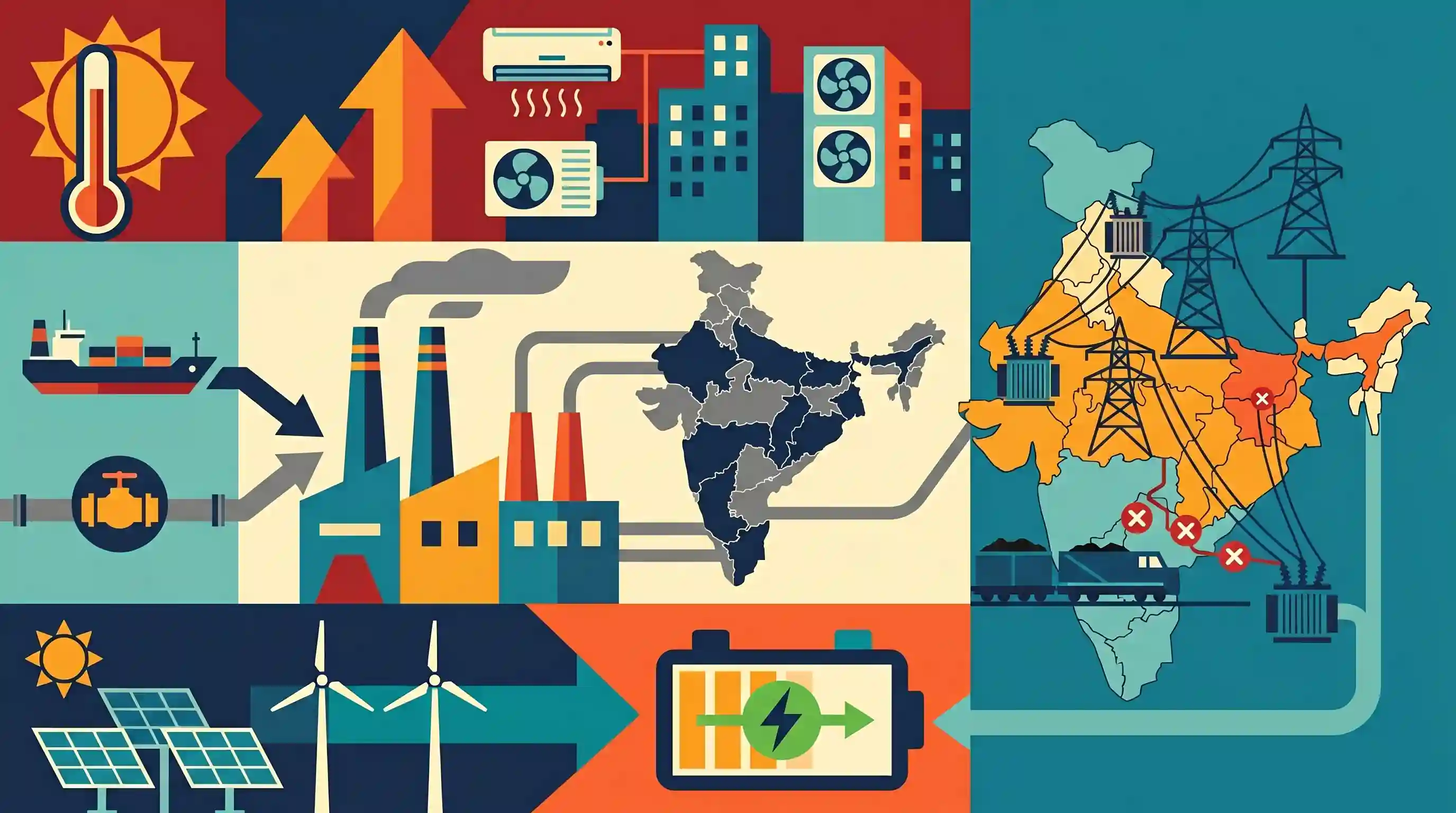
The article examines how Indian states are coping with record-breaking electricity demand driven by severe summer heatwaves. Despite a strong policy push towards renewable energy, states are predominantly relying on coal-fired thermal power plants to meet immediate baseload requirements, prompting the Union government to mandate maximum generation from imported coal and gas-based facilities. This recurring scenario underscores the critical challenges of grid management, domestic coal logistics, and the necessity of integrating battery storage systems to ensure uninterrupted power supply, highlighting India's delicate balance between decarbonization goals and immediate energy security.
Key Points
- Unprecedented heatwaves across India have driven summer electricity demand to record highs, straining state power grids and infrastructure.
- To avert blackouts, the Union government often relies on emergency provisions like Section 11 of the Electricity Act, mandating imported coal-based and gas-based plants to operate at full capacity.
- While India's renewable energy capacity is rapidly expanding, states remain fundamentally reliant on coal-fired thermal power to provide the stable baseload generation required during peak evening demand.
- State distribution companies (DISCOMs) are utilizing short-term power exchanges, day-ahead markets, and optimized hydro generation to bridge sudden supply-demand gaps.
- The recurring summer power crisis highlights the urgent need for investment in grid modernization, Battery Energy Storage Systems (BESS), and resolving coal logistics to ensure long-term energy security.
Important Terms
Section 11 of the Electricity Act, 2003

A statutory provision empowering the government to mandate power plant operation and maintenance during "extraordinary circumstances" (e.g., crises, natural calamities) to ensure energy security and public interest.
UPSC context
GS Paper III: Infrastructure (Energy). Tests legislative mechanisms for emergency grid management during peak demand or fuel shortages.
Central Electricity Authority (CEA)
A statutory body acting as the technical arm of the Ministry of Power; it advises on national electricity policy, formulates development plans, and sets grid/safety standards.
UPSC context
GS Paper II/III: Statutory Bodies/Energy. Relevant for long-term power planning and technical oversight of India's energy transition.
Grid Controller of India Limited (Grid-India)
A Miniratna CPSU (formerly POSOCO) that manages the National and Regional Load Despatch Centres, ensuring round-the-clock integrated operation and stability of the Indian Power System.
UPSC context
GS Paper III: Infrastructure. Important for understanding real-time grid management, regional power transfers, and power market regulations.
Ministry of Power
The Union ministry responsible for power generation, transmission, and distribution policy; it coordinates national energy security and monitors summer demand management.
UPSC context
GS Paper II: Government Policies. Primary agency for implementing power sector reforms and climate-responsive energy strategies.
Prelims Trap
"Non-fossil fuel sources now account for over 50% of the total electricity generated in India."
India recently crossed 50% in installed capacity for non-fossil fuels, but coal still accounts for >70% of actual electricity generation due to the low capacity factors of renewables.
Static Concepts Connected
What are the emergency provisions under Section 11 of the Electricity Act?
- Government Mandate: Empowers the government to direct generating companies to operate and maintain stations in extraordinary circumstances (e.g., severe supply deficits or natural calamities).
- Target Plants: Often used to force imported-coal and gas-based power plants, which usually sit idle due to high costs, to run at full capacity.
- Cost Compensation: The Central Electricity Regulatory Commission (CERC) determines tariffs to offset financial losses for plants forced to operate under this mandate.
How does the Day-Ahead Market (DAM) function in India's Power Exchange?
- Spot Trading: A physical electricity trading market where delivery occurs the following day, helping DISCOMs bridge short-term supply-demand gaps.
- 15-Minute Blocks: Trading is divided into 15-minute time blocks to precisely match real-time grid demand fluctuations.
- Regulatory Authority: Power exchanges like IEX and PXIL are regulated by the Central Electricity Regulatory Commission (CERC).
Cross-Topic Patterns
PM-KUSUM & Grid Stability
Shifting agricultural pumping loads to daytime via solarization reduces evening grid stress, connecting rural agriculture schemes directly to national energy security and peak-load management.
Climate-induced Energy Trilemma
Heatwaves (Geography) force higher coal reliance to avert blackouts, demonstrating how climate change directly compromises India's COP26 decarbonization targets (Environment), creating an 'Energy Trilemma'.

A 2026 Prelims question will likely test the distinction between RE 'installed capacity' vs actual 'generation', paired with Section 11.
Linked PYQs · 4
Linked PYQs · 4
- 2018MainsGS3
“Access to affordable, reliable, sustainable and modern energy is the sine qua non to achieve Sustainable Development Goals (SDGs).” Comment on the progress made in India in this regard.
- 2014MainsGS3
Environmental Impact Assessment studies are increasingly undertaken before a project is cleared by the Government. Discuss the environmental impacts of coal-fired thermal plants located at coal pitheads.
- 2024PrelimsGS1
According to the Environmental Protection Agency (EPA), which one of the following is the largest source of sulphur dioxide emissions?
- 2006PrelimsGS1
Which one of the following is a renewable source of energy?
