Urban Heatwaves and Climate Vulnerabilities of Street Vendors
Source:Indian Express ↗
Why It Matters
The intersection of climate change, urban planning, and informal livelihoods is a critical governance challenge. With a vast majority of India's workforce in the unorganized sector, extreme weather events directly threaten economic stability and public health, linking environmental issues directly to poverty and inclusive growth.
Summary
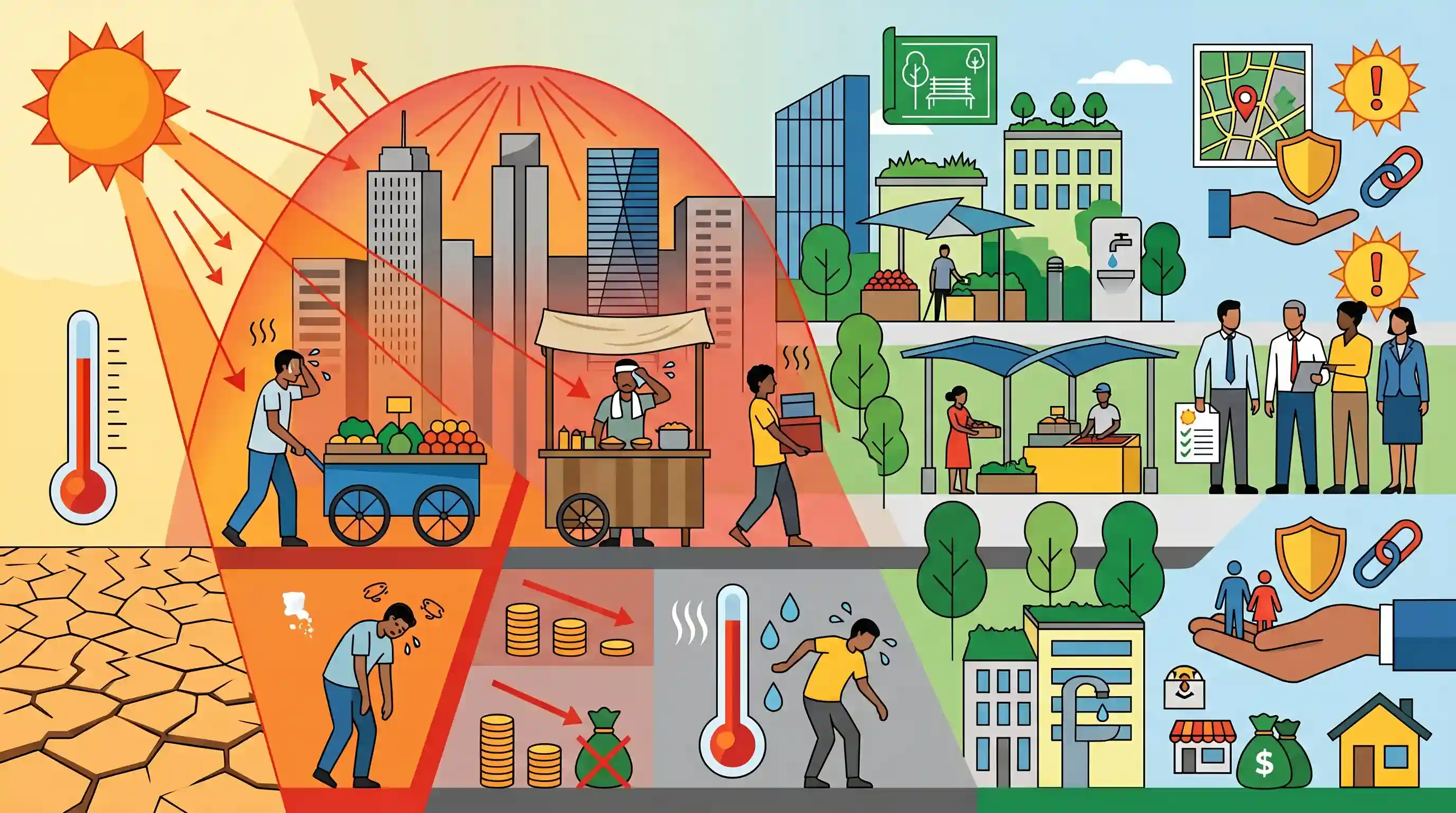
The article examines the severe impact of soaring temperatures and climate change-induced heatwaves on street vendors and the broader informal workforce. Highly exposed to urban heat islands and lacking adequate social protection, these workers face significant occupational health risks and direct losses in daily income. The rising wet-bulb temperatures present acute survival challenges for outdoor labor. The piece underscores the urgent need for inclusive urban planning and Heat Action Plans (HAPs) that specifically address the vulnerabilities of the unorganized sector, advocating for the integration of climate resilience into livelihood support schemes to protect the urban poor.
Key Points
- Street vendors and other informal sector workers face disproportionate occupational health hazards and income loss due to escalating heatwaves.
- The urban heat island effect exacerbates the localized temperatures for outdoor workers, pushing conditions closer to dangerous wet-bulb temperature thresholds.
- Current urban planning and localized Heat Action Plans frequently fail to incorporate the specific livelihood and health needs of the unorganized workforce.
- Climate change acts as a threat multiplier, deepening poverty and vulnerability for those without adequate social security or climate-resilient infrastructure.
- Building climate resilience requires integrating livelihood support initiatives, such as PM SVANidhi, with comprehensive social protection and adaptive urban design.
Important Terms
PM SVANidhi

A Ministry of Housing and Urban Affairs (MoHUA) central sector scheme providing collateral-free micro-credit to street vendors to support livelihoods and foster formal financial inclusion.
UPSC context
GS II (Welfare Schemes) and GS III (Inclusive Growth); vital for evaluating social security for the unorganized urban sector.
Heat Action Plans (HAP)
Comprehensive state or city-level strategies for heatwave preparedness, including early warning systems, public awareness, cooling centers, and inter-agency coordination to reduce heat-related mortality and morbidity.
UPSC context
GS III (Disaster Management); tests knowledge of climate adaptation, urban resilience, and localized mitigation strategies against extreme weather.
National Disaster Management Authority (NDMA)
India’s apex body for disaster management, established under the DM Act 2005, responsible for framing guidelines and coordinating responses to disasters, including heatwaves and climate extremes.
UPSC context
GS III (Disaster Management); central to institutional frameworks and policy responses for climate-induced hazards.
International Labour Organization (ILO)
A UN agency that sets international labor standards and advocates for occupational safety and health (OSH) protections against climate risks like heat stress and productivity loss.
UPSC context
GS II (International Agencies) and GS III (Economy); relevant for discussing global labor standards and occupational health.
World Bank
An international financial institution providing loans and grants to developing countries; its reports highlight the urgent need for climate-resilient urban infrastructure and investment in India.
UPSC context
GS II (International Institutions) and GS III (Infrastructure); tests understanding of global development finance and urban climate resilience.
Prelims Trap
"PM SVANidhi provides working capital loans and climate-risk micro-insurance to urban street vendors."
PM SVANidhi only provides collateral-free working capital. It lacks built-in climate insurance, which is exactly why experts are currently advocating for policy upgrades to include it.
Static Concepts Connected
What are the primary drivers of the Urban Heat Island (UHI) effect?
- Low Albedo: Urban materials like asphalt and concrete absorb and retain much higher amounts of solar radiation compared to natural vegetation, creating localized heat zones.
- Urban Canyons: Closely packed tall buildings trap thermal energy and block cooling winds, significantly preventing convective heat dissipation.
- Anthropogenic Heat: Direct thermal emissions from vehicular traffic, industrial activity, and air conditioning units continually pump excess heat into the localized city environment.
What is Wet-Bulb Temperature (WBT) and why is it a critical climate metric?
- Heat and Humidity: It is a combined measure of heat and humidity, reflecting the lowest temperature a surface can reach through evaporative cooling.
- Physiological Threshold: At a WBT of ~35°C, human sweat cannot evaporate. The body loses its ability to cool down, causing fatal heatstroke even in healthy resting adults.
Cross-Topic Patterns
Heatwaves & Disaster Notification Limits
Heatwaves are excluded from the notified "national disaster" list under the NDRF. This denies central compensation for informal workers, forcing reliance on limited state funds (SDRF) for livelihood relief.
PM SVANidhi & Financial Adaptation
Linking a GS2 welfare scheme (micro-credit) with GS3 climate adaptation (micro-insurance) highlights a necessary policy shift from basic financial inclusion to climate-resilient livelihood protection for the urban poor.

Expect a 2026 multi-statement prelims question interlinking wet-bulb thresholds, Urban Heat Island causes, and PM SVANidhi provisions.
Linked PYQs · 4
Linked PYQs · 4
- 2025PrelimsGS1
The World Bank warned that India could become one of the first places where wet-bulb temperatures routinely exceed 35 °C. Which of the following statements best reflect(s) the implication of the above-said report? I. Peninsular India will most likely suffer from flooding, tropical cyclones and droughts. II. The survival of animals including humans will be affected as shedding of their body heat through perspiration becomes difficult. Select the correct answer using the code given below.
- 2013MainsGS1
Bring out the causes for the formation of heat islands in the urban habitat of the world.
- 2017MainsGS3
'Climate change' is a global problem. How India will be affected by climate change? How Himalayan and coastal states of India will be affected by climate change?
- 2019MainsGS2
Performance of welfare schemes that are implemented for vulnerable sections is not so effective due to absence of their awareness and active involvement at all stages of policy process. Discuss.
