Urban Footpath Encroachments and Sustainable Mobility Policy
Source:The Hindu ↗
આ શા માટે મહત્વનું છે
Pedestrian rights and non-motorized transport are critical elements of sustainable urban development. UPSC frequently tests topics related to urban mobility (e.g., the National Urban Transport Policy), smart cities, and the challenges of rapid urbanization. This article provides critical points for writing answers on urban infrastructure, local governance, and inclusive city planning.
સારાંશ
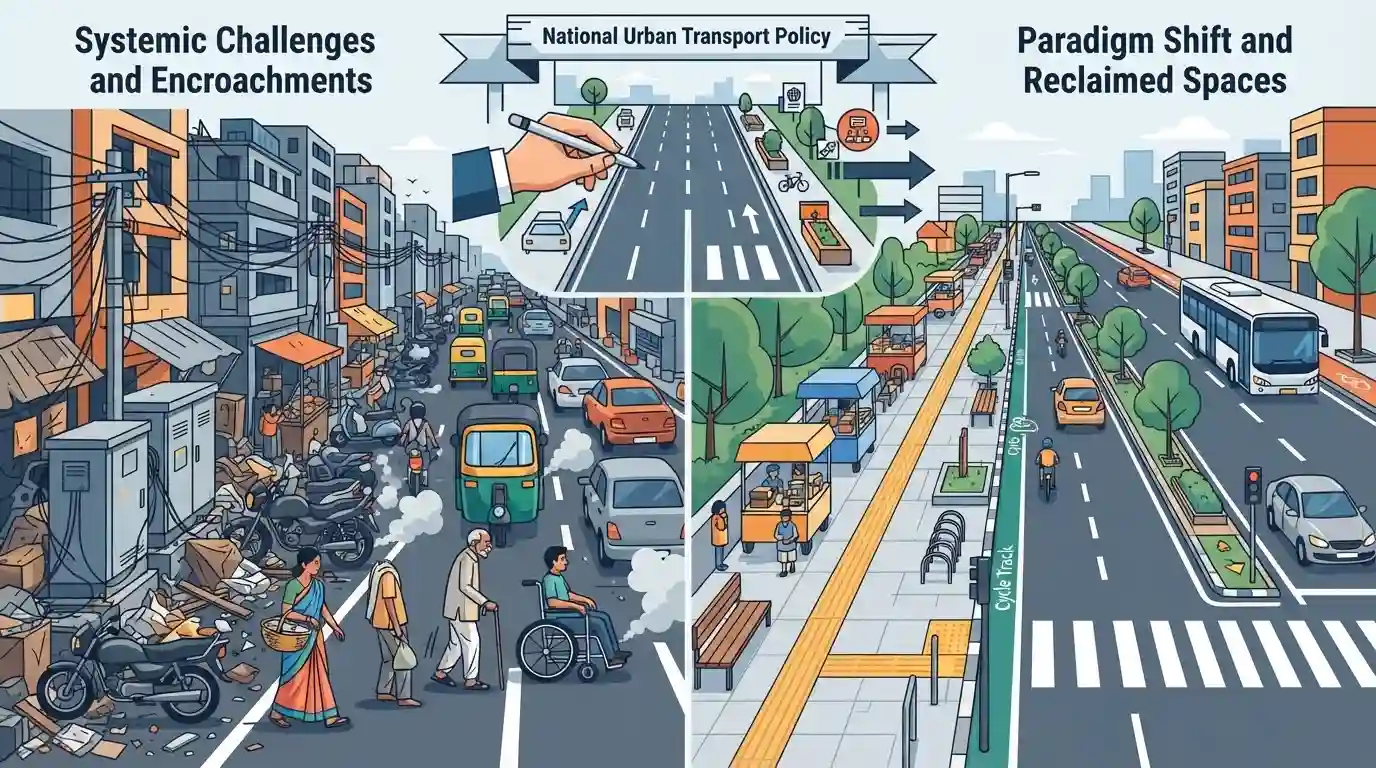
The article examines the systemic challenges faced by pedestrians in Indian cities, advocating for the urgent need to reclaim footpaths from encroachments, utility boxes, and illegal parking. It underscores the failure of city administrations to prioritize non-motorized transport (NMT) and calls for a paradigm shift in urban planning—from a motor vehicle-centric approach to one that prioritizes 'moving people,' in line with the National Urban Transport Policy (NUTP). Key interventions include enforcing Indian Roads Congress (IRC) guidelines for barrier-free, continuous pedestrian infrastructure, empowering Urban Local Bodies (ULBs), and ensuring inclusive urban spaces that balance pedestrian rights with the livelihood needs of street vendors.
મુખ્ય મુદ્દા
- Motor vehicle-centric urban planning has systematically marginalized pedestrians in Indian cities, resulting in inadequate, poorly maintained, or heavily encroached footpaths.
- Indian Roads Congress (IRC) guidelines mandate specific minimum widths and barrier-free designs to ensure universal accessibility, including for the elderly and differently-abled.
- The National Urban Transport Policy (NUTP) fundamentally advocates for moving people rather than vehicles, prioritizing investments in Non-Motorized Transport (NMT) and public transit infrastructure.
- Reclaiming footpaths requires functionally and financially empowered Urban Local Bodies (ULBs) to clear encroachments (parking, utilities) while harmonizing pedestrian needs with the rights of street vendors under the Street Vendors Act.
- Robust pedestrian infrastructure is essential for mitigating urban pollution, enhancing road safety, and achieving Sustainable Development Goal (SDG) 11 (Sustainable Cities and Communities).
મહત્વપૂર્ણ શબ્દો
National Urban Transport Policy (NUTP)

A central policy launched in 2006 to guide urban transport planning, advocating for a shift from vehicle-centric to "people-centric" mobility by prioritizing public transit and non-motorized transport.
UPSC context
GS Paper III (Infrastructure) and GS Paper II. Evaluates strategies for sustainable urban mobility and transport planning.
Street Vendors (Protection of Livelihood and Regulation of Street Vending) Act, 2014
A central legislation enacted to legalise, protect, and regulate street vending in India, mandating Town Vending Committees (TVCs) to register vendors and allocate vending zones.
UPSC context
GS Paper II (Welfare Schemes). Tests understanding of vulnerable groups, informal sector livelihoods, and urban participatory governance.
Smart Cities Mission
A centrally sponsored urban renewal initiative launched in 2015 to develop 100 sustainable, citizen-friendly cities using smart digital solutions, robust physical infrastructure, and participatory governance.
UPSC context
GS Paper III (Urbanization & Infrastructure) and GS Paper II. Evaluates technology-driven governance and public-private partnerships.
Sustainable Development Goal 11 (SDG 11)
A United Nations goal established in 2015 that aims to "make cities and human settlements inclusive, safe, resilient, and sustainable" by 2030.
UPSC context
GS Paper III (Environment, Disaster Management, Urbanization). Crucial for discussions on sustainable urban planning and global commitments.
Urban Local Bodies (ULBs)
Constitutionally recognized institutions of local self-government in urban areas (like Municipal Corporations and Municipalities), formalized under the 74th Amendment Act of 1992.
UPSC context
GS Paper II (Polity & Governance). Assesses local governance, fiscal federalism, decentralization, and the 74th Amendment.
Indian Roads Congress (IRC)
The premier technical body of highway engineers in India, established in 1934, responsible for setting road design, construction, and pedestrian safety standards.
UPSC context
GS Paper III (Infrastructure: Roads). Relevant for questions on road safety, technical infrastructure design, and pedestrian accessibility.
પ્રિલિમ્સ ટ્રેપ
The Indian Roads Congress (IRC) is a statutory authority under the Ministry of Road Transport and Highways.
The IRC is a registered society founded in 1934 (not a statutory body) on the recommendations of the Jayakar Committee.
સંલગ્ન સ્થિર ખ્યાલો
What is the constitutional status of Urban Local Bodies (ULBs) regarding town planning?
- Twelfth Schedule: Article 243W of the Constitution lists 18 matters under the Twelfth Schedule, including urban planning, town planning, and regulation of land-use.
- Functional devolution: While the 74th Amendment Act constitutionally recognized ULBs, states retain complete discretion on the actual devolution of financial and administrative powers.
What are the key provisions of the Street Vendors Act, 2014?
- Town Vending Committee: A TVC, chaired by the Municipal Commissioner, must be formed in every local authority to decide vending zones and issue certificates.
- No-eviction guarantee: No street vendor can be evicted or relocated until a survey is completed and a certificate of vending is issued.
- Vending representation: At least 40% of TVC members must be representatives of street vendors, elected by their peers.
આંતર-વિષય પેટર્ન
Urban Design & Public Health
Prioritizing walkable, non-motorized infrastructure directly reduces non-communicable diseases by encouraging daily physical activity and mitigating toxic localized vehicular emissions.
Article 21 & Socio-Economic Rights
The judiciary's expansion of Article 21 to include 'Right to Walk' mirrors past expansions like 'Right to Shelter,' creating positive state obligations to build public infrastructure.

Judicial expansion of Article 21 (Right to Walk) versus statutory protection of street vendors will likely be tested in GS Paper 2/3.
સંલગ્ન PYQ · 4
સંલગ્ન PYQ · 4
- 2014MainsGS3
National Urban Transport Policy emphasises on 'moving people' instead of 'moving vehicles'. Discuss critically the success of the various strategies of the Government in this regard.
- 2019MainsGS1
How is efficient and affordable urban mass transport key to the rapid economic development of India?
- 2013MainsGS1
Discuss the various social problems which originated out of the speedy process of urbanization in India.
- 2023MainsGS2
“The states in India seem reluctant to empower urban local bodies both functionally as well as financially.” Comment.
