Global plastic pollution crisis threatens ecosystems and treaties
Source:The Hindu ↗
Why It Matters
Plastic pollution has transitioned from a localized litter problem to a systemic global environmental crisis. Understanding its lifecycle, the specific ecological threats of microplastics, and the diplomatic efforts to forge a Global Plastics Treaty is crucial for UPSC aspirants, as it integrates core themes of ecology, waste management, and global governance.
Summary
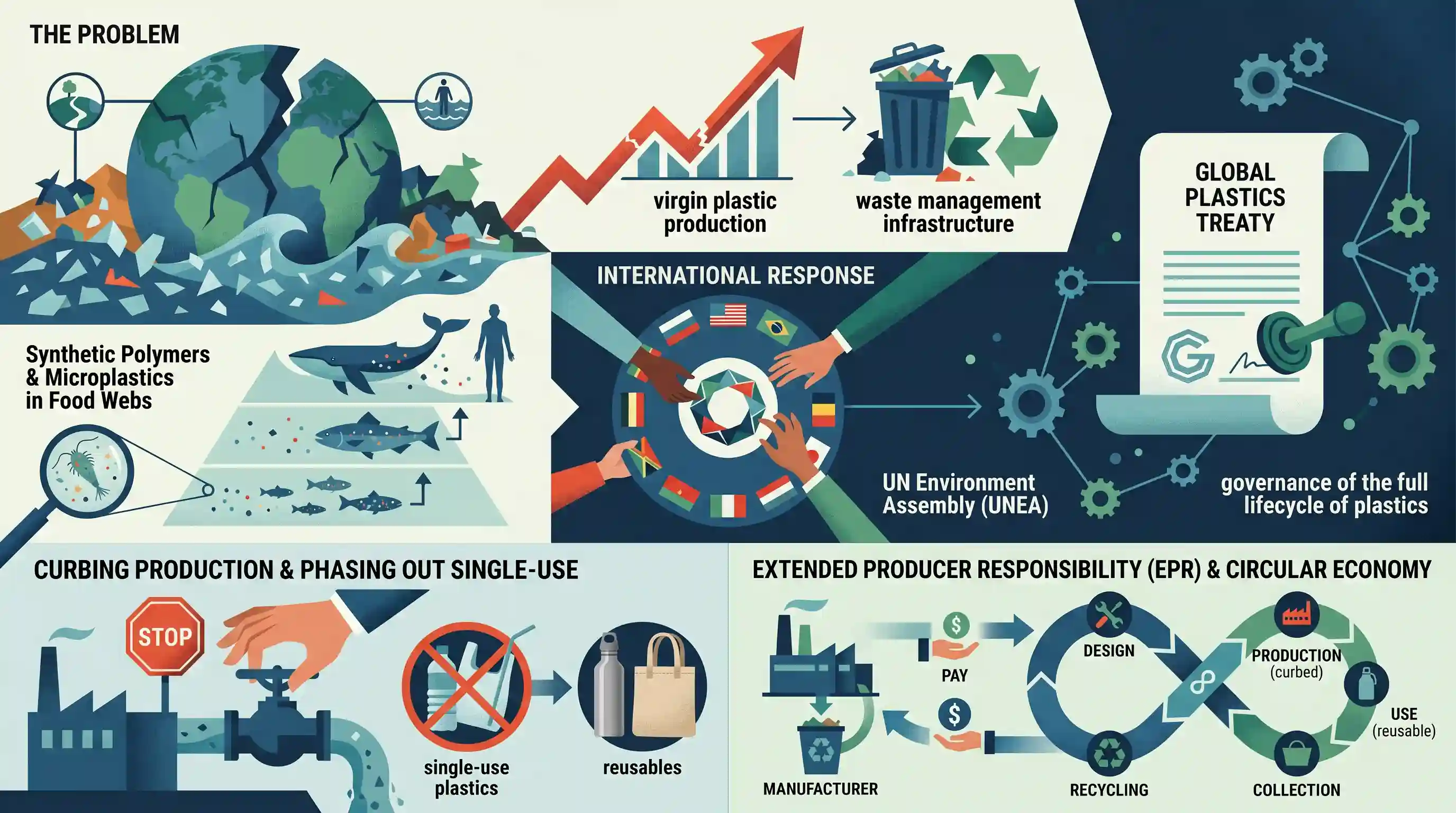
The global plastic pollution crisis poses an existential threat to marine and terrestrial ecosystems, driven by exponential increases in virgin plastic production and inadequate waste management infrastructure. Synthetic polymers and microplastics are heavily contaminating food webs, prompting an urgent transboundary response. Under the auspices of the UN Environment Assembly (UNEA), the international community is negotiating a legally binding Global Plastics Treaty. This landmark agreement aims to govern the full lifecycle of plastics by curbing primary production, phasing out single-use plastics, and mandating robust Extended Producer Responsibility (EPR) frameworks to successfully transition towards a sustainable, circular economy.
Key Points
- Global plastic pollution is worsening due to low recycling rates, the extreme durability of synthetic polymers, and their continuous leakage into the environment.
- Microplastics (like microbeads and tyre wear) have emerged as critical health and ecological hazards, infiltrating marine food webs, terrestrial soils, and human bodies.
- Negotiations for a legally binding UN Global Plastics Treaty are underway to address the entire lifecycle of plastics, moving beyond just end-of-pipe waste management.
- Effective mitigation demands transitioning to a circular economy through strict bans on problematic single-use plastics and the global enforcement of Extended Producer Responsibility (EPR).
Important Terms
Global Plastics Treaty

A proposed international, legally binding agreement to end plastic pollution by addressing the entire lifecycle of plastics, from production and design to disposal and recycling.
UPSC context
GS Paper III (Environment); vital for understanding global environmental governance and international efforts toward a circular economy.
UN Environment Assembly (UNEA)
The world’s highest-level decision-making body on the environment, comprising 193 UN Member States; it sets the global agenda and mandated the plastic treaty negotiations.
UPSC context
GS Paper II (International Relations) & III (Environment); tests knowledge of international organizations and their mandates.
Intergovernmental Negotiating Committee (INC)
A UN-mandated body established to negotiate and draft a legally binding global instrument on plastic pollution, including in the marine environment.
UPSC context
GS Paper III (Environment); important for tracking specific roadblocks like production caps in international environmental law.
Extended Producer Responsibility (EPR)
A policy approach making producers responsible for the entire lifecycle of their products, especially post-consumer waste collection, recycling, and environmentally sound disposal.
UPSC context
GS Paper III (Pollution); frequently tested regarding the 'polluter pays' principle and circular economy targets in India.
Plastic Waste Management Rules
India’s regulatory framework for plastic waste management, mandating single-use plastic bans, EPR targets, and strict standards for biodegradable and compostable plastics.
UPSC context
GS Paper III (Pollution & Degradation); essential for understanding national legislation and environmental compliance mechanisms.
United Nations Environment Programme (UNEP)
The leading global authority on the environment that sets the global environmental agenda and hosts the UNEA and INC negotiation processes.
UPSC context
GS Paper III (Environment); foundational organization for environmental treaties, reports, and global conservation standards.
Prelims Trap
The UN Global Plastics Treaty is currently in force and focuses exclusively on marine plastic waste.
The treaty is still under negotiation (via INC) and explicitly targets the entire lifecycle of plastics (including virgin production), not just downstream marine waste.
Static Concepts Connected
How is Extended Producer Responsibility (EPR) implemented for plastics in India?
- Statutory Backing: Mandated under the Plastic Waste Management (PWM) Rules, 2016, which draw their statutory power from the Environment (Protection) Act, 1986.
- Applicability: Shifts the physical and financial burden of post-consumer waste management to Producers, Importers, and Brand Owners (PIBOs).
- Market Mechanism: India's framework introduces a market mechanism allowing the generation, sale, and purchase of EPR certificates to meet compliance targets.
What defines Microplastics and what are their primary ecological threats?
- Definition: Any plastic fragment less than 5 mm in length. Includes primary (microbeads in cosmetics) and secondary (degraded larger plastics/tyre wear).
- Trophic Impact: Due to their size, they are ingested by plankton and fish, causing physical blockages and facilitating the biomagnification of toxic chemicals up the food chain.
Cross-Topic Patterns
Plastics Treaty vs Petrochemical Economics
The push to cap virgin plastic production creates a geopolitical rift, pitting environmental lifecycle goals against the economic interests of oil-producing and developing nations heavily invested in petrochemicals.
Microplastics and the Stockholm Convention
Microplastics act as vectors by absorbing Persistent Organic Pollutants (POPs) from the water, linking physical marine litter to chemical bioaccumulation and the Stockholm Convention.

Expect a multi-statement question combining the Global Plastics Treaty's 'lifecycle' mandate with India's EPR certificate trading rules.
Linked PYQs · 4
Linked PYQs · 4
- 2019PrelimsGS1
Why is there a great concern about the 'microbeads' that are released into environment?
- 2024PrelimsGS1
Consider the following statements : Statement-I: Many chewing gums found in the market are considered a source of environmental pollution. Statement-II : Many chewing gums contain plastic as gum base. Which one of the following is correct in respect of the above statements?
- 2025PrelimsGS1
Consider the following: I. Cigarette butts II. Eyeglass lenses III. Car tyres How many of them contain plastic?
- 2018MainsGS3
What are the impediments in disposing the huge quantities of discarded solid wastes which are continuously being generated? How do we remove safely the toxic wastes that have been accumulating in our habitable environment?
