Punjab Border District Opioid Crisis and Narco-Terrorism
Source:Indian Express ↗
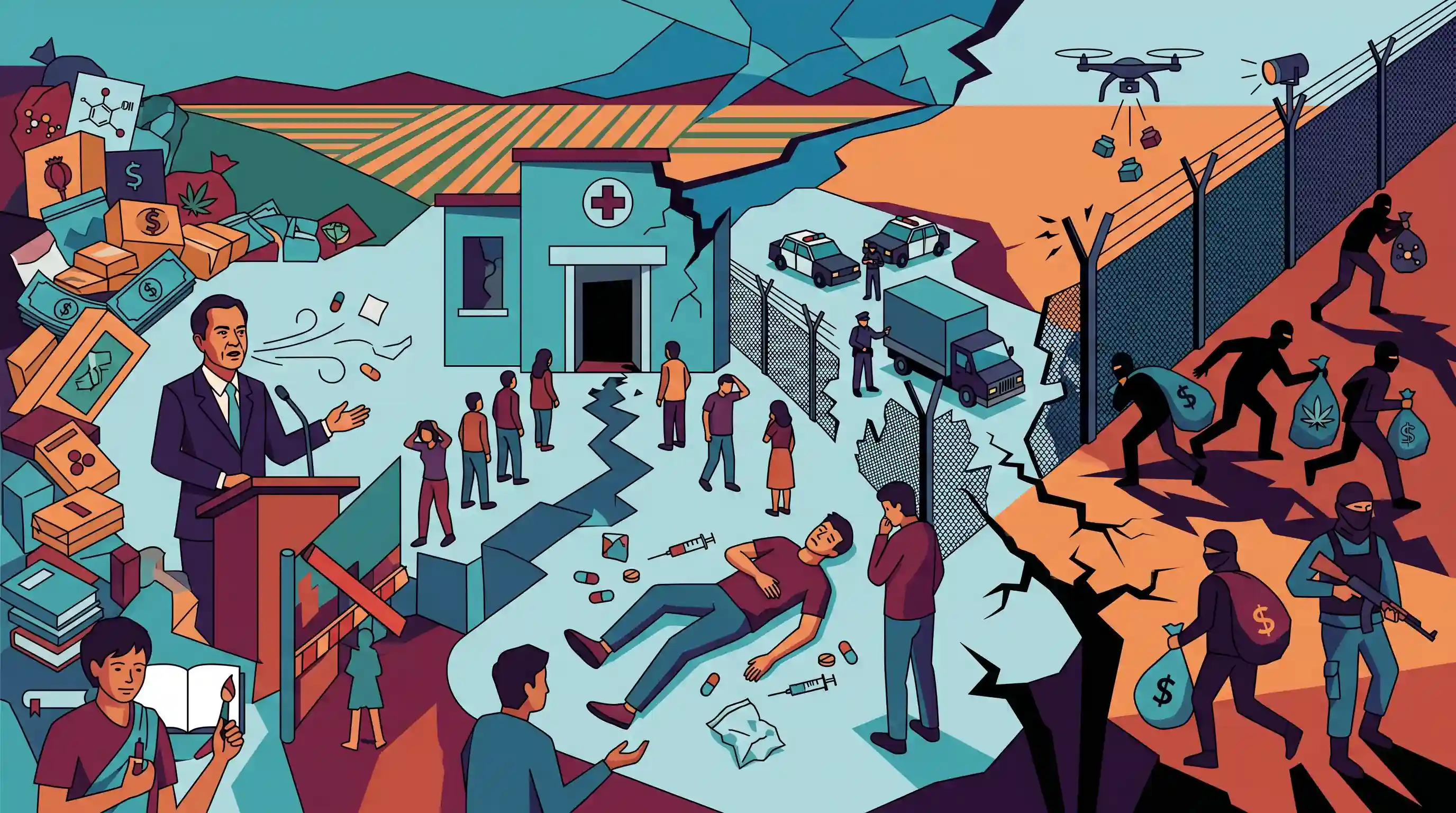
Why It Matters
The drug crisis in Punjab's border districts is a classic case study for GS Paper 3 (Internal Security), illustrating the nexus between cross-border smuggling (Golden Crescent proximity) and narco-terrorism. It also touches upon GS Paper 2 (Social Justice/Governance) regarding the effectiveness of public health interventions, de-addiction centers, and state policies to protect vulnerable youth.
Summary
The drug epidemic remains a critical socio-political and security challenge in Punjab, highlighted by the suspected overdose death of an AAP worker in the border district of Tarn Taran ahead of bypolls. The region struggles with the widespread misuse of opioids and synthetic drugs, fueled by cross-border smuggling networks. This crisis highlights systemic vulnerabilities in border security and narco-terrorism prevention, alongside major gaps in public health policies for de-addiction and youth rehabilitation. The persistence of the drug trade despite political rhetoric underscores the need for comprehensive strategies integrating internal security measures with socio-economic development.
Key Points
- The suspected drug overdose death of an AAP worker in Tarn Taran has reignited the debate over Punjab's deep-rooted drug crisis ahead of the upcoming bypolls.
- Border districts like Tarn Taran face severe challenges due to their geographical vulnerability to cross-border drug smuggling, primarily from Pakistan.
- The crisis involves not just traditional narcotics but a rising misuse of pharmaceutical opioids and synthetic drugs, complicating law enforcement and rehabilitation efforts.
- Despite political promises and police crackdowns, the continued availability of drugs points to systemic gaps in border management, intelligence, and corruption.
- The issue underscores a massive public health challenge, requiring a shift from purely punitive law enforcement to comprehensive rehabilitation and socio-economic support for the youth.
Important Terms
Narco-terrorism

The symbiotic nexus between drug traffickers and terrorist organizations, where narcotics trade provides financial resources for terror activities while cartels exploit insurgent networks for safe passage.
UPSC context
GS Paper III: Internal Security; tests understanding of multifaceted threats and financing of terrorism in border states like Punjab.
NDPS Act, 1985
India's primary legal framework prohibiting the production, possession, and sale of narcotics and psychotropic substances, while providing for stringent punishments and the establishment of the Narcotics Control Bureau.
UPSC context
GS Paper II (Polity) and III (Security); relevant for legal measures against drug abuse and organized crime.
Golden Crescent
A principal global drug-producing region spanning Afghanistan, Iran, and Pakistan; it is the primary source of illicit opium and heroin smuggled into India's western border.
UPSC context
GS Paper III: Security; essential for analyzing cross-border drug trafficking routes affecting Punjab and Jammu & Kashmir.
Border Management
The strategic coordination of security forces, infrastructure (like fencing), and technology (drones) to secure national frontiers against infiltration, smuggling, and trans-border crimes.
UPSC context
GS Paper III: Security; tests ability to evaluate effectiveness of agencies like BSF in porous regions.
Non-State Actors
Entities such as terrorist groups, criminal syndicates, and insurgent modules that wield influence and destabilize internal security without the formal backing of a sovereign state.
UPSC context
GS Paper III: Internal Security; focuses on the role of external groups in fueling proxy wars and drug-trafficking.
Punjab Police
The primary law enforcement agency responsible for maintaining internal security, managing local drug distribution networks, and coordinating with federal agencies to curb the drug epidemic in Punjab.
UPSC context
GS Paper III: Internal Security; highlights the role and challenges of state-level law enforcement in tackling narco-terrorism.
Prelims Trap
"Punjab's severe drug crisis is primarily fueled by its direct geographic proximity to the Golden Triangle."
Aspirants often confuse the Golden Triangle (Myanmar/Laos/Thailand affecting the Northeast) with the Golden Crescent (Iran/Afghanistan/Pakistan), which is the actual source for Punjab's smuggling.
Static Concepts Connected
What is the geographical distinction between the Golden Crescent and the Golden Triangle?
- Golden Crescent: Comprises Iran, Afghanistan, and Pakistan. It primarily fuels cross-border narco-smuggling into Northwestern Indian states like Punjab, Rajasthan, and Gujarat.
- Golden Triangle: Comprises Myanmar, Laos, and Thailand. It threatens India's internal security predominantly through the porous borders of Northeastern states like Manipur and Mizoram.
What are India's institutional measures to combat narco-terrorism and drug abuse?
- NDPS Act, 1985: The primary legislation providing stringent punitive frameworks for the control, regulation, and confiscation of assets related to narcotic drugs and psychotropic substances.
- NCB Coordination: The Narcotics Control Bureau acts as the national nodal agency under the Ministry of Home Affairs, coordinating intelligence-sharing with border guarding forces and state police.
- Nasha Mukt Bharat: A flagship campaign focusing on 'Demand Reduction' through institutional rehabilitation, preventive awareness, and public health interventions in India's most vulnerable districts.
Cross-Topic Patterns
Anti-Drone Tech & Border Security
The shift from traditional smuggling to low-flying UAVs airdropping synthetic drugs links narco-terrorism directly with the need for indigenous anti-drone technology and modernized border infrastructure.
Pharmaceutical Opioids & NDPS Licensing
The transition from illicit heroin to diverted pharmaceutical opioids exposes regulatory loopholes in drug licensing, challenging traditional law enforcement and necessitating a public health approach to the NDPS Act.

Narco-terrorism via drones linked with Golden Crescent routes is highly probable as a multi-statement internal security question in 2026.
Linked PYQs · 2
Linked PYQs · 2
- 2024MainsGS3
Explain how narco-terrorism has emerged as a serious threat across the country. Suggest suitable measures to counter narco-terrorism.
- 2018MainsGS3
India's proximity to two of the world's biggest illicit opium-growing states has enhanced her internal security concerns. Explain the linkages between drug trafficking and other illicit activities such as gunrunning, money laundering and human trafficking. What counter-measures should be taken to prevent the same?
