Crowd management failures in Goa temple stampede
Source:Indian Express ↗
Why It Matters
Stampedes at religious places are a recurring human-made disaster in India. For UPSC aspirants, this event serves as a practical case study for GS3 (Disaster Management) regarding vulnerability assessment, crowd control, and the implementation of NDMA guidelines, as well as GS2/GS4 for administrative accountability and public safety governance.
Summary
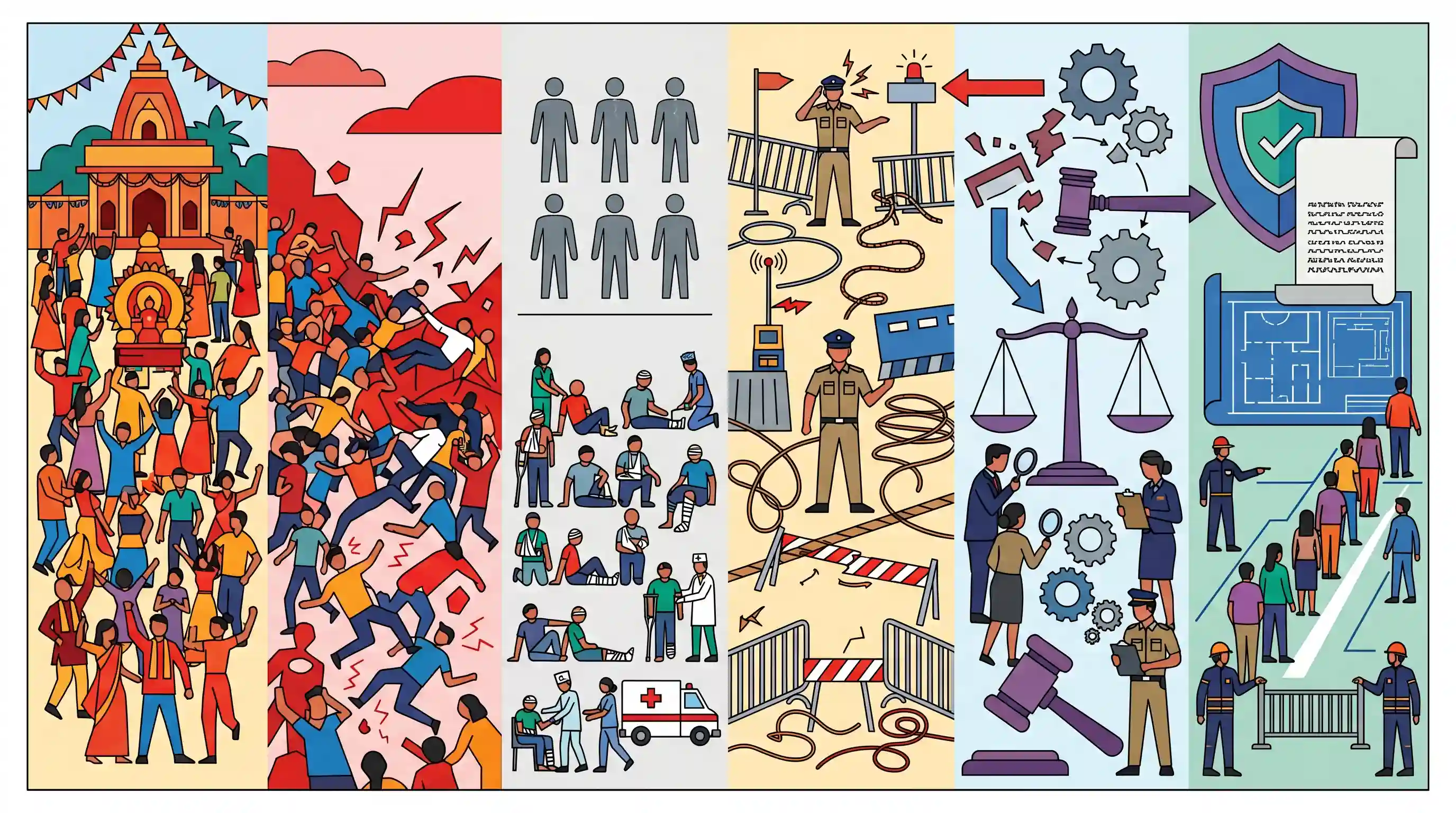
A stampede during a festival at the Lairai Devi temple in Goa has left 6 people dead and 70 injured. The incident, described as resulting from a 'series of failures,' highlights critical administrative and crowd-management lapses during large religious gatherings. A probe has been launched to investigate the causes and establish accountability, bringing attention back to the importance of disaster preparedness and the enforcement of NDMA guidelines for public safety at cultural events.
Key Points
- A severe stampede at the Lairai Devi temple festival in Goa resulted in 6 deaths and 70 injuries.
- The tragedy is attributed to a 'series of failures,' indicating significant lapses in crowd control, infrastructure planning, and administrative coordination.
- A probe is underway to determine accountability and identify the specific systemic breakdowns that led to the deadly crush.
- The incident underscores the urgent need to strictly implement NDMA guidelines for crowd management at large religious and cultural gatherings to enhance disaster preparedness.
Important Terms
National Disaster Management Authority (NDMA)

The apex statutory body for disaster management in India, established under the Disaster Management Act, 2005, and chaired by the Prime Minister.
UPSC context
GS Paper 3: Disaster Management; tests understanding of institutional frameworks for disaster risk reduction and response.
NDMA Guidelines on Crowd Management
Specific NDMA protocols for managing large gatherings through risk assessment, capacity planning, crowd-flow regulation, and real-time monitoring to prevent stampedes and casualties.
UPSC context
GS Paper 3: Disaster Management; high relevance for case studies on administrative failure and public safety.
Disaster Management Act, 2005
The primary legal framework in India that provides for the effective management of disasters and for matters connected therewith, including the creation of NDMA and SDMAs.
UPSC context
GS Paper 2 & 3: Laws and Institutions; tests knowledge of the statutory basis for emergency response and governance.
Crowd Management
A systematic process of planning, organizing, and monitoring mass gatherings to ensure safety, order, and efficient movement while mitigating risks like crowd crushes.
UPSC context
GS Paper 2 & 3: Governance and Security; essential for ethics and administration questions on public order.
Hazard, Risk and Vulnerability Analysis (HRVA)
A systematic analysis used in disaster management to identify potential threats, evaluate population susceptibility, and assess the degree of potential damage.
UPSC context
GS Paper 3: Disaster Management; tests technical understanding of pre-disaster planning and risk mitigation.
Public Order
The maintenance of peace and tranquility in society, primarily the responsibility of state governments under the Seventh Schedule of the Indian Constitution.
UPSC context
GS Paper 2: Polity; tests knowledge of State List subjects and administrative roles in maintaining civil stability.
Prelims Trap
NDMA is directly responsible for executing crowd management and safety protocols at major socio-religious festivals.
NDMA only formulates policies and guidelines under the DM Act 2005. Direct execution, crowd control, and event management remain the exclusive responsibility of local/state administrations.
Static Concepts Connected
What are the core NDMA guidelines for mass crowd management?
- Capacity Planning: Assessing venue limits, defining distinct entry/exit routes, and preventing bottlenecks to avoid unidirectional stampedes.
- Unified Control System: Establishing a Unified Command Centre to ensure seamless coordination between police, medical staff, and temple administration.
- Vulnerability Mapping: Categorizing and preempting vulnerabilities across six areas: structural, fire/electrical, crowd control, crowd behavior, security, and coordination.
What is the cultural significance of the Shirgao Jatra in Goa?
- Lairai Devi Worship: An annual socio-religious festival dedicated to Goddess Lairai, reflecting Goa's deep-rooted pre-colonial religious heritage.
- Agnidivya Ritual: The festival is famous for its unique traditional fire-walking ritual performed by devout followers known as 'Dhonds'.
Cross-Topic Patterns
AI integration in Crowd Dynamics
Real-time AI surveillance and drone mapping are increasingly linking GS3 technology with disaster management to predict and preempt 'turbulent' stampedes at mass gatherings.
Article 25 vs. Public Order
The recurring administrative failures at festivals highlight the tension between the Right to freedom of religion (Article 25) and the state's mandate to restrict it for 'public order'.

GS3 Mains 2026 will likely test the structural vs behavioral causes of stampedes, demanding integration of NDMA crowd management guidelines.
Linked PYQs · 3
Linked PYQs · 3
- 2019MainsGS3
Vulnerability is an essential element for defining disaster impacts and its threat to people. How and in what ways can vulnerability to disasters be characterized? Discuss different types of vulnerability with reference to disasters.
- 2019MainsGS3
Disaster preparedness is the first step in any disaster management process. Explain how hazard zonation mapping will help disaster mitigation in the case of landslides.
- 2024MainsGS3
What is disaster resilience? How is it determined? Describe various elements of a resilience framework. Also mention the global targets of Sendai Framework for Disaster Risk Reduction (2015–2030).
