AI Integration and Human Oversight in Healthcare
Source:The Hindu ↗
Why It Matters
The integration of AI in critical sectors like healthcare is a highly probable topic for both UPSC Mains (GS3 S&T, GS4 Ethics) and Prelims. It highlights the intersection of technological advancement with ethical governance, data privacy, and the human element in public health.
Summary
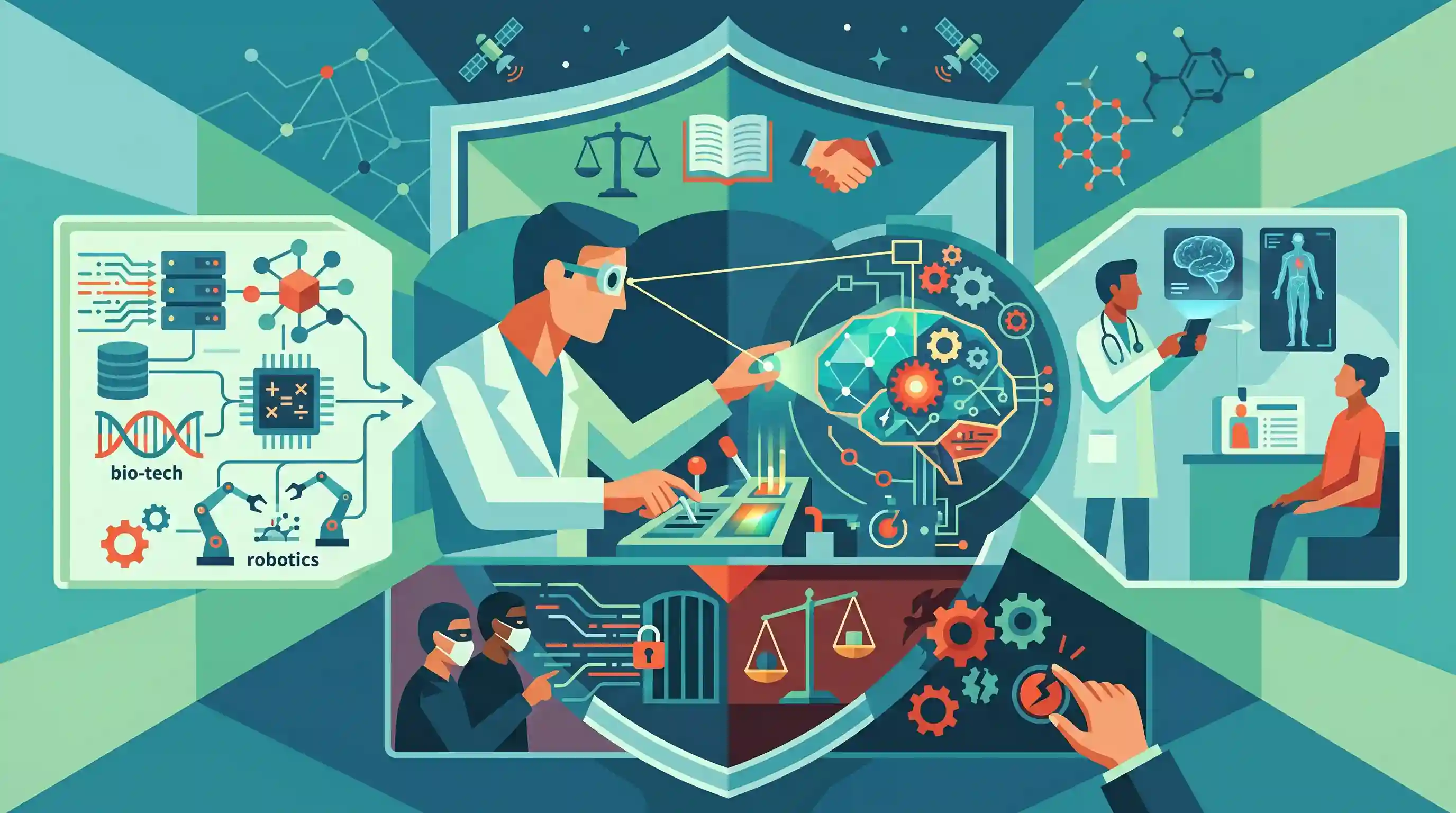
The article underscores that the safety and effectiveness of Artificial Intelligence (AI) in the healthcare sector are fundamentally dependent on human oversight and ethical governance. While AI can revolutionize clinical diagnosis and patient care, its deployment is fraught with risks like algorithmic bias, privacy violations, and over-reliance on automation. Mitigating these dangers requires a strong 'human-in-the-loop' framework where medical professionals maintain ultimate decision-making authority, ensuring that empathy, contextual judgment, and strict accountability remain at the core of healthcare.
Key Points
- Artificial Intelligence (AI) offers significant advancements in healthcare, including improved clinical diagnosis, personalized medicine, and administrative efficiency.
- The safety, fairness, and efficacy of healthcare AI depend heavily on the human experts who design, train, and oversee these systems, highlighting the need for a 'human-in-the-loop' approach.
- Unchecked AI deployment poses ethical risks such as algorithmic bias, patient data privacy breaches, and potential diagnostic errors due to black-box models.
- To ensure patient safety, human medical professionals must retain the final decision-making authority rather than over-relying on automated AI outputs.
- Effective governance frameworks are required to establish accountability, ensuring that healthcare institutions and practitioners remain responsible for AI-assisted clinical outcomes.
Prelims Trap
"AI algorithms are mathematically objective and automatically eliminate cognitive and structural biases in clinical diagnosis."
AI systems inherit and often amplify the biases present in their historical training data. They are not inherently objective or neutral.
Static Concepts Connected
What are the core ethical risks of AI in critical sectors like healthcare?
- Algorithmic Bias: AI trained on skewed datasets perpetuates inequalities, such as misdiagnosing marginalized groups not represented in historical training data.
- Black-Box Problem: The opacity of complex deep neural networks makes it difficult to explain how a specific decision was reached, undermining accountability.
- Automation Bias: The cognitive risk where human professionals over-trust AI outputs, overriding their own clinical empathy and critical judgment.
What frameworks govern the intersection of technology and digital health data in India?
- DPDP Act 2023: The primary legislation regulating digital personal data processing, which inherently covers sensitive health and genetic data collected for AI training.
- Ayushman Bharat Digital Mission: A comprehensive repository of all health-related information of citizens, which requires stringent ethical firewalls against unauthorized AI exploitation.
Cross-Topic Patterns
AI Bias & Fundamental Rights (Art 21)
AI healthcare systems trained on non-representative datasets risk violating the Right to Health (Article 21) by systematically misdiagnosing marginalized demographic groups.
Human-in-the-Loop & GS4 Accountability
The 'human-in-the-loop' framework mirrors core GS4 administrative values—ensuring empathy, subjective contextual judgment, and ultimate accountability remain with human officers rather than automated systems.

A GS-3 or GS-4 question in 2026 will likely ask to evaluate 'automation bias' and the 'black-box problem' in critical public services.
Linked PYQs · 3
Linked PYQs · 3
- 2023MainsGS3
Introduce the concept of Artificial Intelligence (AI). How does Al help clinical diagnosis? Do you perceive any threat to privacy of the individual in the use of Al in healthcare?
- 2020PrelimsGS1
With the present state of development, Artificial Intelligence can effectively do which of the following? 1. Bring down electricity consumption in industrial units 2. Create meaningful short stories and songs 3. Disease diagnosis 4. Text-to-Speech Conversion 5. Wireless transmission of electrical energy Select the correct answer using the code given below:
- 2024MainsGS4
The application of Artificial Intelligence as a dependable source of input for administrative rational decision-making is a debatable issue. Critically examine the statement from the ethical point of view.
