Spatial Inequality and Healthcare Access in Urban India
Source:The Hindu ↗
Why It Matters
Understanding the intersection of social geography and public health is crucial for policymakers to design equitable healthcare delivery systems. It highlights how spatial inequality acts as a structural barrier to health access, aligning with UPSC syllabus themes on urbanization issues (GS1) and health sector management (GS2).
Summary
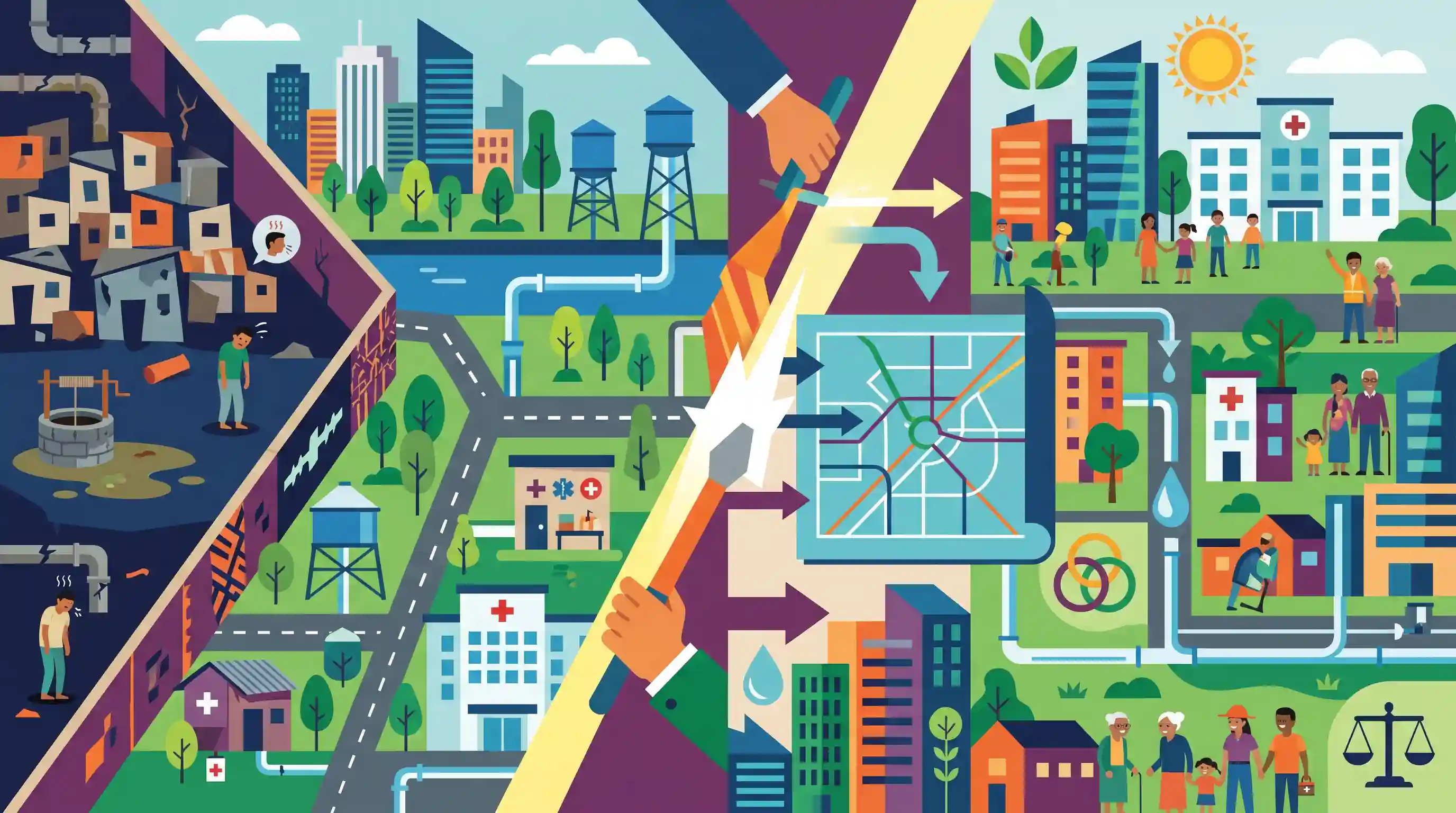
The article examines the profound impact of residential segregation on access to public health services in India. Indian urban spaces are often starkly divided along the lines of caste, class, and religion, leading to an unequal allocation of civic amenities and healthcare infrastructure. Marginalized communities residing in segregated neighborhoods or slums disproportionately lack access to proximate primary healthcare, clean drinking water, and proper sanitation. This spatial inequity exacerbates vulnerabilities to diseases and drives disparities in health outcomes across different demographic groups. Bridging this gap necessitates integrating a spatial justice framework into urban planning and healthcare policies to ensure an equitable distribution of public health infrastructure.
Key Points
- Residential segregation in Indian cities along caste, religious, and economic lines systematically influences the spatial distribution of public infrastructure, resulting in unequal access to healthcare.
- Marginalized communities, such as Dalits, Muslims, and the urban poor, are often relegated to slums or peripheral areas that face a severe deficit of Primary Health Centers (PHCs), clean water, and sanitation.
- This spatial inequity directly translates into poorer health outcomes, including higher morbidity rates and reduced life expectancy for populations living in segregated neighborhoods.
- Addressing these disparities requires spatial justice in urban planning, ensuring equitable distribution of public health facilities and strengthening targeted initiatives like the National Urban Health Mission (NUHM).
Important Terms
Residential Segregation

The physical separation of social groups—often based on caste, religion, or income—into different neighborhoods. In India, it restricts marginalized communities from accessing high-quality public infrastructure, including health facilities.
UPSC context
GS Paper I (Social Issues) and GS Paper II (Social Justice); tests understanding of urbanization and structural inequality.
Spatial Justice
A framework asserting that social justice has a geographic dimension. It demands the fair distribution of resources, services, and opportunities across space to prevent 'locational discrimination' against certain neighborhoods.
UPSC context
GS Paper I (Urbanization) and GS Paper II (Governance); tests ability to link spatial planning with social equity.
National Urban Health Mission (NUHM)
A sub-mission of the National Health Mission (launched 2013) targeting the urban poor. It aims to provide equitable, affordable, and quality primary healthcare through Urban Primary Health Centres (UPHCs) and community outreach.
UPSC context
GS Paper II (Social Justice/Health); tests knowledge of welfare schemes for vulnerable urban populations.
Ayushman Bharat
The flagship national health scheme comprising two pillars: Health and Wellness Centres (HWCs) for comprehensive primary care, and PM-JAY for insurance covering secondary and tertiary hospitalisation.
UPSC context
GS Paper II (Government Policies/Health); core flagship scheme frequently tested in Prelims and Mains.
Urban Primary Health Centre (UPHC)
The basic health delivery unit under NUHM. Serving a population of 30,000-50,000, it is ideally located within 0.5km of slums to provide essential preventive and outpatient services.
UPSC context
GS Paper II (Governance/Health); tests specific understanding of urban health infrastructure decentralization.
Prelims Trap
"Urbanization in India has largely eliminated caste and religious residential segregation."
Aspirants often conflate urbanization with social modernization, missing empirical data showing urban caste segregation in India mirrors US racial segregation.
Static Concepts Connected
What are the core delivery tiers of the National Urban Health Mission (NUHM)?
- Urban-PHCs: One facility is mandated for every 30,000 to 50,000 urban population, ideally sited within or near slum clusters.
- Mahila Arogya Samiti: A community-based peer group managing and monitoring health, water, and sanitation for 50-100 households in slums.
- Urban ASHA: Deployed at the community level, typically 1 for every 10,000 to 2,500 vulnerable population in urban areas.
How does the Census of India classify urban 'Slums'?
- Notified Slums: Areas formally notified as slums by municipalities, corporations, or local bodies under any relevant Act.
- Recognized Slums: Areas officially recognized as slums by State governments or local bodies, but not formally notified.
- Identified Slums: Compact areas of at least 300 population (60-70 households) with poorly built, congested tenements lacking basic sanitary and drinking facilities.
Cross-Topic Patterns
Spatial Justice & Urban Heat Islands
Residential segregation concentrates marginalized groups in slums, which heavily overlap with severe Urban Heat Island (UHI) zones lacking green cover, worsening climate vulnerabilities.
AMRUT 2.0 & Slum Sanitation
The deficit of basic water infrastructure in segregated neighborhoods directly ties to AMRUT 2.0's mandate to provide universal equitable water supply across all statutory towns.

Expect a Prelims question on NUHM's Mahila Arogya Samiti structure, or a GS1/GS2 Mains question evaluating spatial justice in cities.
Linked PYQs · 3
Linked PYQs · 3
- 2023MainsGS1
Does urbanization lead to more segregation and/or marginalization of the poor in Indian metropolises?
- 2021MainsGS2
“Besides being a moral imperative of a Welfare State, primary health structure is a necessary precondition for sustainable development.” Analyze.
- 2013MainsGS1
Discuss the various social problems which originated out of the speedy process of urbanization in India.
