Energy Governance Challenges from Artificial Intelligence Data Centres
Source:Indian Express ↗
Why It Matters
The intersection of digital technology (AI, Data Centres) and energy policy is a critical emerging issue. It tests India's ability to balance rapid technological and economic growth with sustainable development and climate change mitigation, making it highly relevant for GS-3 (Infrastructure, Technology, and Environment).
Summary
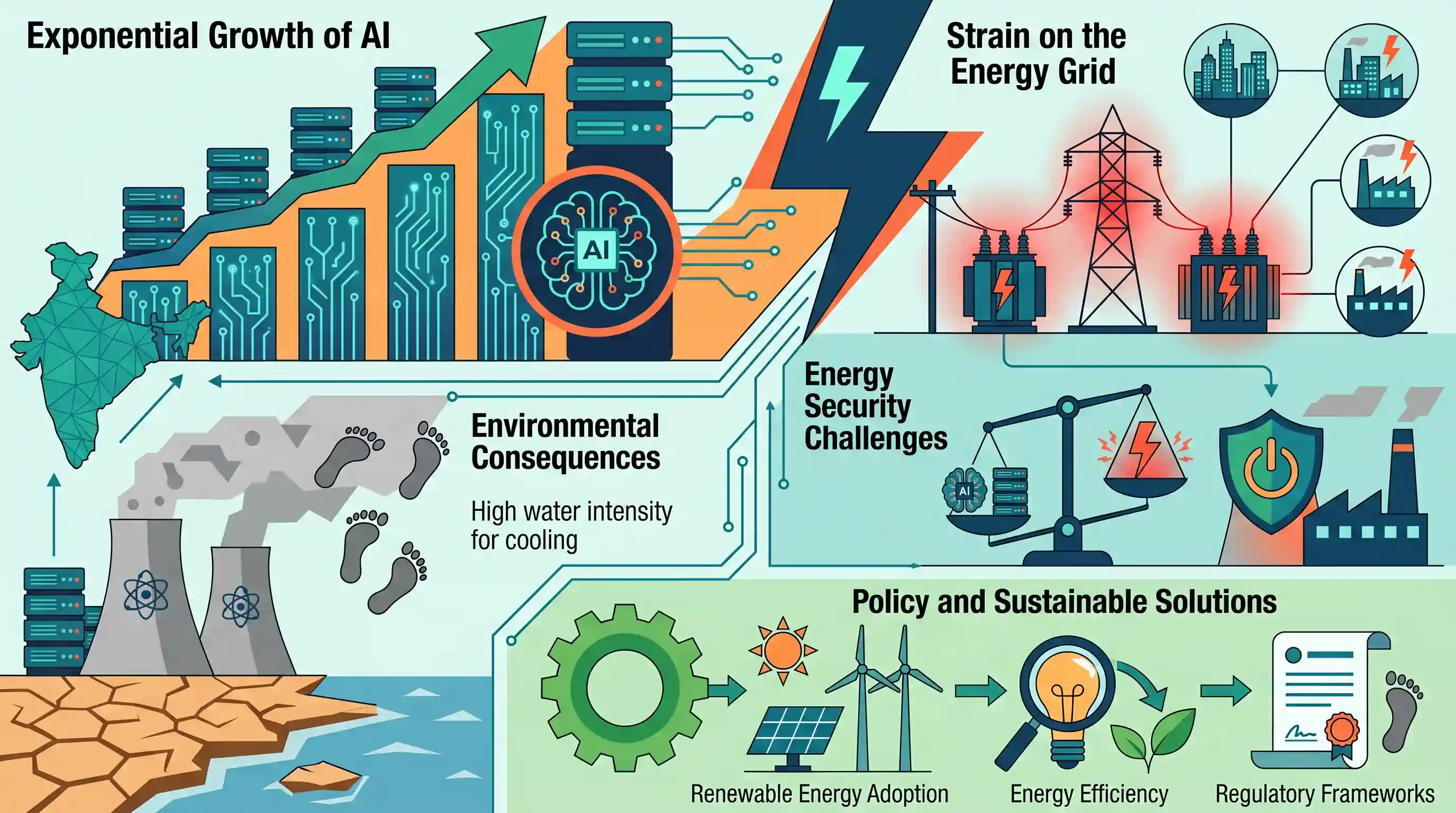
The exponential growth of AI and data centres in India is driving a massive surge in energy demand, presenting a critical challenge to the country's energy governance. As India emerges as a major digital infrastructure hub, the intensive power and cooling requirements of these facilities strain the electrical grid and complicate efforts to meet climate targets. The article underscores the urgent need for integrated policies that align digital expansion with sustainable energy practices, including the adoption of renewable energy, energy-efficient technologies, and robust regulatory frameworks to manage the carbon footprint of the tech sector.
Key Points
- AI computations and data centres require vast amounts of electricity for processing and cooling, significantly increasing India's overall energy consumption.
- This rapid surge in demand poses challenges to grid stability and energy security, necessitating swift upgrades to the power infrastructure.
- Balancing the expansion of digital infrastructure with India's net-zero emission commitments requires a substantial shift towards powering data centres with renewable energy sources.
- Effective energy governance is needed to mandate 'green data centres', promote energy-efficient AI models, and regulate the environmental impact of the tech industry.
Important Terms
Draft Data Centre Policy

MeitY's roadmap to establish India as a global data hub. It proposes 'Infrastructure Status' for data centers, single-window clearances, and incentives like 20-year tax holidays to attract hyperscale investments.
UPSC context
GS III: Infrastructure & Economy. Relevant for digital sovereignty and Ease of Doing Business (EoDB) reforms.
Energy Conservation (Amendment) Act, 2022
Legislation enabling a domestic carbon credit market and mandating 'designated consumers' (including data centers) to use a minimum share of non-fossil energy to meet climate targets.
UPSC context
GS III: Environment & Energy Security. Tests knowledge of India's Net Zero strategy and regulatory tools.
Ministry of Power (MoP)
The nodal ministry for grid stability and transmission planning. It ensures high-voltage connectivity for data centers and is developing the 'India Energy Stack' for unified digital energy infrastructure.
UPSC context
GS III: Infrastructure. Crucial for understanding the 'integrated planning' required for energy-intensive sectors like AI.
Ministry of New and Renewable Energy (MNRE)
Ministry driving India’s 500 GW non-fossil target by 2030. It facilitates green power access for data centers through 'open access' rules and firm dispatchable renewable energy (FDRE) tenders.
UPSC context
GS III: Renewable Energy. Key to decarbonization of the tech sector.
Ministry of Electronics and Information Technology (MeitY)
Ministry responsible for IT policy and digital growth. It lead-manages the Data Centre Policy and coordinates with the Ministry of Power to resolve AI-driven energy bottlenecks.
UPSC context
GS III: IT & Computers. Primary regulator for AI and digital infrastructure growth.
Power Usage Effectiveness (PUE)
A standard metric for data center energy efficiency; it is the ratio of total power used by the facility to the power delivered to computing equipment. Goal is 1.0.
UPSC context
GS III: Science & Technology. Technical yardstick for evaluating 'green' data center sustainability.
Data Centre Economic Zones (DCEZs)
Specialized clusters proposed by the government to host hyperscale data centers, cloud providers, and IT companies with dedicated infrastructure and ready-to-use power and connectivity.
UPSC context
GS III: Infrastructure. Important for regional development and industrial corridors.
Prelims Trap
The DPDP Act mandates that all new hyperscale data centres in India operate entirely on renewable energy.
The DPDP Act strictly governs digital privacy and data localization. Energy and emission norms for tech infrastructure are managed via the Energy Conservation Act and the Draft Data Centre Policy.
Static Concepts Connected
Why are Small Modular Reactors (SMRs) strategically suited for AI data centres?
- Baseload Reliability: Unlike intermittent solar or wind, SMRs provide the uninterrupted 24x7 clean baseload power that continuous AI computations require.
- Modular Capacity: Generates up to 300 MW(e) per module, offering a scalable energy solution with a much smaller physical footprint than conventional nuclear plants.
- Siting Flexibility: They can be prefabricated in factories and transported to dedicated hyperscale tech hubs, avoiding complex grid-transmission losses.
What are the core 'Panchamrit' targets vulnerable to uncontrolled data centre expansion?
- Non-Fossil Capacity: Raising India's non-fossil fuel energy capacity to 500 GW by the year 2030.
- Renewable Share: Meeting 50% of the country's total energy requirements from renewable energy sources by 2030.
- Carbon Intensity: Reducing the carbon intensity of the economy by 45% by 2030 (over 2005 levels).
- Net Zero 2070: Achieving complete carbon neutrality, or Net Zero emissions, by the year 2070.
Cross-Topic Patterns
Data Localization risks Carbon Lock-in
The DPDP Act mandates domestic data storage, triggering exponential data centre growth. Because India's grid is coal-heavy, this digital localization inadvertently risks 'carbon lock-in' and threatens Net Zero targets.
AI cooling and the Urban Water Crisis
Data centres consume millions of litres of water annually for server cooling. Unregulated hyperscale expansion in IT hubs severely strains local aquifers, directly exacerbating India's urban water crises.

Expect a 2026 multi-statement Prelims question linking AI baseload energy demands, alternative cooling tech, and Small Modular Reactors.
Linked PYQs · 4
Linked PYQs · 4
- 2018MainsGS3
“Access to affordable, reliable, sustainable and modern energy is the sine qua non to achieve Sustainable Development Goals (SDGs).” Comment on the progress made in India in this regard.
- 2016MainsGS3
Give an account of the current status and the targets to be achieved pertaining to renewable energy sources in the country. Discuss in brief the importance of National Programme on Light Emitting Diodes (LEDs).
- 2023MainsGS3
Introduce the concept of Artificial Intelligence (AI). How does Al help clinical diagnosis? Do you perceive any threat to privacy of the individual in the use of Al in healthcare?
- 2024MainsGS3
Describe the context and salient features of the Digital Personal Data Protection Act, 2023.
