Rajasthan OBC Demographic Survey and Reservation Sub Categorisation
Source:india-today ↗
Why It Matters
Caste-based census data, OBC reservation sub-categorisation, and the role of the State Election Commission in local body elections are highly relevant for the RPSC RAS Prelims syllabus, particularly under State Polity, Governance, and Rajasthan Demographics.
Summary
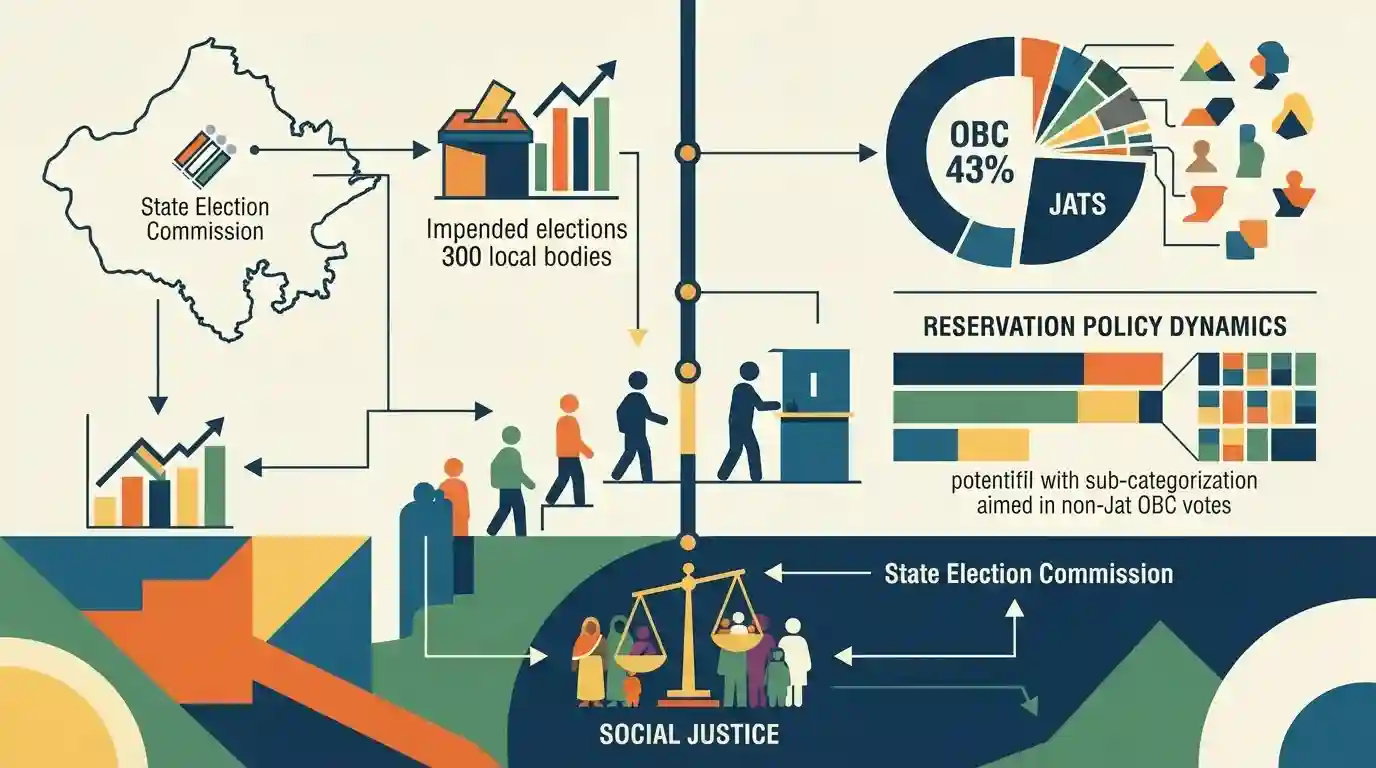
The Rajasthan government's recent OBC survey reveals that Other Backward Classes constitute roughly 43% of the state's population, with Jats forming the largest sub-group. These demographic findings are likely to be leveraged by the BJP to execute a 'Haryana-style' political strategy, aiming to consolidate non-Jat OBC votes through potential sub-categorisation. With impending elections to over 300 urban local bodies and panchayats announced by the State Election Commission, this data highlights the political dynamics of reservation policies and caste-based demographics in Rajasthan.
Key Points
- A recent OBC survey by the Rajasthan government covers 92 communities, revealing the state's OBC population is approximately 36.3 million (around 43% of the total population).
- Jats and Jat Sikhs form the largest OBC bloc in the state, comprising 20.14% of the OBC population and 9.2% of the overall population.
- The BJP is reportedly considering an OBC sub-categorisation strategy, akin to its 'Haryana plan', to consolidate non-Jat OBC voters by addressing the uneven distribution of reservation benefits.
- State Election Commissioner Rajeshwar Singh announced elections for 309 urban local bodies and panchayati raj institutions, making these demographic insights politically significant in the immediate term.
Important Terms
OBC Sub-categorisation

The policy of dividing the existing Other Backward Classes quota into smaller subgroups to ensure reservation benefits are equitably distributed to the most historically marginalized and underrepresented backward communities.
UPSC context
Crucial for RPSC Paper 3 (Polity & Social Justice), testing knowledge of affirmative action, quota equity, and related commissions.
State Election Commission, Rajasthan
A single-member constitutional body established in July 1994 under Articles 243K and 243ZA to direct, control, and conduct elections for the state's Panchayati Raj Institutions and Urban Local Bodies.
UPSC context
Highly tested in RPSC Paper 3 (Rajasthan Polity), focusing on local self-government, constitutional bodies, and democratic decentralisation.
Social Justice and Empowerment Department
The nodal state department in Rajasthan tasked with executing welfare measures, managing reservation policies, and conducting socio-economic and caste-based surveys to uplift SC, ST, OBC, and other vulnerable sections.
UPSC context
Important for RPSC Paper 3 (Public Administration and Welfare Policies), covering state governance and empowerment of marginalized groups.
Panchayati Raj Institutions (PRIs)
The three-tier system of rural local self-government in Rajasthan (Zila Parishad, Panchayat Samiti, and Gram Panchayat) constitutionalised by the 73rd Amendment to ensure democratic decentralisation at the grassroots level.
UPSC context
A core topic in RPSC Paper 3 (Rajasthan Polity) evaluating knowledge of rural administration, Article 243, and local governance.
Prelims Trap
"The State Election Commissioner is appointed and removed by the Governor of Rajasthan."
While the Governor appoints the State Election Commissioner, removal can only be done by the President in the same manner as a High Court Judge.
Static Concepts Connected
What are the constitutional provisions governing the State Election Commission (SEC)?
- Article 243K: Mandates the creation of an SEC for the superintendence, direction, and control of elections to Panchayats.
- Article 243ZA: Extends the SEC's constitutional mandate to conduct and control elections for Municipalities (Urban Local Bodies).
- Independence: The SEC's conditions of service cannot be varied to their disadvantage after appointment, ensuring operational autonomy.
What is the constitutional and legal basis for OBC sub-categorisation?
- Article 340: Empowers the President to appoint a commission to investigate the conditions of socially and educationally backward classes (e.g., Justice Rohini Commission).
- Indra Sawhney (1992): The Supreme Court explicitly recognized and validated the sub-categorisation of backward classes into "backward" and "more backward" to ensure equitable distribution of benefits.
Cross-Topic Patterns
Local Polls + Reservation Matrix
The interplay between demographic surveys and local body polls tests how reservation rosters (SC/ST/OBC/Women) rotate according to the Rajasthan Panchayati Raj Act, 1994.
State vs Central OBC Lists
Jats in Rajasthan are OBCs for state government jobs, but Jats of Bharatpur and Dholpur are excluded from the Central OBC list. This State vs. Central list distinction is highly testable.

Expect a multi-statement question on SEC powers (Art 243K/243ZA) paired with current appointee details and tenure rules (5 yrs/65 yrs).
Linked PYQs · 4
Linked PYQs · 4
- 2016RPSC_PRELIMSGS1
The State Election Commission of Rajasthan is
- 2013RPSC_PRELIMSGS1
Consider the following statements regarding the State Election Commission of Rajasthan – (i) It was formed under Article 243k of the Indian Constitution in July 1994. (ii) It is a multi-member commission with the State Election Commissioner as its head. (iii) It has a Secretary who is also the State Registrar of Voters. (iv) It prepares voter lists for Panchayati Raj institutions and urban bodies and conducts elections. Select the correct answer using the code given below
- 2023RPSC_PRELIMSGS1
Consider the following statements regarding the State Election Commission of Rajasthan: (i) It was constituted in July 1994 under Article 243 T of the Constitution of India. (ii) It is a one-member commission headed by the State Election Commissioner.
- 2013RPSC_PRELIMSGS1
According to the figures presented by the Government of India and Rajasthan on May 25, 2013, the combined population of Scheduled Castes and Scheduled Tribes in Rajasthan is
